Why "8 Weeks" Is the Wrong Question
The 8-week separation age is treated as a default in many contexts — legal regulations specify it as a minimum in many jurisdictions, breeders typically organise their puppy placements around it, owners typically expect to bring a new puppy home at 8 weeks. The framing positions 8 weeks as the right answer.
The empirical literature suggests a different framing: 8 weeks is the minimum below which problems become considerably more likely; the optimal age is often older than 8 weeks. The legal minimum is a floor, not an optimum.
A few reasons the 8-week default does not match the empirical picture:
Behavioural development continues past 8 weeks. The primary socialization window extends to approximately 14-16 weeks. The dam and littermates contribute to socialization throughout this period — bite inhibition learning, dog-dog social skills, appropriate play patterns, communication signal development. Removing the puppy at 8 weeks shortens this contribution.
Different individual puppies have different developmental rates. Toy-breed puppies in particular often develop more slowly than larger-breed puppies in some respects; an 8-week toy-breed puppy may be developmentally more like a 6-week medium-breed puppy. Some practitioners specifically recommend 10-12 weeks for toy breeds.
Some temperaments need more time. Shy or nervous puppies benefit from additional time with the mother and littermates before facing the substantial change of a new home. Confident puppies handle the transition better.
First-time owners have specific challenges. Owners without prior puppy experience benefit from puppies who have had additional development with the dam — the puppy comes with somewhat more developed bite inhibition, social skills, and self-regulation.
What the Empirical Studies Show
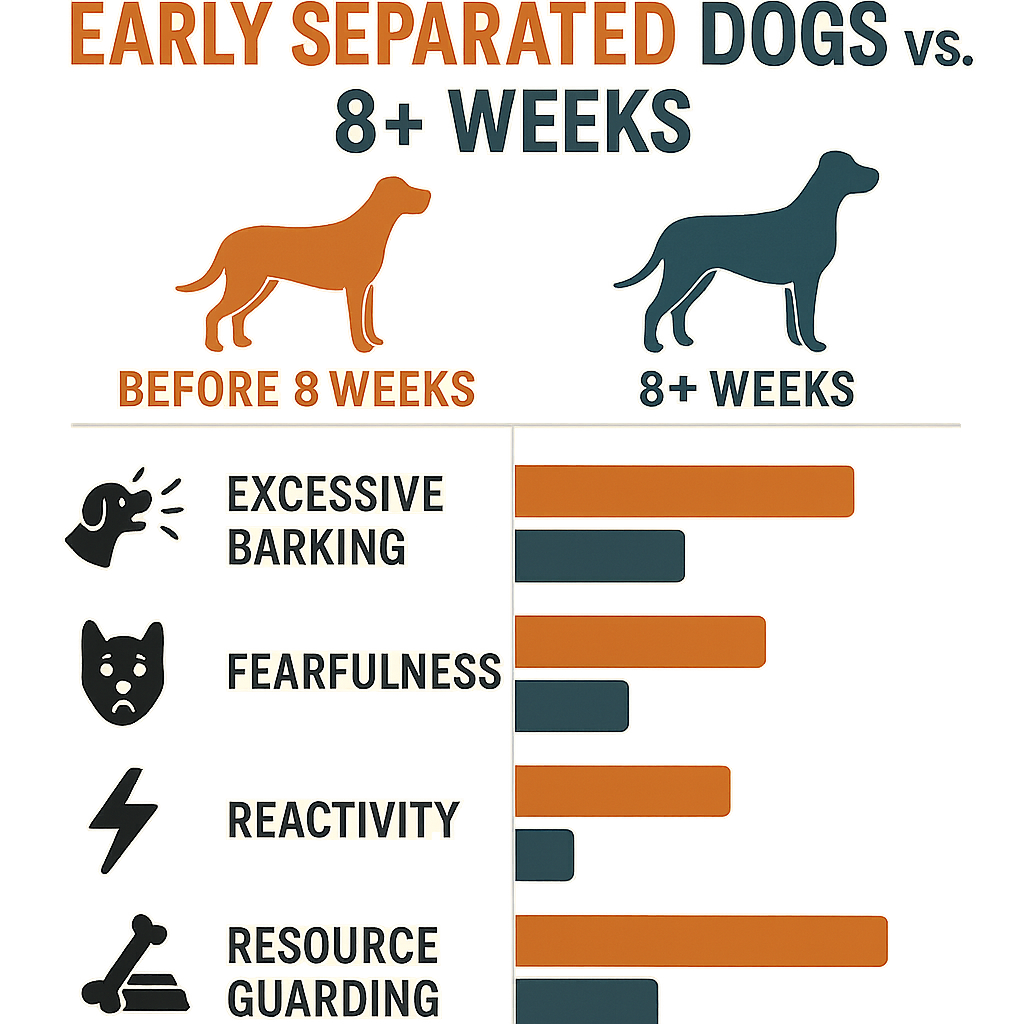
The most-cited direct study is Pierantoni, Albertini & Pirrone (2011), examining behavioural outcomes in adult dogs that had been separated from littermates at different ages[^pierantoni]. The findings:
- Adult dogs separated from littermates before 8 weeks showed elevated rates of multiple behaviour problems compared to those separated at 8+ weeks.
- The behaviour problems included excessive barking, fearfulness on walks, reactivity, destructive behaviour when alone, food possessiveness, attention-seeking, play biting, and resource-guarding.
- The effect was specifically related to the early-separation age rather than to other variables that were controlled for.
Other studies (Slabbert & Rasa, Foyer et al., and others) have examined related questions about early environment and adult behaviour. The convergent picture: early separation has measurable downstream consequences, with the magnitude varying by specific outcome.
The AVSAB position on early separation reflects the practitioner consensus: separation before 8 weeks is associated with increased risk of behaviour problems and is generally not recommended[^avsab].
What Is Lost When the Puppy Leaves Too Early

A short list of what the dam and littermates provide that the new home typically does not:
Bite inhibition learning. When a puppy bites a littermate too hard, the littermate yelps, withdraws, and play stops. The biting puppy learns that hard biting ends play. This is the foundation of bite inhibition — the dog's ability to control bite pressure. Puppies with insufficient bite inhibition learning produce harder bites in stressful situations as adults. The 6-8 week period is particularly intense for bite inhibition learning.
Dog-dog social signals. Reading and producing canine body-language signals, including play bows, calming signals, and the specific patterns of canine social communication. Puppies learn this from interactions with the mother and littermates; missing weeks of this learning produces dogs less skilled at dog-dog interaction.
Appropriate play patterns. Play styles, intensity regulation, role-shifting in play. The dam corrects inappropriate play; littermates calibrate appropriate play. Removing the puppy too early truncates this learning.
Self-regulation and impulse control. The dam provides correction and structure that the new owner often replaces with permissive interactions. The dam-driven structure during weeks 6-8 contributes to the puppy's developing self-regulation.
Maternal weaning behaviour. The dam progressively weans puppies and discourages excessive nursing-and-clinginess as the litter develops. This is part of the puppy's gradual independence development.
These contributions are partial; the new home provides its own learning experiences, and many 8-week-separated puppies become well-adjusted adults. But the cumulative effect of an additional 2-4 weeks with the dam and littermates is non-trivial in many cases.
When 10-12 Weeks Is Particularly Indicated

A few situations where additional time is most beneficial:
Toy-breed puppies. Slower physical and behavioural maturation in many toy breeds. 10-12 weeks is often a more appropriate placement age than 8 weeks for Yorkshire Terriers, Maltese, Pomeranians, Chihuahuas, and other toy breeds.
Nervous or under-confident temperaments. Puppies showing more cautious or shy behaviour at 7-8 weeks benefit from additional time before the stressful transition to a new home.
First-time owners. Puppies going to homes without prior dog experience benefit from additional development before placement.
Single-puppy litters. A puppy who has only had one littermate (or whose littermates left earlier) benefits from time with the dam to compensate for the limited littermate interaction.
Working or sport dogs. Some working-dog programmes specifically place puppies at 10-12 weeks because the additional littermate-and-dam time supports the temperament and socialization the program needs.
When 8 Weeks Is Reasonable
8 weeks is reasonable when:
- The puppy has shown confident, well-adjusted behaviour in early observation.
- The breeder has actively socialized the litter (introduced puppies to varied surfaces, sounds, gentle handling, household activities).
- The new owner has prior puppy experience or strong support resources.
- The puppy is medium-or-larger breed with typical developmental trajectory.
What the Evidence Does Not Support
A few related claims that go further than the evidence:
- "Puppies must stay until 12 weeks regardless." The 8-week minimum is appropriate in many cases; the 10-12 week recommendation is for specific situations.
- "Earlier than 8 weeks is fine if the breeder bottle-feeds." The behavioural-development concern is not just about milk; the dam-and-littermate interactions are not replaceable by hand-rearing.
- "The 8-week legal minimum is excessive." The empirical evidence supports the minimum and suggests for some puppies more time is better.
What This Does Not Imply
- Every breeder must hold puppies until 10-12 weeks. The evidence supports flexibility and judgment based on individual puppies and circumstances.
- Puppies separated at 8 weeks are guaranteed to have problems. Most do well; the elevated risk is at population level.
- The legal minimum should always be raised. The framework supports flexibility rather than blanket rule changes.
What Is and Is Not Settled
Settled: separation before 8 weeks is associated with elevated rates of adult behaviour problems (Pierantoni 2011 and other studies)[^pierantoni]; the AVSAB position recommends against very early separation[^avsab]; bite inhibition, dog-dog social signals, and self-regulation continue developing during weeks 6-8.
Not settled: the precise comparative effectiveness of 10 weeks vs. 12 weeks vs. 8 weeks across the spectrum of puppy temperaments and home situations; the optimal protocols for compensating for early-separation effects when they have already occurred.
Key Takeaways
- The 8-week separation age is a legal minimum in many jurisdictions, not necessarily an optimum.
- Pierantoni 2011 and other studies show elevated rates of adult behaviour problems in puppies separated before 8 weeks.
- For toy breeds, nervous temperaments, first-time owners, and single-puppy litters, 10-12 weeks is often more appropriate than 8.
- What the dam and littermates provide that the new home typically does not: bite inhibition learning, dog-dog social signals, appropriate play patterns, self-regulation, gradual maternal weaning.
- 8 weeks is reasonable for confident, well-socialized medium-or-larger-breed puppies going to experienced owner homes.
- AVSAB position supports against very early separation as a practitioner consensus.
Sources & further reading
- Pierantoni, L.; Albertini, M.; Pirrone, F.. (2011). Prevalence of owner-reported behaviours in dogs separated from the litter at two different ages. Veterinary Record, 169(18), 468. https://doi.org/10.1136/vr.d4967
- American Veterinary Society of Animal Behavior. AVSAB Early Separation Position Statement. AVSAB. https://avsab.org/resources/position-statements/
- American Animal Hospital Association. AAHA Weaning Guidelines. American Animal Hospital Association. https://www.aaha.org/