Why Life Stage Matters for Enrichment
Enrichment is not a single activity or product; it is the broader strategy of providing the dog with appropriate cognitive, sensory, and motor stimulation to support welfare. The right enrichment for a puppy is not the same as the right enrichment for an 8-year-old adult or a 13-year-old senior. The needs differ in several ways:
Cognitive demand. Different ages can handle and benefit from different levels of cognitive challenge.
Physical capacity. Enrichment activities that require running, jumping, or sustained physical effort are appropriate for some life stages and not others.
Developmental priorities. Puppies are building their foundational understanding of the world; seniors are maintaining function against age-related decline; the in-between adult years are about ongoing engagement.
Environmental novelty tolerance. Puppies in the socialization window need substantial exposure; adolescents and adults benefit from targeted novelty; some seniors find excessive novelty stressful.
The article addresses each life stage with the specific priorities and example activities.
Puppyhood (8-16 weeks): Novelty and Exposure
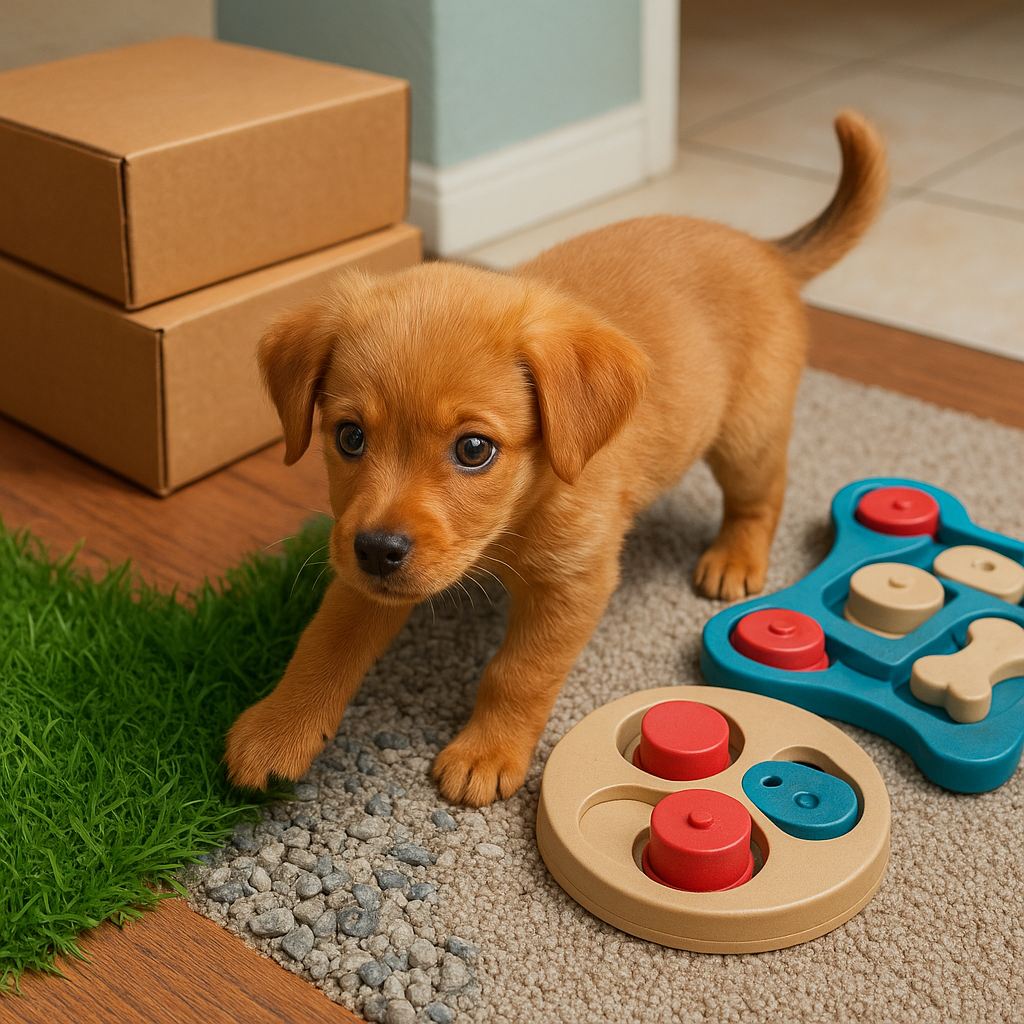
The primary enrichment priority during puppyhood is exposure — to surfaces, sounds, people, other dogs, environments, handling. The socialization-windows article covers this in detail. Enrichment-as-exposure during the socialization window pays dividends for the dog's lifetime.
Specific puppy enrichment activities:
- Surface variety. Hardwood, tile, carpet, grass, gravel, sand, metal grates. Each new surface is a small enrichment.
- Sound exposure. Household sounds (vacuum, hair dryer, dishwasher), outdoor sounds (traffic, construction at distance), specific potentially-frightening sounds (thunderstorm recordings at low volume).
- Object exploration. Cardboard boxes, paper bags, novel toys, household objects under supervision.
- Mild puzzle introduction. Snuffle mats, easy puzzle feeders, treat-stuffed Kongs at low difficulty.
- Cooperative-care basics. Brief positive handling, brief tooth-touching, brief paw-touching — building positive associations with handling that pay off in adult veterinary and grooming care.
- Calm exposure to other dogs and people. Vaccinated friend dogs, careful puppy-class environments, controlled social experiences.
- Brief structured training. Short sessions building marker training, name response, sit, basic recall.
Puppy enrichment is more about quality and structure than quantity; brief positive sessions repeated frequently outperform long sessions.
Juvenile (4-6 months) and Adolescent (6-18 months) Periods
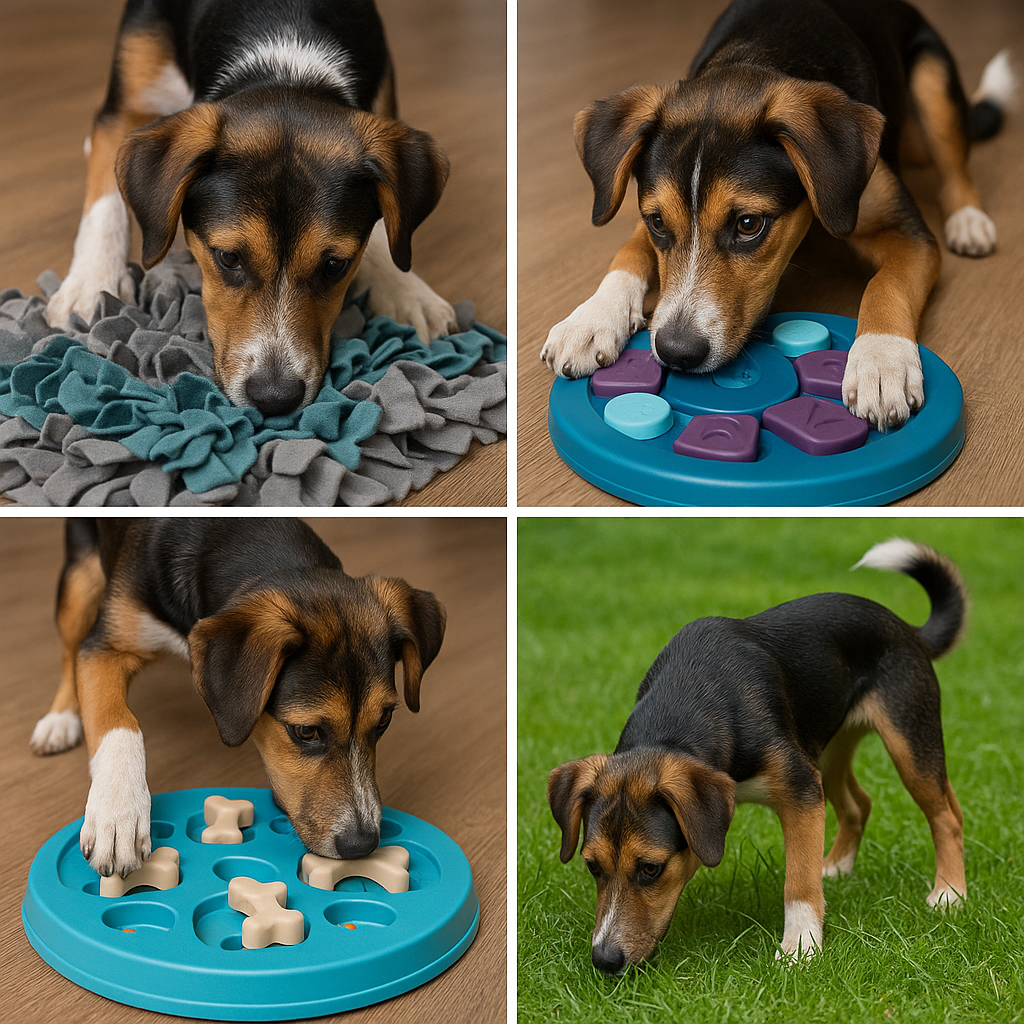
Enrichment shifts toward problem-solving and skill-building. The juvenile-gap article covers training priorities; from the enrichment angle:
Specific juvenile and adolescent activities:
- Progressive puzzle feeders. Moving from low-difficulty to moderate-difficulty puzzle toys; rotating among types to maintain novelty.
- Scent work introduction. Hidden treats at increasing difficulty; structured scent-work games (find-it games, simple scent-discrimination).
- Trick training. Building on basic obedience with progressively more complex trick sequences.
- Structured exercise with cognitive component. Walks with sniffing time, recall games at increasing distance, fetch with rules and commands.
- Cooperative-care continuation. Building on the puppy foundation toward more comprehensive handling tolerance (nail trims, ear cleaning, dental work).
- Social skill development. Carefully chosen play partners; structured interactions with dogs of varied size, age, and temperament.
- Environmental challenge. New environments at increasing complexity — quieter parks, then busier ones; novel pet-friendly stores; varied walking routes.
The juvenile and adolescent enrichment supports the dog's transition into a confident adult; under-enrichment during this period contributes to adult behaviour problems.
Adulthood (1-7 years, depending on breed size)
The adult years are about ongoing engagement and skill maintenance. A well-enriched adult dog has:
- Solid trained behaviours that are reinforced and refined over time.
- Regular exercise appropriate to breed and individual capacity.
- Variety in daily and weekly experiences.
- Cognitive challenges proportional to the dog's capability.
Specific adult enrichment activities:
- Sport and structured activity. Agility, scent work, herding (for herding breeds), water work (for water breeds), barn hunt, treibball, lure coursing, dock diving — many activities exist for the engaged owner.
- Trick training continuation. Adult dogs can learn complex tricks throughout their lives; the activity itself is enrichment.
- Variable feeding formats. Continued puzzle feeders, snuffle mats, lick mats, scatter feeding to keep the foraging and problem-solving systems engaged.
- Walks with engagement. Sniffing time, varied routes, occasional novel destinations, social opportunities.
- Mental challenges. New tricks, new commands, complex sequences, brain games.
- Regular practice of trained behaviours. Without practice, behaviours degrade; with practice, they remain reliable and the dog stays engaged with the human-dog working relationship.
The risk in adulthood is enrichment plateauing — the dog's daily experience becomes routine and the cognitive challenge decreases. Periodic introduction of new activities, new environments, or new training goals prevents this.
Senior Stage
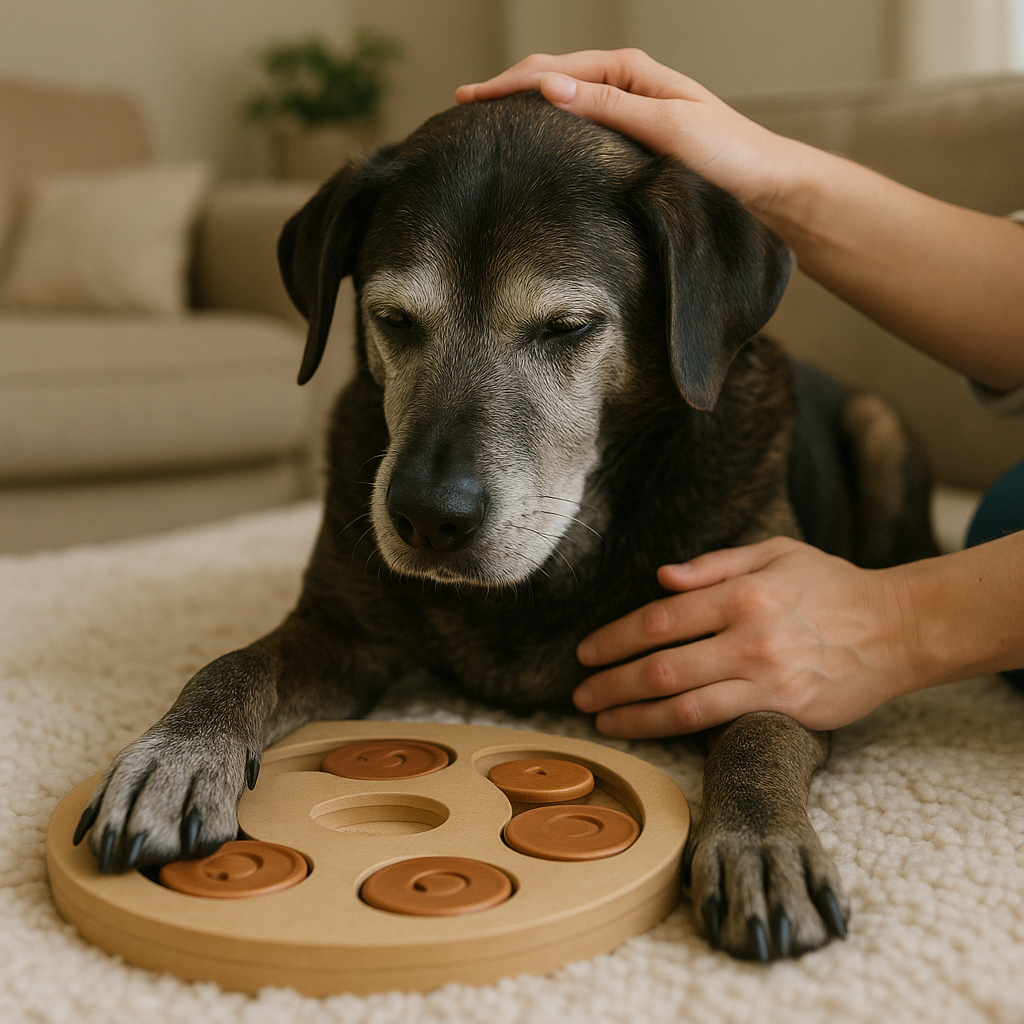
Senior enrichment serves cognitive maintenance and welfare-supporting engagement. The DISHA-CCD-management article covers the cognitive-decline framework; from the enrichment angle:
Specific senior enrichment activities:
- Continued cognitive engagement at appropriate difficulty. Puzzles, scent work, simple training continue to provide value but should be calibrated to the dog's current capability rather than past peak.
- Cognitive-support diet considerations. Hill's b/d, Purina Bright Mind / NeuroCare have peer-reviewed evidence (covered in DISHA article) for cognitive support in aging dogs.
- Sensory enrichment. As physical activity decreases, sensory engagement (scent, taste, gentle handling) provides welfare value.
- Social engagement. Continued contact with familiar people and dogs; gentle introduction to new but calm social experiences.
- Physical activity adapted to capability. Shorter, more frequent walks; softer surfaces; swimming for joint-friendly exercise; avoiding high-impact activities.
- Routine and predictability. Senior dogs often benefit from predictable routines (regular feeding times, familiar walking routes) that reduce cognitive load.
- Pain management awareness. Many senior enrichment failures are actually pain-management failures — a dog who has stopped enjoying activities may be in undiagnosed osteoarthritis or other pain. Veterinary evaluation matters.
- Cognitive monitoring. The DISHA framework helps catch cognitive decline early; appropriate adjustments to enrichment follow.
The principle for senior enrichment: continue engagement, but adapt the type and intensity to the dog's current capability rather than stopping engagement when the previous enrichment regime becomes inappropriate.
Common Errors Across Life Stages
A few patterns:
Generic enrichment regardless of life stage. Treating a puppy, an adult, and a senior as if they need the same activities. The right enrichment varies.
Stopping enrichment in seniors. "She's old, she just wants to sleep" misses the welfare value of continued (adapted) engagement. Disengagement in seniors is often a clinical signal (pain, cognitive decline) rather than a normal aging state to accept.
Over-stimulation in adolescents. High-arousal activities for an arousal-prone adolescent dog can amplify rather than channel energy. Calm enrichment alongside the more energetic activities supports better outcomes.
Confusing exercise with enrichment. Physical exercise alone does not provide cognitive enrichment; long walks without sniffing or engagement are exercise but not full enrichment.
Ignoring physical capability. Pushing an arthritic senior to do agility-style activities, or pushing a giant-breed adolescent to do high-impact running before growth-plate closure, produces injury risk that outweighs enrichment benefit.
What This Does Not Imply
- Every dog needs hours of structured enrichment daily. The principle is appropriate engagement, not maximal engagement.
- Older dogs cannot learn or benefit from cognitive enrichment. They can; the Milgram and others' work documents continued cognitive learning into old age.
- Specific commercial products are essential. Many enrichment activities are free or low-cost (scent work, scatter feeding, training, varied walks).
What Is and Is Not Settled
Settled: enrichment supports welfare across life stages; specific cognitive-support diets have peer-reviewed evidence in senior dogs; the broader environmental-enrichment literature supports feeding-as-enrichment, exposure-based puppy enrichment, and continued engagement in seniors[^aaha][^wsava].
Not settled: optimal life-stage-specific enrichment intensity and type combinations; the comparative effectiveness of specific commercial enrichment products vs. low-cost alternatives.
Key Takeaways
- Enrichment needs change across the dog's life: puppy (novelty and exposure), juvenile/adolescent (problem-solving and skill-building), adult (ongoing engagement and skill maintenance), senior (cognitive maintenance and welfare-supporting engagement).
- Match challenge level and activity type to the dog's life stage and physical capability.
- Senior enrichment continues; it does not stop. Disengagement in seniors is often a clinical signal warranting evaluation.
- Common errors: generic enrichment regardless of stage, stopping in seniors, over-stimulation in adolescents, confusing exercise with enrichment, ignoring physical capability.
- Companion to puzzle-feeders-transition article (food enrichment) and DISHA-CCD-management article (senior cognitive support).
Sources & further reading
- American Animal Hospital Association. AAHA Cognitive Health and Senior Care resources. American Animal Hospital Association. https://www.aaha.org/
- World Small Animal Veterinary Association. (2021). WSAVA Global Nutrition Guidelines. World Small Animal Veterinary Association. https://wsava.org/global-guidelines/global-nutrition-guidelines/
- Association of Professional Dog Trainers. APDT Enrichment Resources. Association of Professional Dog Trainers. https://www.apdt.com/