Why This Article Is Decision-Tree Format
The companion spay-neuter-timing-evidence article covers the underlying evidence framework — what the studies measure, the limitations of the data, the broader debate. This article is the practical follow-on: given the evidence, what does the breed-specific picture look like? The owner's decision-relevant question is "what is the best timing for my specific dog given my specific breed and sex".
The Hart, Hart & Thigpen UC Davis programme has produced the largest breed-specific dataset on this question. Hart et al. (2014) covered Golden Retrievers, Labrador Retrievers, and German Shepherds in detail; Hart et al. (2020) in Frontiers in Veterinary Science extended to 35+ breeds with separate analyses for males and females across multiple sterilization-timing windows[^hart2020][^hart2014].
The findings vary substantially by breed and sex. The decision-tree below summarises the practical implications for the most common breeds.
The General Pattern Across Breeds
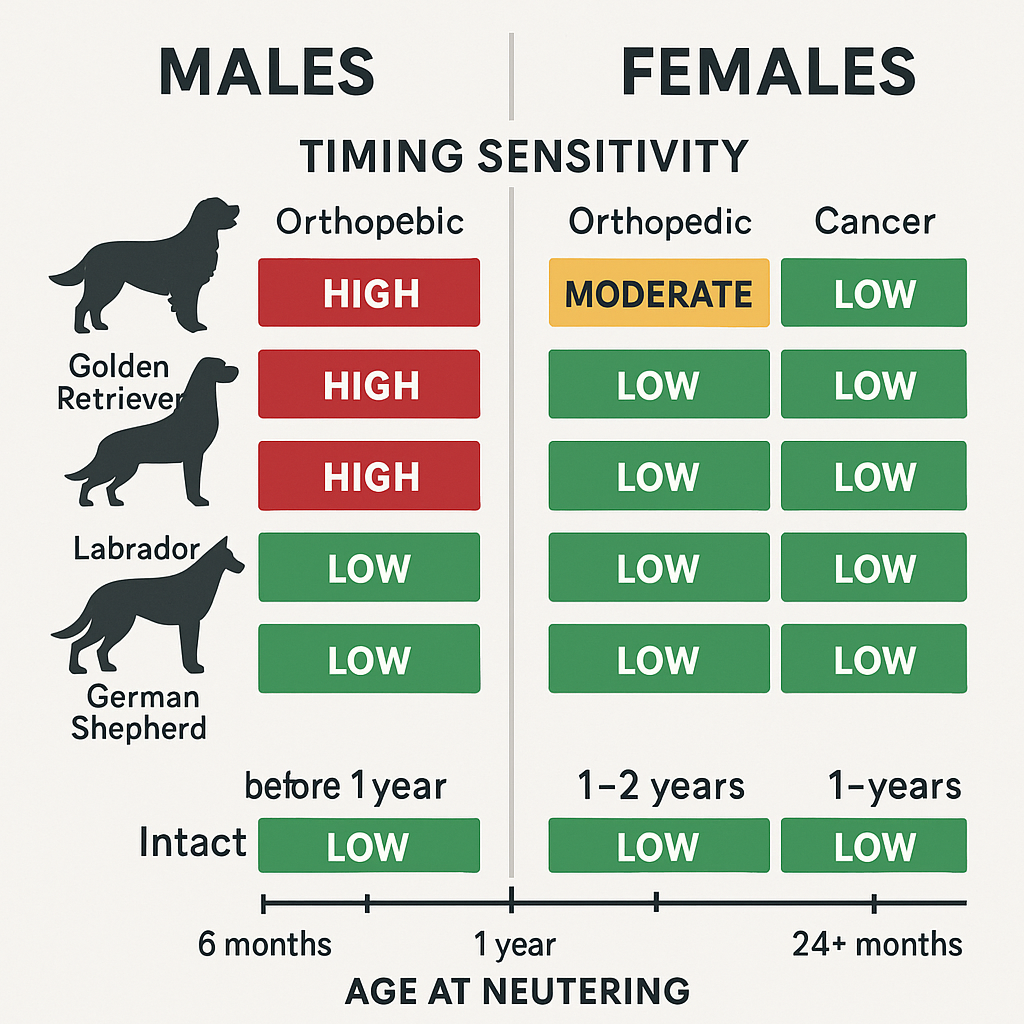
A few patterns recur in the Hart 2020 data:
Some breeds show substantial sensitivity to timing in males but less in females. Golden Retrievers, Labradors, German Shepherds, Doberman Pinschers — males in these breeds show notably elevated orthopedic and/or cancer rates with early neutering compared to delayed or intact, while females show smaller differences.
Some breeds show patterns in females that are different from males. Hart 2020 documents breeds where female-specific cancer concerns (mammary tumours, pyometra) interact with the orthopedic/cancer findings.
Some breeds appear less sensitive. Smaller breeds and some specific breeds in the Hart dataset show minimal differences across timing categories.
The overall trend has been toward later sterilization in larger breeds. The traditional 6-month neuter recommendation has largely moved away in modern practitioner consensus for medium-and-larger dogs.
Breed-Specific Summary
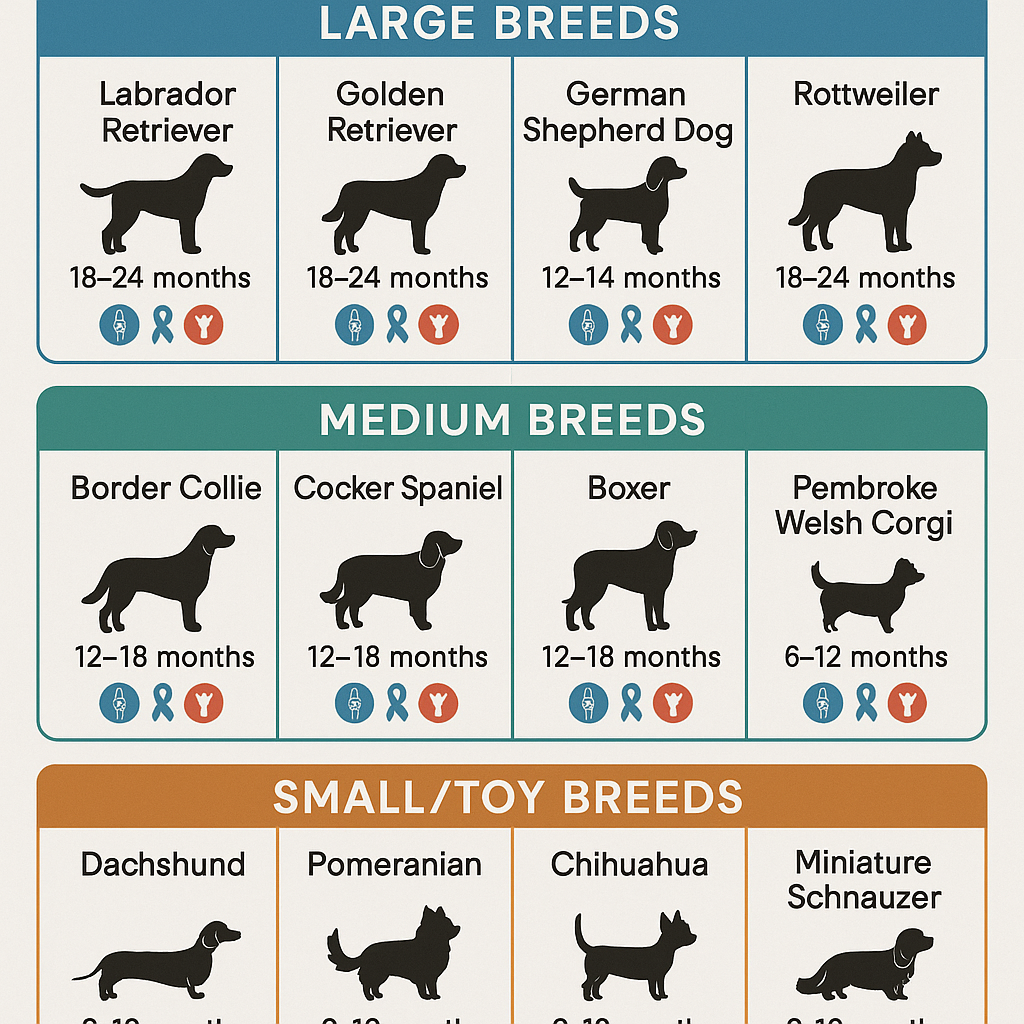
A practical summary by breed group, drawing on the Hart 2020 dataset and broader practitioner consensus. Note: the Hart dataset measures specific orthopedic and cancer endpoints; the recommendations are based on these measured outcomes plus the broader behaviour-and-management considerations for individual households.
Golden Retriever.
- Males: Hart 2020 shows considerably elevated rates of joint disorders (hip dysplasia, cranial cruciate ligament rupture, elbow dysplasia) and several cancers (lymphoma, hemangiosarcoma) with neutering before 1 year compared to delayed or intact. Recommendation: delay neutering until at least 1 year; many practitioners suggest 18-24 months.
- Females: Less dramatic but still meaningful elevation in some endpoints with very early spaying. Recommendation: 1-2 years for spaying; some consider intact lifetime with appropriate management.
Labrador Retriever. Similar pattern to Goldens with somewhat smaller magnitude. Males: delay to 1+ year. Females: similar timing flexibility.
German Shepherd. Substantial sensitivity to timing, particularly for joint disorders in both sexes. Hart 2014 supported delaying past 1 year for both sexes. Males more sensitive than females.
Doberman Pinscher. Sensitivity to early neutering for hemangiosarcoma in particular. Recommendation: delay to 1-2 years.
Rottweiler. Hart data and broader literature support delayed sterilization, particularly for males.
Bernese Mountain Dog. Cancer rates are already elevated; timing effects compound this. Specialist consultation is appropriate.
Boxer. Substantial cancer sensitivity in the breed; specialist guidance helpful.
Vizsla. Hart 2020 shows specific timing sensitivity for orthopedic and behavioural outcomes.
Poodle (Standard). Standard size shows timing sensitivity; toy and miniature less so.
Cocker Spaniel. Less sensitive than some larger breeds; standard 6-month timing is more defensible.
Beagle. Less timing sensitivity in the Hart data.
Cavalier King Charles Spaniel. Less timing sensitivity per the available data; mitral valve disease dominates the breed's health concerns.
Toy and small breeds. Generally show less sensitivity to timing in the Hart data; the standard 6-month timing is more defensible. Pyometra prevention through spaying remains a relevant consideration in females.
Mixed-breed dogs. Limited direct breed-specific data; rough guidance based on adult body weight is reasonable. Larger mixed-breed dogs (>30 kg expected adult weight) are typically given the larger-breed guidance.
How to Discuss With Your Veterinarian
A practical approach:
Bring the evidence. The Hart 2020 paper is open-access and provides specific tables. Print or save the relevant section for your breed; this is much more productive than abstract conversations.
Frame as a discussion, not a demand. "I've been reading the breed-specific data on neutering timing. Can we discuss what's appropriate for my dog?" — most veterinarians are comfortable with this framing and will engage thoughtfully.
Acknowledge the practical considerations. Population control, behavioural considerations, household management, and routine veterinary practice all bear on the decision. The Hart data is one input, not the whole answer.
Be prepared for practitioner variation. Some veterinarians have already incorporated the modern breed-specific guidance; others default to historical 6-month recommendations. Both perspectives are reasonable; the conversation is the goal.
Consider second opinions if there is fundamental disagreement. A breed-specific specialist or referral practice with sports-medicine or orthopedic expertise may have more nuanced perspective for sensitive breeds.
Endpoints Driving the Recommendations
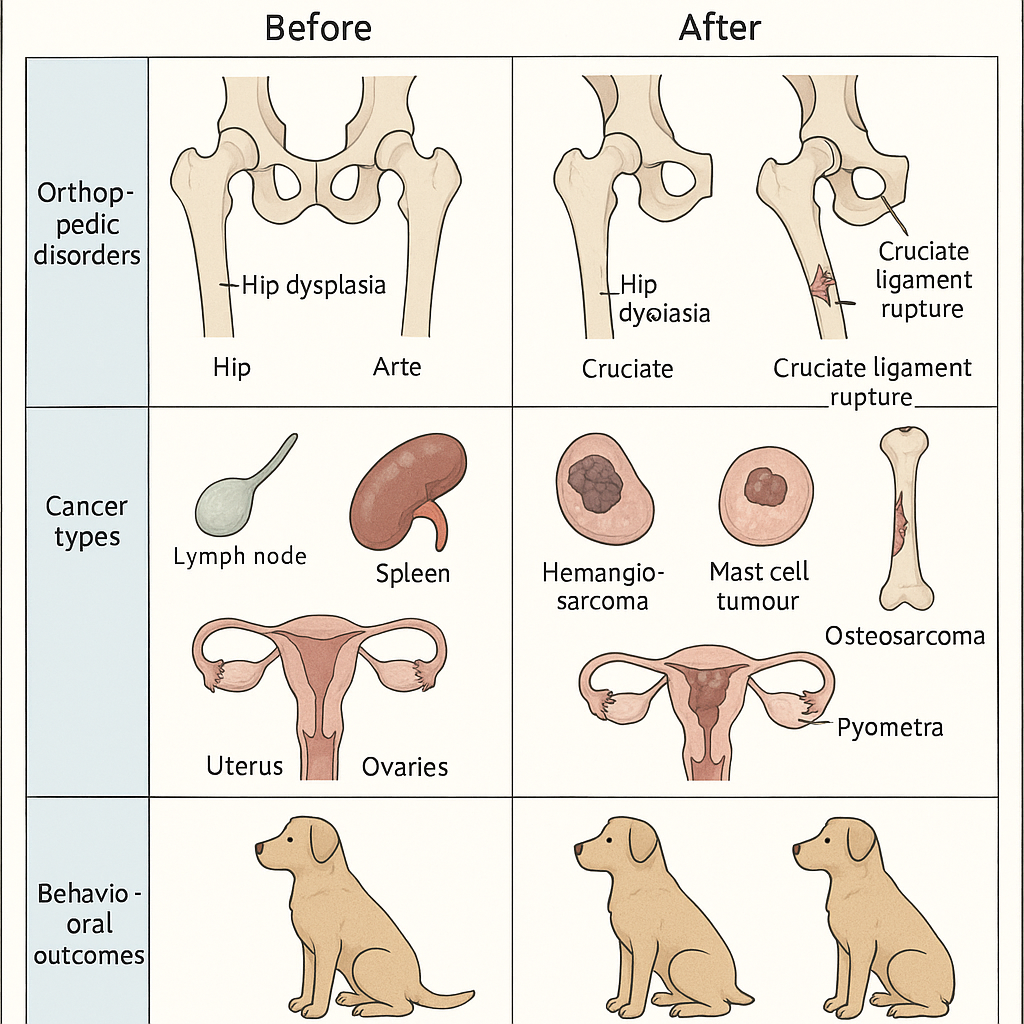
The Hart studies measured several specific outcomes:
Orthopedic disorders. Hip dysplasia (HD), cranial cruciate ligament rupture (CCL), elbow dysplasia (ED). Early neutering before growth-plate closure has been associated with elevated rates of these disorders, plausibly because gonadal hormone effects on growth plate timing produce different bone-development trajectories.
Cancers. Lymphoma, mast cell tumour, hemangiosarcoma (particularly cardiac and splenic), osteosarcoma. The mechanisms are partly unknown; the empirical association exists.
Reproductive cancers. Mammary cancer in females, prostate disease in males. These are cancers that sterilization typically reduces; the breed-specific picture sometimes balances these reductions against the elevations in other cancers.
Pyometra. Severe uterine infection in intact females; spaying eliminates the risk. This is one of the strongest arguments for spaying intact females, particularly in middle-age and older.
Behavioural considerations. Some behaviour effects (urine marking, roaming, intermale aggression in males; phantom pregnancy issues in females) are reduced by sterilization; some other behaviour effects (anxiety, aggression in some breed and individual contexts) may be exacerbated. The behaviour effects are individual and harder to predict.
What This Does Not Imply
- Every dog should be intact. Many should be sterilized; the question is timing and sex-specific protocol.
- The Hart data is the only consideration. Population control, household management, behaviour, and individual circumstances all weigh in.
- Your veterinarian is wrong if they recommend 6 months. For some breeds, that timing remains defensible; for others, the breed-specific evidence has moved the recommendation.
- Delaying sterilization is always safer. Pyometra in older intact females, urine marking, roaming, and other concerns are real.
What Is and Is Not Settled
Settled: breed-and-sex-specific sterilization timing produces meaningfully different health outcomes for several common breeds (Hart 2014; Hart 2020)[^hart2014][^hart2020]; the AVMA position has moved toward acknowledging individual decision-making[^avma]; the traditional 6-month neuter recommendation is no longer universally appropriate.
Not settled: the optimal timing for breeds not yet in the Hart dataset; the comparative effectiveness of alternative procedures (vasectomy, ovary-sparing spay, hormone-sparing approaches) for specific applications.
Key Takeaways
- Hart 2014 and Hart 2020 (UC Davis) provide breed-specific data on sterilization-timing health outcomes for 35+ breeds.
- General pattern: large-breed and giant-breed males show the most substantial timing sensitivity; some females show meaningful but smaller differences.
- Practical recommendation: medium-and-larger breeds typically delay sterilization to at least 1 year, often 18-24 months for highly-sensitive breeds. Small breeds: standard 6-month timing more defensible.
- Bring the Hart paper or breed-specific section to veterinary conversations; frame as discussion rather than demand.
- The decision is individual: sex, breed, household context, behavioural considerations, and veterinary input all matter.
- Companion to spay-neuter-timing-evidence-not-settled article for the underlying evidence framework.
Sources & further reading
- Hart, B. L.; Hart, L. A.; Thigpen, A. P.; Willits, N. H.. (2020). Assisting decision-making on age of neutering for 35 breeds of dogs: associated joint disorders, cancers, and urinary incontinence. Frontiers in Veterinary Science, 7, 388. https://doi.org/10.3389/fvets.2020.00388
- Hart, B. L.; Hart, L. A.; Thigpen, A. P.; Willits, N. H.. (2014). Long-term health effects of neutering dogs: comparison of Labrador Retrievers with Golden Retrievers. PLoS ONE, 9(7), e102241. https://doi.org/10.1371/journal.pone.0102241
- American Veterinary Medical Association. AVMA Pediatric Sterilization Policy. American Veterinary Medical Association. https://www.avma.org/