What "By-Product" Means in Regulatory Terms
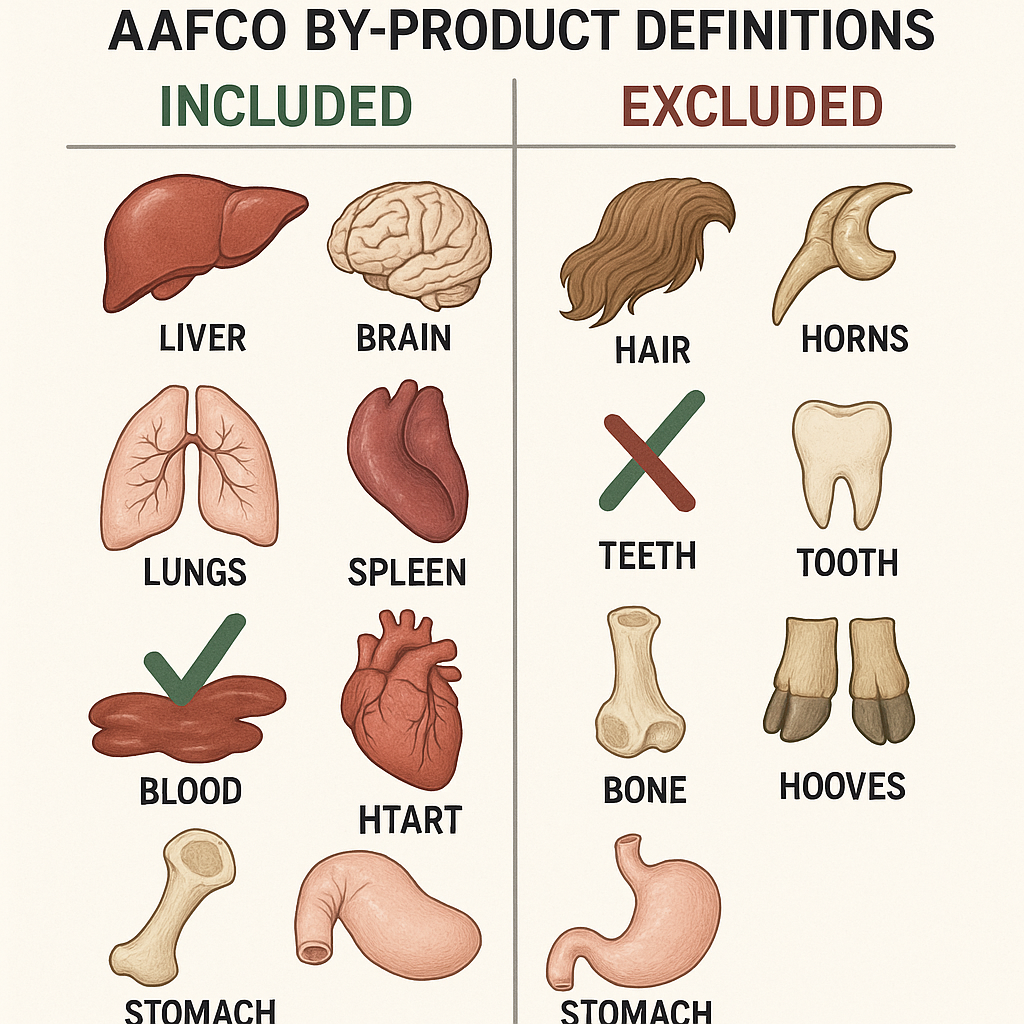
The Association of American Feed Control Officials (AAFCO) defines pet-food ingredients precisely. The relevant definitions:
Meat by-products. "The non-rendered, clean parts, other than meat, derived from slaughtered mammals." The definition explicitly includes the lungs, spleen, kidneys, brain, livers, blood, bone, partially defatted low-temperature fatty tissue, and stomachs and intestines freed of their contents. It explicitly excludes hair, horns, teeth, and hoofs. The "other than meat" wording specifies that "meat" is reserved for skeletal muscle (the part typically considered the cut you would buy at a butcher).
Poultry by-products. "Must consist of non-rendered clean parts of carcasses of slaughtered poultry such as heads, feet, viscera, free from fecal content and foreign matter except in such trace amounts as might occur unavoidably in good factory practice."
Meat by-product meal / poultry by-product meal. The same materials as above, rendered (processed by heat to remove water and fat) into a concentrated dry meal.
The regulatory definition specifies what is included and what is excluded. By-products are defined animal parts — clean, processed under standards equivalent to those for human-food slaughterhouse operations — and they are not the random refuse the marketing framing suggests.
A useful way to think about it: in human cooking, organ meats (liver, kidney, heart, sweetbreads, tripe) are valued ingredients in many cuisines. They are not "muscle meat" but they are not garbage. The AAFCO "by-products" category covers essentially the same ingredients, plus some additional clean parts (bone, blood, defatted fatty tissue), processed for use in pet food.
Why the Public Perception Is Different
The mismatch between the regulatory definition and the public perception has identifiable causes:
Marketing. A subset of pet-food brands have built positioning around "no by-products". This positioning works only if "by-products" is framed negatively. Marketing materials that describe by-products as "beaks, feet, hooves, hair" are not accurately representing the regulatory definition; they are constructing an unfavourable framing for competitive purposes.
The word itself. "By-product" sounds inferior to "main product". The semantic implication is that this is leftover material. In food-industry context, by-products of slaughter (organs, bone, etc.) are economically valuable secondary outputs, not waste. But the linguistic association is hard to override.
Lack of clear consumer information. AAFCO's definitions are publicly available but not easily accessible to the typical consumer. The marketing framing fills the information vacuum.
Confusion with 4D meat (dead, dying, diseased, disabled). Some consumer information conflates by-products with non-AAFCO-compliant ingredients from improperly sourced animal carcasses. Properly-defined by-products in pet food sold in the US must come from animals deemed fit for human consumption at the point of slaughter; they are not "4D" sources.
What Organ Meats Actually Provide
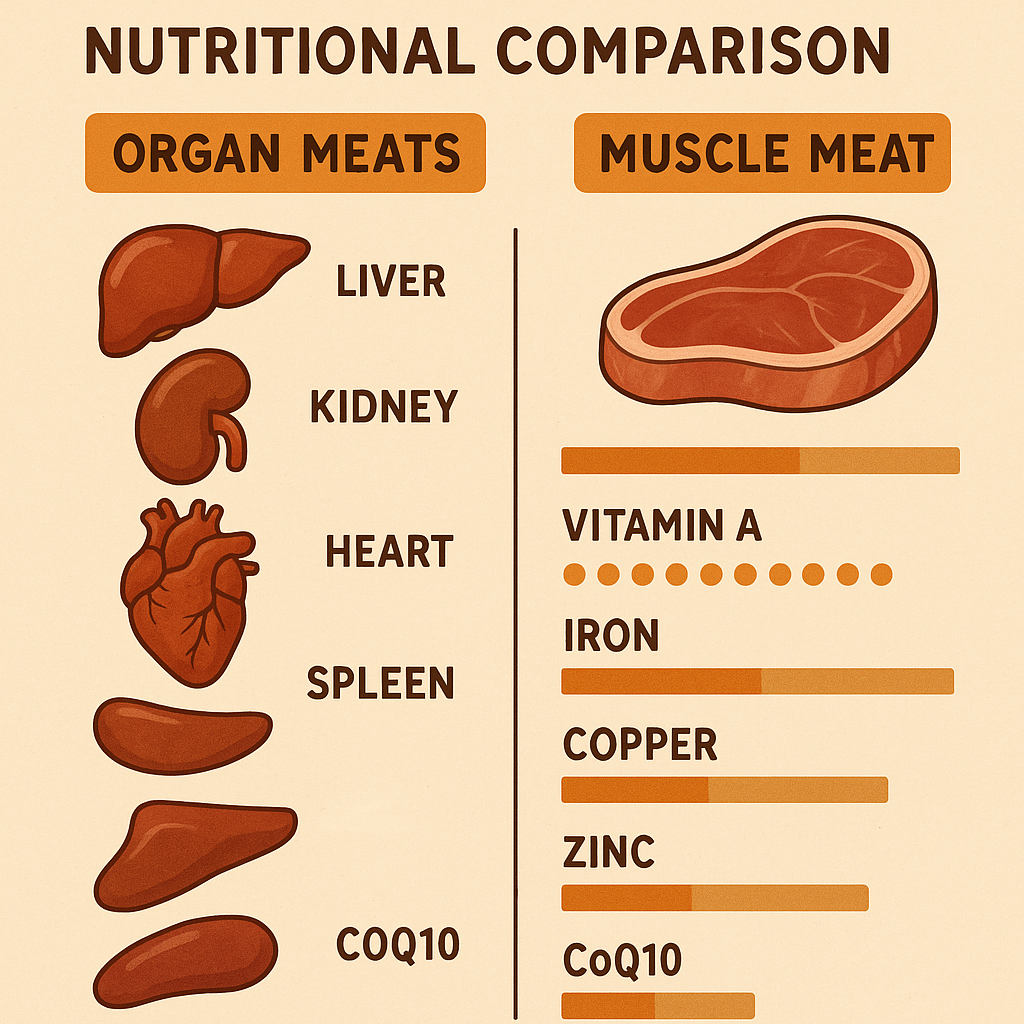
The nutritional case for organ meats — which are the bulk of what "by-products" actually are — is strong. Organ meats provide:
- Concentrated B vitamins. Liver in particular is the densest dietary source of vitamin B12, riboflavin, niacin, and folate. Many of these vitamins are found at much lower concentrations in skeletal muscle.
- Vitamin A. Liver is the most concentrated dietary source.
- Iron and copper. Heart, liver, and spleen are dense sources of heme iron and copper.
- Zinc and selenium. Various organs contribute trace minerals at higher concentrations than muscle meat.
- High-quality complete protein. Organ proteins contain all essential amino acids in appropriate ratios.
- Coenzyme Q10. Heart muscle is particularly high in CoQ10, with cardiovascular and metabolic relevance.
A diet that excludes organ meats and uses only skeletal muscle is nutritionally incomplete unless the missing nutrients are added through supplementation. Many "no by-products" formulations do supplement these nutrients synthetically. The result is the same nutritional profile as a diet using organ meats, just delivered through synthetic supplementation rather than whole-food sources.
The irony is that the "no by-products" marketing positioning sometimes goes alongside marketing that emphasises whole-food and minimally-processed nutrition — but excluding organ meats and replacing them with synthetic supplementation moves in the opposite direction.
How to Read By-Product Mentions on Labels
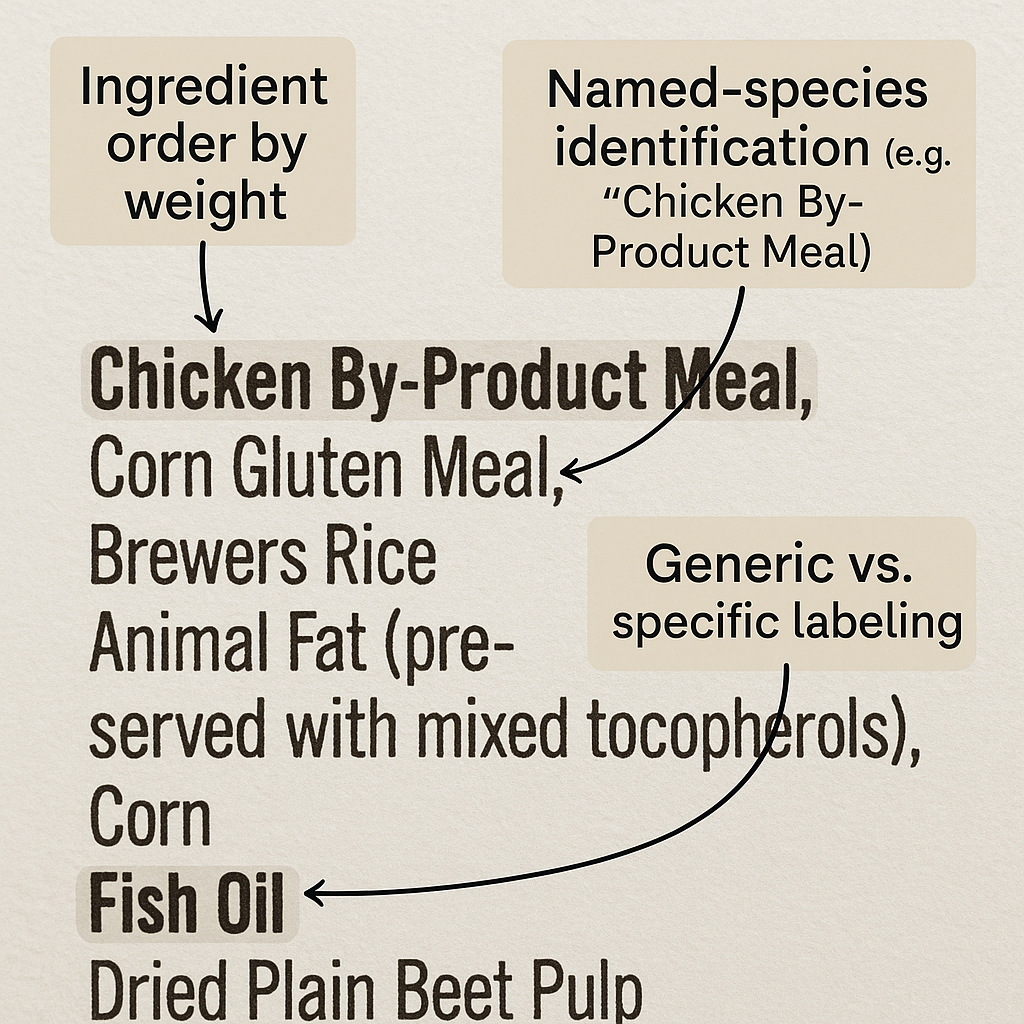
A practical approach:
Named-species by-products are normal and acceptable. "Chicken by-product meal", "beef by-products", "lamb by-product meal" — these are AAFCO-defined ingredients with specific compositional standards. The named species means the ingredient is sourced from that specific animal type, which provides traceability.
Generic "meat by-product" is more variable. Without species specification, the source can rotate across species. This is regulatory-permitted but provides less specificity.
The order of ingredients matters more than presence. Ingredient lists are by weight at the time of formulation. A diet with chicken meal first and chicken by-product meal second is using chicken meat protein as the primary protein source with by-product meal as a contributing ingredient.
Manufacturer reputation matters. Established manufacturers with strong nutritional-research programmes tend to use by-products in formulations that meet specific nutrient targets, with appropriate quality controls. This is the same pattern that the grain-free DCM update article covers in a different context.
"By-product-free" is not automatically nutritionally superior. A formulation that excludes by-products and replaces the missing nutrients with synthetic supplementation produces the same nutritional profile through different means. The regulatory adequacy is the same; the marketing positioning differs.
Common Errors
- Treating "by-products" as a marker of low quality. It is a regulatory definition covering nutrient-dense ingredients with wide acceptance in the veterinary-nutrition community.
- Equating by-products with 4D meat or non-food-grade material. AAFCO-compliant pet food must use ingredients from animals deemed fit for human consumption; properly-defined by-products are not 4D sources.
- Avoiding by-products on principle while accepting other ingredient choices uncritically. The same scrutiny applied to "by-products" should be applied to "natural flavors", "meat meal" (without species), and other generic descriptors that may be less informative than named-species by-products.
- Assuming "no by-products" means "more meat". Many "no by-products" diets have similar muscle-meat content to diets that include by-products; the difference is in how the additional nutrients are sourced.
What This Does Not Imply
- All by-products are equally good. Generic species-unspecified by-products provide less traceability than named-species by-products.
- Manufacturer reputation does not matter. It matters considerably. Strong manufacturers use ingredients (including by-products) in formulations meeting specific quality and nutrient standards.
- Whole-food organ meat is identical to rendered by-product meal. The processing differs; rendered meals have moisture removed and are concentrated. Both are nutritionally meaningful; they are not identical products.
What Is and Is Not Settled
Settled: AAFCO definitions of meat by-products and poultry by-products specify clean animal parts other than skeletal muscle (and exclude hair, horns, teeth, hooves, and intestinal contents)[^aafco]; organ meats are nutritionally dense sources of B vitamins, iron, zinc, copper, vitamin A, and high-quality protein; the public perception of "by-products" is shaped markedly by marketing rather than by nutritional or regulatory facts.
Not settled: the precise comparative nutritional outcomes of by-product-inclusive vs. by-product-free diets that have equivalent nutrient profiles through different ingredient strategies (the underlying nutrients are matched; long-term health-outcome differences are not well-studied).
Key Takeaways
- AAFCO defines by-products as clean animal parts other than skeletal muscle — typically organs (liver, kidney, heart, spleen, lung), blood, and bone — and explicitly excludes hair, horns, teeth, hooves, and intestinal contents.
- Organ meats provide concentrated B vitamins, vitamin A, iron, zinc, copper, and high-quality protein at densities skeletal muscle does not.
- The "no by-products" marketing framing often relies on inaccurate descriptions of what by-products actually are.
- Named-species by-products (chicken by-product meal, beef by-products) provide traceability; generic "meat by-product" is more variable.
- "By-product-free" diets typically deliver the missing nutrients through synthetic supplementation, producing the same nutritional profile through different means.
- Manufacturer reputation and overall formulation matter more than the by-product binary.
Sources & further reading
- Association of American Feed Control Officials. AAFCO Pet Food Standards and Byproducts Guide. AAFCO. https://www.aafco.org/consumers/understanding-pet-food/byproducts/
- World Small Animal Veterinary Association. (2021). WSAVA Global Nutrition Guidelines. World Small Animal Veterinary Association. https://wsava.org/global-guidelines/global-nutrition-guidelines/
- American Animal Hospital Association. AAHA nutrition resources. American Animal Hospital Association. https://www.aaha.org/