What the GA Panel Actually Is
The Guaranteed Analysis (GA) is the table on a pet-food label that lists, at minimum:
- Crude protein, minimum. The food guarantees at least this much protein.
- Crude fat, minimum. At least this much fat.
- Crude fiber, maximum. No more than this.
- Moisture, maximum. No more than this.
The "crude" prefix is a chemistry term referring to the analytical method used to measure each nutrient — it does not mean "rough estimate" or "low quality". Crude protein is total nitrogen-containing material multiplied by a standard factor; crude fat is everything that dissolves in a particular solvent; crude fiber is the indigestible plant cell-wall residue measured by a specific assay.
The GA is required on every commercial complete-and-balanced pet-food label in the United States, with formal regulatory definitions in the AAFCO Pet Food Standards[^aafco]. The numbers are guarantees the manufacturer must meet — not averages, not targets — so a product showing "crude protein, minimum 25%" must contain at least 25% crude protein in any sample tested.
Why the Numbers Are Misleading on First Glance
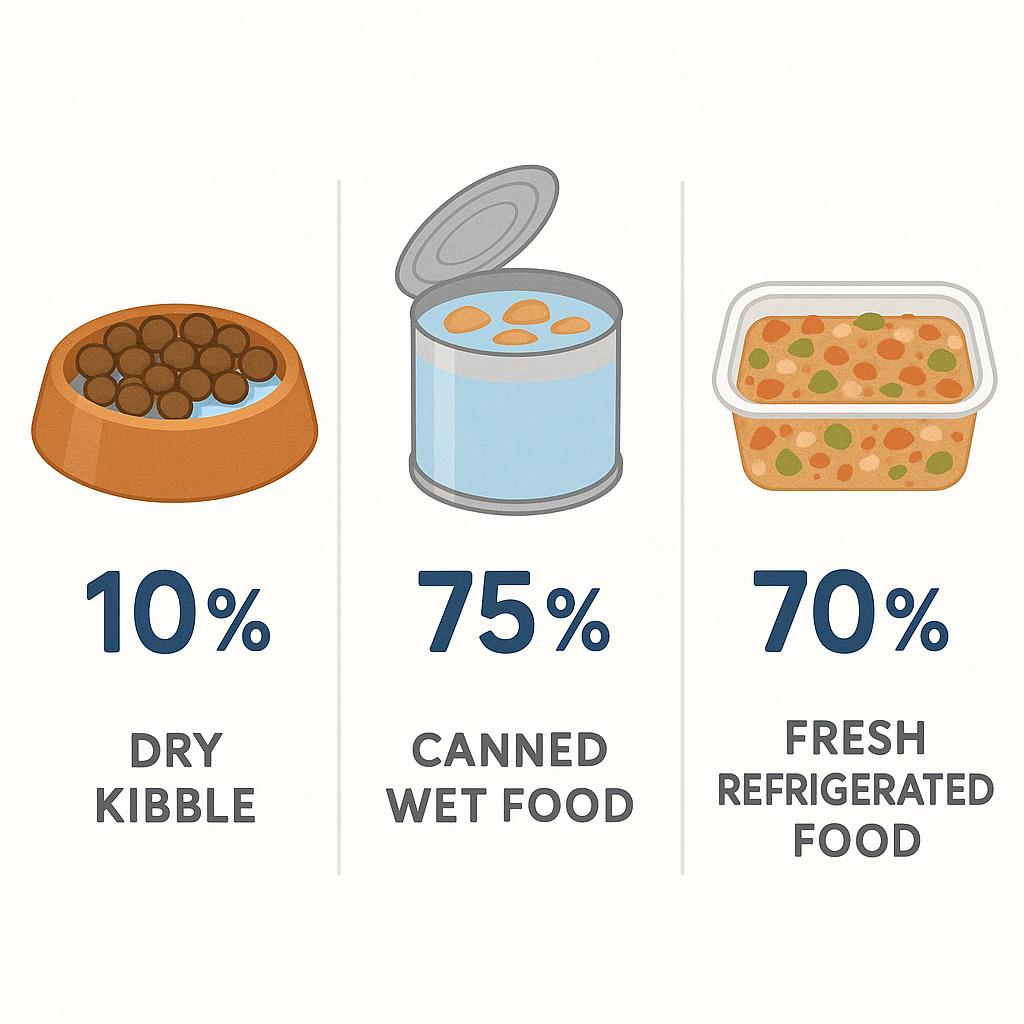
The trap: the percentages are calculated on an as-fed basis, which means the percentages include the water content of the food. Moisture varies enormously across pet-food formats:
- Dry kibble: roughly 8-12% moisture.
- Semi-moist: roughly 25-35% moisture.
- Canned/wet food: roughly 70-82% moisture.
- Fresh/refrigerated/raw: roughly 65-75% moisture.
Two foods with very different moisture contents cannot be compared directly on as-fed numbers. A canned food showing "crude protein, minimum 10%" and a kibble showing "crude protein, minimum 25%" looks like the kibble has 2.5 times the protein. But the canned food is mostly water; the kibble is mostly food.
Comparing fairly requires removing the moisture and looking at the food on a dry-matter basis. The canned food's actual dry-matter protein, after the moisture is removed, may be considerably higher than the kibble's.
The Dry-Matter Conversion
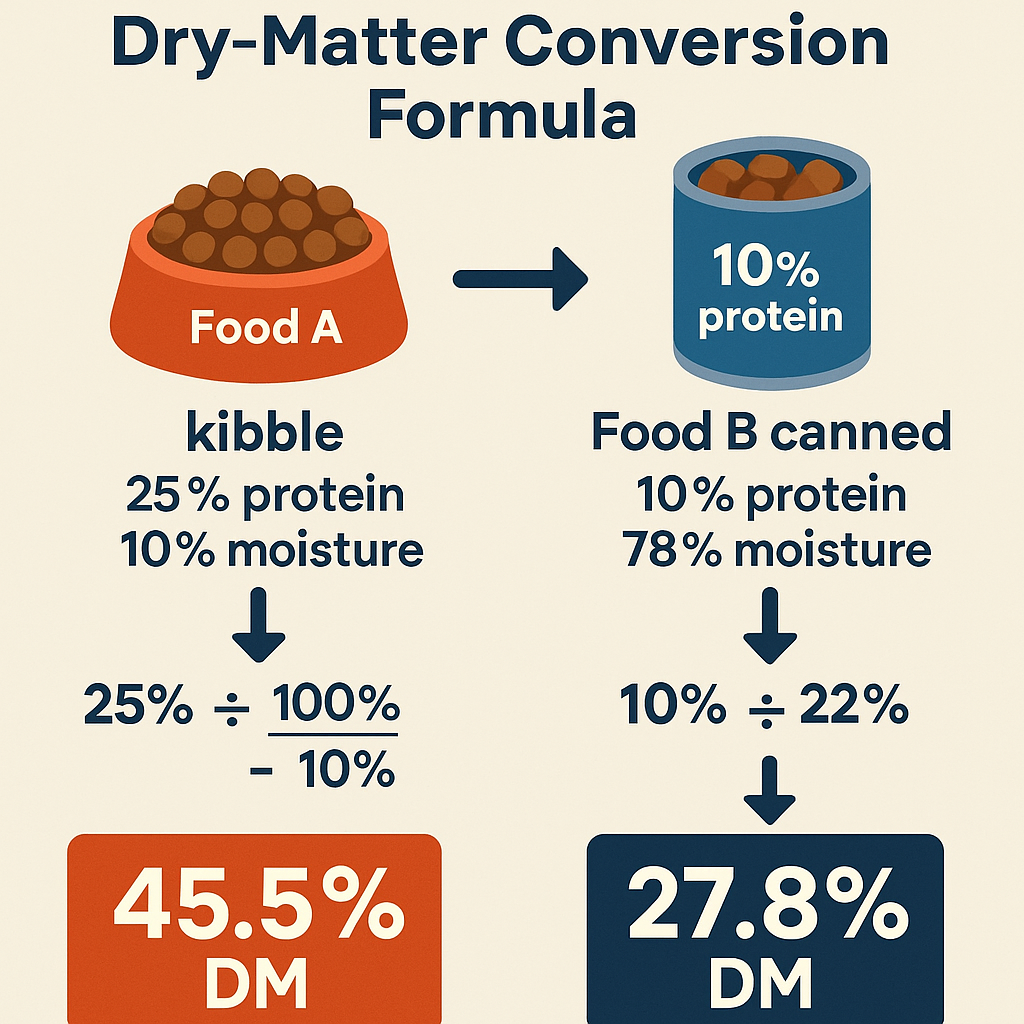
The arithmetic is simple. The dry-matter percentage for any nutrient is:
Dry-matter % = (As-fed nutrient %) ÷ (1 − moisture as decimal)
Or equivalently:
Dry-matter % = (As-fed %) × 100 ÷ (100 − moisture %)
A worked example. Compare:
- Food A (kibble): Crude protein 25%, moisture 10%.
- Food B (canned): Crude protein 10%, moisture 78%.
For Food A: dry-matter protein = 25 ÷ (1 − 0.10) = 25 ÷ 0.90 = 27.8%
For Food B: dry-matter protein = 10 ÷ (1 − 0.78) = 10 ÷ 0.22 = 45.5%
On an as-fed basis, the kibble looks like it has more than twice the protein. On a dry-matter basis, the canned food has appreciably more. This reverses the apparent comparison.
The same calculation applies to fat and fiber. Always convert to dry matter before comparing foods of different moisture levels.
What the GA Does and Does Not Tell You
The GA is honest about what it covers, but it is not a complete nutritional picture:
What it tells you:
- Minimum protein and fat content (as guarantees).
- Maximum fiber and moisture (as guarantees).
- Some labels also guarantee minimums for specific nutrients (omega-3, glucosamine, taurine, etc.) when the manufacturer wants to claim those.
What it does not tell you:
- The protein quality (digestibility, amino-acid balance). Two foods with the same crude protein percentage can have very different protein quality.
- The actual fat composition (saturated vs. unsaturated, omega-3:omega-6 ratio).
- Carbohydrate content. AAFCO does not require carbohydrate disclosure; you can estimate it as: 100% − (protein% + fat% + fiber% + moisture% + ash%). Ash is roughly 6-8% in most diets but is not always disclosed.
- Specific nutrient breakdown (vitamins, individual minerals, specific fatty acids) unless the manufacturer chooses to add them.
- Caloric density. Calories are listed separately on AAFCO-compliant labels (typically as kcal/cup and kcal/kg) and are critical for actual feeding decisions.
The GA is one tool among several. The Nutritional Adequacy Statement (which life stage the food meets), the ingredient list, the calorie statement, the AAFCO statement of nutritional adequacy, and the manufacturer's reputation all contribute to a picture the GA alone cannot give.
Practical Application
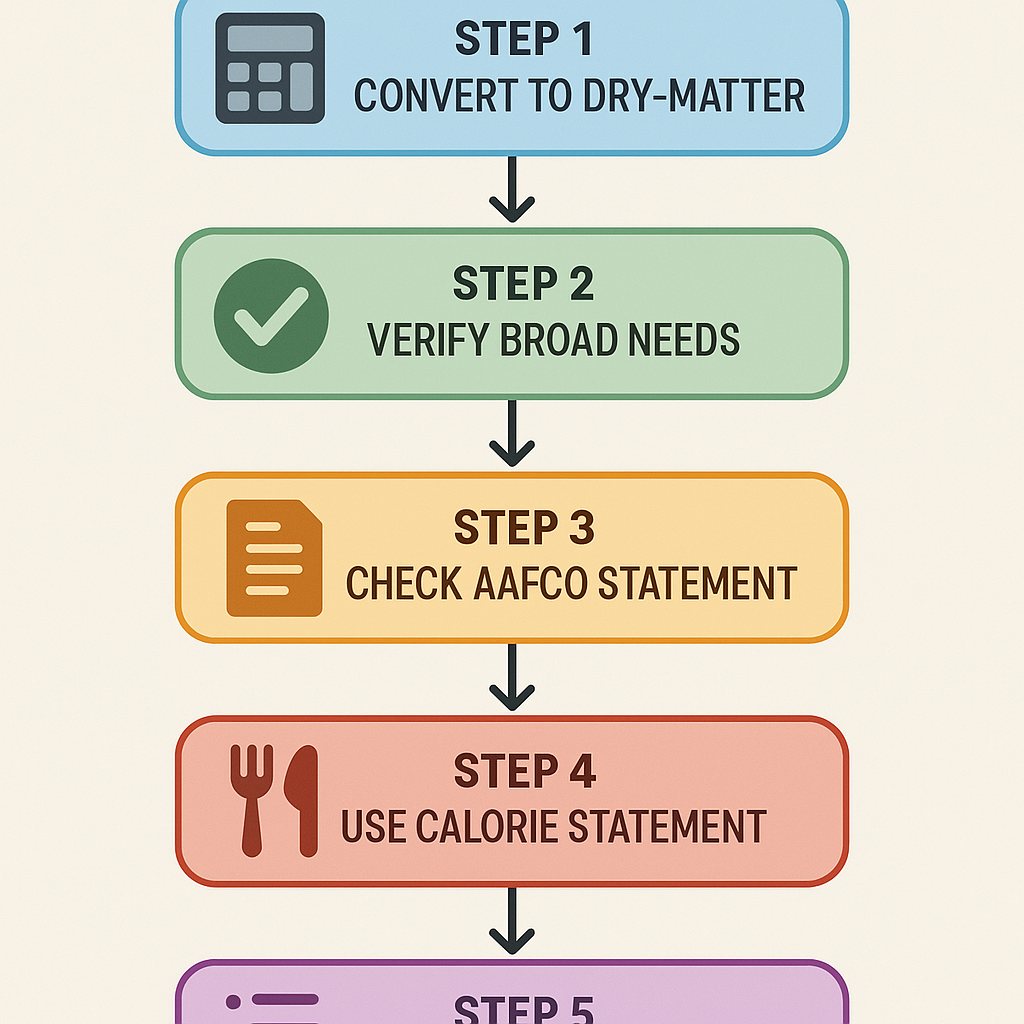
A workable approach to using the GA:
Step 1 — Convert to dry-matter basis when comparing foods of different formats. Always. Side-by-side comparisons of kibble and canned food on as-fed numbers are nearly always wrong.
Step 2 — Use the GA to verify the food meets the dog's broad needs. A diet with reasonable protein and fat percentages on dry-matter basis is doing the basic job; a diet that is dramatically out of range (very low protein, very low fat) needs a closer look.
Step 3 — Check the AAFCO Nutritional Adequacy Statement separately. This is where the food's regulatory life-stage compliance is documented. The GA shows the percentages; the Nutritional Adequacy Statement confirms the food meets the formal standards.
Step 4 — Use the calorie statement for actual feeding amount. Calorie density varies substantially and the right amount of food depends on calories, not on volume.
Step 5 — Read the ingredient list for protein and ingredient quality. Crude protein percentage does not capture quality; the actual ingredients (named meat, named meal, by-products, plant proteins) provide that picture.
Common Errors
- Comparing kibble and canned on as-fed numbers. The most common error. Always convert to dry-matter first.
- Treating "minimum protein 25%" as "the food has exactly 25% protein". It is a minimum guarantee; the actual content may be higher.
- Assuming higher protein percentage is automatically better. Protein needs vary by life stage, activity, and clinical context. The protein-debate article covers the broader question.
- Ignoring fiber and moisture maximums. These are guarantees too; they bound the food's composition.
- Treating the GA as the complete nutritional picture. It is not. Quality, ingredient sourcing, processing, and digestibility are not in the panel.
What This Does Not Imply
- The GA is not "marketing" or "false advertising". It is a regulatorily-defined panel with specific legal definitions; it is just easy to misread.
- Dry-matter basis is not always the right comparison. For practical feeding (how much to feed), as-fed amounts and calories are what matter. Dry-matter basis is for comparing nutrient content across foods of different moisture levels.
- No GA conversion replaces the AAFCO Nutritional Adequacy Statement. The latter is the regulatory confirmation that the food meets the life-stage standards.
What Is and Is Not Settled
Settled: the Guaranteed Analysis is regulatorily defined with specific legal meanings under the AAFCO Pet Food Standards[^aafco]; dry-matter conversion is uncontroversial nutrient-density mathematics; cross-format food comparisons require dry-matter conversion to be accurate.
Not settled (in this article's scope): the broader nutritional questions of protein quality, ingredient sourcing, and diet philosophy that the GA does not cover.
Key Takeaways
- The Guaranteed Analysis lists minimums for protein and fat, maximums for fiber and moisture, on an as-fed basis.
- As-fed numbers cannot be compared across foods of different moisture content; always convert to dry-matter basis: DM% = As-fed% ÷ (1 − moisture decimal).
- The GA does not capture protein quality, ingredient sourcing, specific nutrient breakdown, or carbohydrate content.
- Use the GA together with the AAFCO Nutritional Adequacy Statement, the ingredient list, the calorie statement, and overall diet design.
- Common errors: comparing kibble and canned on as-fed numbers, treating GA as the complete picture, equating higher percentages with higher quality.
Sources & further reading
- Association of American Feed Control Officials. AAFCO Pet Food Label Reading Guide and Pet Food Standards. AAFCO. https://www.aafco.org/consumers/understanding-pet-food/reading-labels/
- PetMD. PetMD nutrition resources and label-reading guides. PetMD. https://www.petmd.com/
- World Small Animal Veterinary Association. (2021). WSAVA Global Nutrition Guidelines. World Small Animal Veterinary Association. https://wsava.org/global-guidelines/global-nutrition-guidelines/