Why This Matters
Car travel with dogs is routine for most owners. The safety considerations are substantial and frequently underestimated:
Crash dynamics with unrestrained dogs. In a vehicle collision, an unrestrained occupant of any species continues moving at the vehicle's pre-collision velocity until something stops them. For a 30 kg dog in a 50 km/h crash, the impact force on whatever stops the dog (typically the windshield, dashboard, or vehicle occupants in front) is on the order of multiple kilonewtons — sufficient to produce severe injury to the dog and to anyone the dog impacts. The physics is the same as for unrestrained child or adult occupants.
Driver distraction risk. Unrestrained dogs in cars are substantial driver-distraction sources. Dogs moving around the cabin, dogs in the driver's lap, dogs barking at outside stimuli — all increase crash risk.
Heat stroke risk in stationary vehicles. A vehicle in moderate ambient conditions reaches dangerously hot interior temperatures within 10-20 minutes. Heat stroke in dogs left in vehicles is a frequent veterinary emergency and a substantial cause of preventable canine death.
Escape risk during routine stops. Dogs in vehicles with open doors at rest stops, gas stations, and similar contexts can escape into traffic. The escape risk during routine travel events is real.
The good news: each of these risks has practical management solutions. The article walks through them.
Crash-Tested Restraint — The Center for Pet Safety
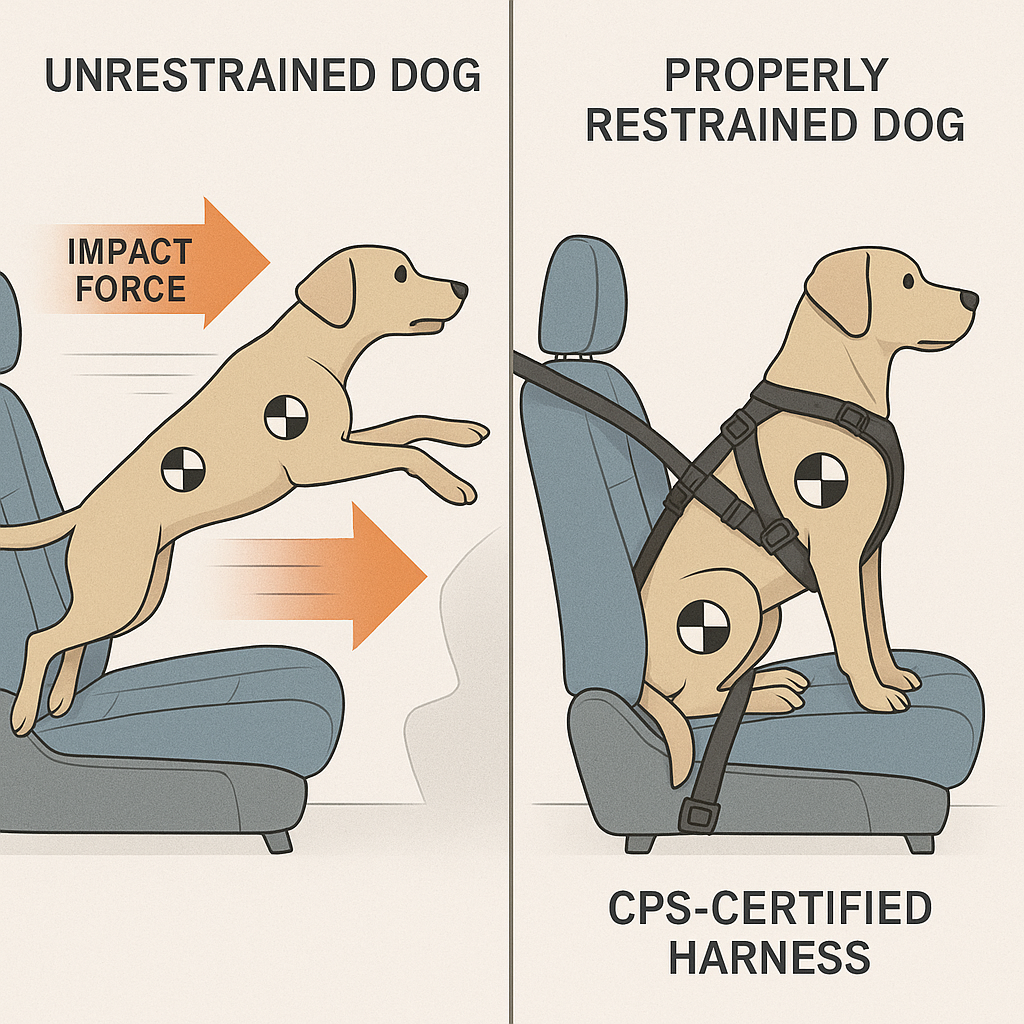
The Center for Pet Safety (CPS) is an independent organisation that crash-tests pet-restraint products using protocols modelled on child-restraint testing. The CPS Certification programme identifies products that have demonstrated actual crash-restraint performance.
The empirical reality of the pet-restraint market is uncomfortable: many products marketed as "safety harnesses" or "safety carriers" fail crash testing. Specifically:
Many marketed "safety harnesses" provide no real crash restraint. Many products are simply walking harnesses with seat-belt-attachment loops; in crash conditions they fail or produce harmful failure modes (the dog slips out, the harness breaks, the connection point fails). The marketing claim is not the same as the demonstrated performance.
Many "travel crates" are not crash-rated. Standard kennels and crates are designed for indoor use; their crash performance is variable.
The CPS certification distinguishes products that perform. The CPS Certified database is the most rigorous independent verification available.
For owners shopping for restraint products: check the CPS Certified database directly rather than relying on product marketing. Currently-certified products vary across categories (harnesses, crates, carriers); the database is updated as new products are tested.
Vehicle Positioning
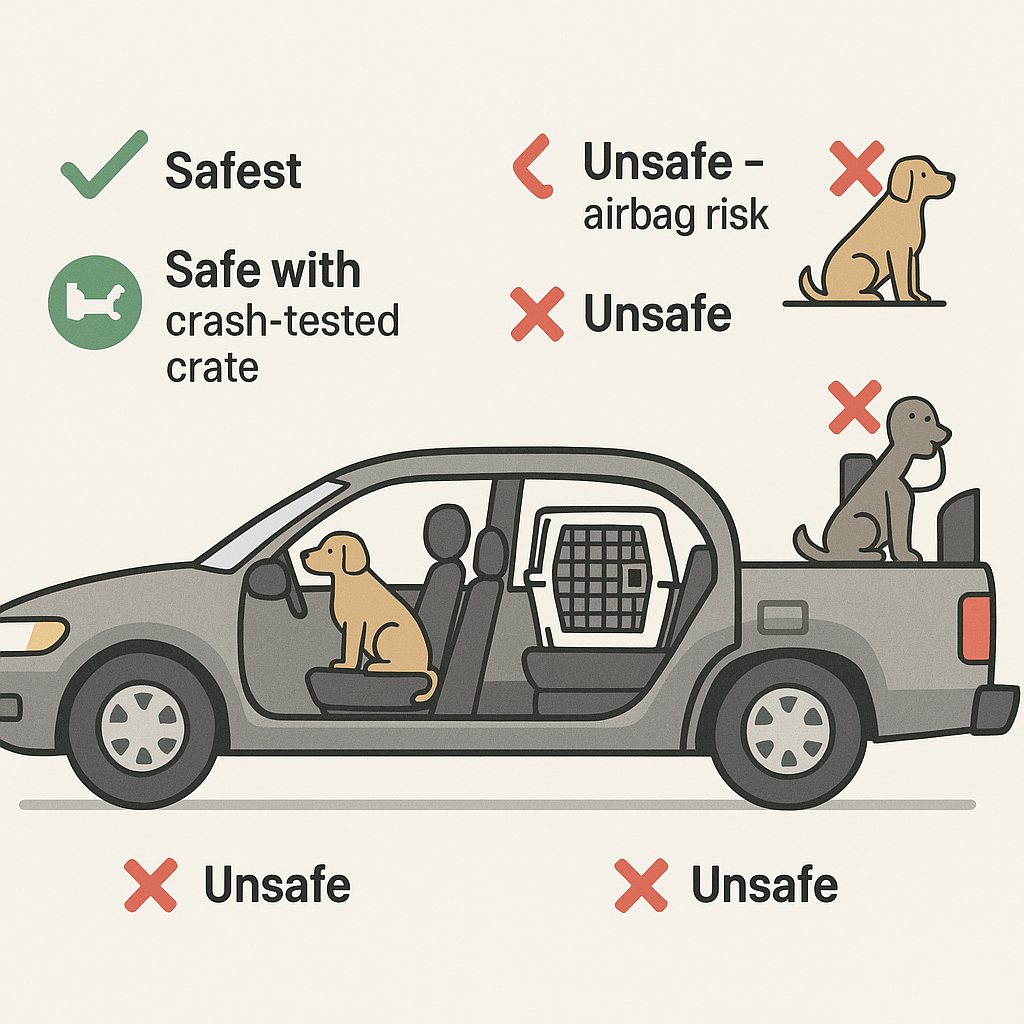
Where to position the restrained dog matters:
Back seat is generally safer than front seat. Front-passenger airbags can produce substantial injury to dogs in the front seat during collision; back-seat positioning avoids this.
Cargo area of SUVs and station wagons is reasonable with a properly-secured crash-tested crate or carrier. The crate should be restrained (anchored to the vehicle) so it does not become a projectile in collision.
Beds of pickup trucks are unsafe for dogs in any but the very specific working-dog contexts where appropriate restraint, securement, and conditions are managed. The popular practice of dogs riding loose in pickup beds produces routine injury and death; many states have specific laws against the practice.
Driver's lap is unsafe; produces both driver-distraction and direct dog-injury risk.
Open windows. Some dogs love putting their head out the window; the practice produces eye-injury risk from flying debris and ear-injury risk in some dogs. Cracking the window for airflow without enabling head-out behaviour is a reasonable middle ground.
Heat-Stroke Prevention
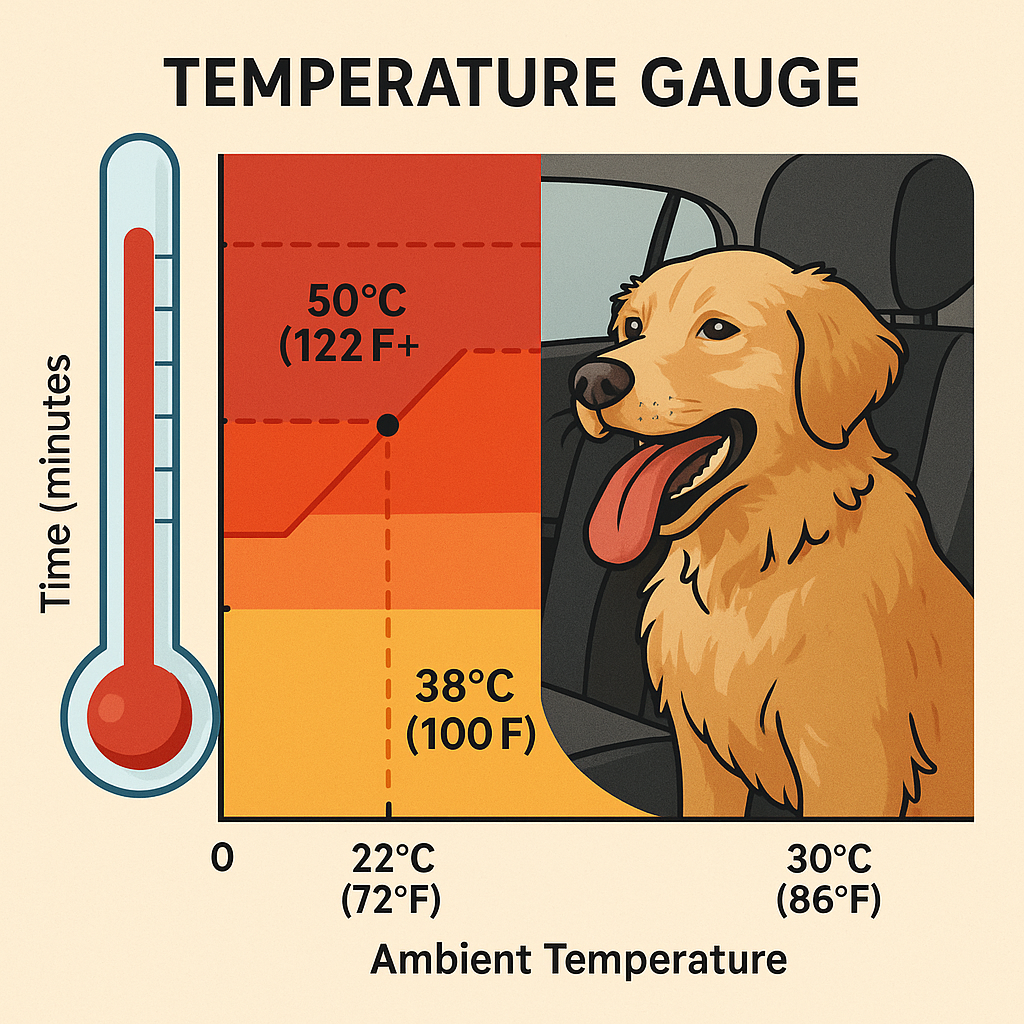
The single most preventable canine vehicle-related death:
Vehicle interior temperature rises rapidly even in moderate weather. At 22°C (72°F) ambient, a vehicle interior reaches 38°C (100°F) within 10 minutes. At 30°C (86°F) ambient, the interior can exceed 50°C (120°F). The temperature rise occurs even with cracked windows and shade.
Dogs are particularly vulnerable to heat stroke. Dogs cannot sweat through skin; they thermoregulate through panting and limited sweating through paw pads. Their thermoregulatory capacity is exceeded faster than humans' in confined-space heat.
The simple rule: do not leave dogs in stationary vehicles. The "I'll only be a minute" frame is the typical pattern in heat-stroke incidents; a longer-than-anticipated stop or a delayed return produces the emergency.
Some states have laws. Many U.S. states have specific laws against leaving animals unattended in dangerous vehicle conditions. Several states have "Good Samaritan" laws permitting bystanders to break windows to rescue animals in distress.
Quick alternatives. When errands require stops, options include: drop the dog off at home before the errands, use drive-through services, ask another household member to stay with the dog, plan to delay the errand to cooler conditions, or use specific dog-friendly facilities (some pet-supply stores, outdoor markets, etc.).
Rest-Stop Protocols
For longer trips, rest stops are essential for the dog's wellbeing and safety:
Frequency. Every 2-3 hours for adult dogs; more frequent for puppies, seniors, and dogs with specific medical conditions.
At the rest stop:
- Maintain leash control before opening any door. Escape risk at unfamiliar rest stops is substantial.
- Designated pet-relief areas at most rest stops. Use them; respects other travellers and reduces fecal contamination of public areas.
- Hydration and brief walking. A short walk and water access is the rest-stop core.
- Avoid feeding immediately before resuming travel. Food immediately before a continued drive can produce car sickness; spacing food and travel reduces issues.
Decompression for nervous travellers. Dogs with travel anxiety benefit from longer rest stops with calm activity (sniffing time, gentle interaction) before resuming.
Heat-stroke awareness during stops. During the stop, the dog should not be left in the vehicle; the same heat risk applies.
Backup IDs and microchip currency. Long trips increase the probability that the dog will be in unfamiliar environments where escape recovery would be difficult.
Other Practical Considerations
Travel preparation. Some dogs need acclimation to longer car rides; building up duration with short trips before a long trip reduces stress.
Anti-anxiety pharmacological support. Dogs with substantial travel anxiety may benefit from veterinary-prescribed support (covered for noise-phobia in noise-phobias article; some of the same medications apply to travel anxiety).
Car-sickness management. Some dogs experience motion sickness; veterinary-prescribed maropitant (Cerenia) is effective for many cases. Spacing food before travel and ensuring the dog can see out the window may reduce motion-sickness signs.
Documentation for crossing borders. International travel and some interstate travel requires specific documentation; AVMA pet-travel resources cover the broader framework.
Trip-emergency preparation. Have the dog's veterinary contact information, vaccination records, and emergency-vet locations along the route. Major pet-emergency apps and websites can identify nearest emergency facilities.
What This Does Not Imply
- All car travel is dangerous. It is not; routine well-managed travel is safe.
- CPS certification is the only acceptable verification. It is the most rigorous; uncertified products may still perform but the verification is absent.
- Long trips are inherently stressful for all dogs. Many dogs travel happily; for the dogs that struggle, the management framework above applies.
What Is and Is Not Settled
Settled: vehicle restraint substantially reduces collision-related injury to dogs and other occupants; the CPS Certification programme distinguishes products that perform; heat-stroke risk in stationary vehicles is severe and rapid; rest-stop protocols support dog wellbeing during longer trips[^cps][^avma].
Not settled (in this article): comparative effectiveness of specific certified products against each other; optimal travel-frequency recommendations across the spectrum of dog ages and conditions.
Key Takeaways
- Unrestrained dogs in vehicles are crash-projectiles with substantial mass; restraint is essential.
- The Center for Pet Safety (CPS) Certification programme identifies products that have actually demonstrated crash performance; check the CPS database rather than relying on marketing claims.
- Vehicle positioning: back seat or properly-secured cargo-area crate; not driver's lap, not pickup-truck beds.
- Heat-stroke risk in stationary vehicles is severe and rapid; do not leave dogs in vehicles. Some states have specific laws and Good Samaritan provisions.
- Rest-stop protocols: every 2-3 hours, leash control before door opening, designated pet-relief areas, hydration and brief walking.
- Other considerations: travel preparation, anti-anxiety support for nervous travellers, motion-sickness management, documentation, emergency preparation.
Sources & further reading
- Center for Pet Safety. Center for Pet Safety crash-test certification database. Center for Pet Safety. https://www.centerforpetsafety.org/cps-certified/
- American Veterinary Medical Association. AVMA Pet Travel Resources. American Veterinary Medical Association. https://www.avma.org/resources-tools/pet-owners/petcare/traveling-your-pet