The "Bite Out of Nowhere" Misframing
A common framing in news stories about dog bites: "the dog attacked without warning". The framing is almost always wrong. Dogs rarely bite without preceding warning signals; what typically happens is that the warning signals were given and either not recognised or not responded to appropriately by the humans present.
This matters because it shifts the framework from "unpredictable dog aggression" to "preventable communication failure". Dogs communicate their stress and discomfort with consistent recognisable signals. Humans who learn to read those signals and respond appropriately considerably reduce bite risk. Humans who do not — particularly children, who may not have learned to read canine signals, and adults who have not been educated about them — are at elevated risk.
The bite-prevention framework is fundamentally about communication recognition, not about identifying "dangerous dogs".
The Ladder of Aggression
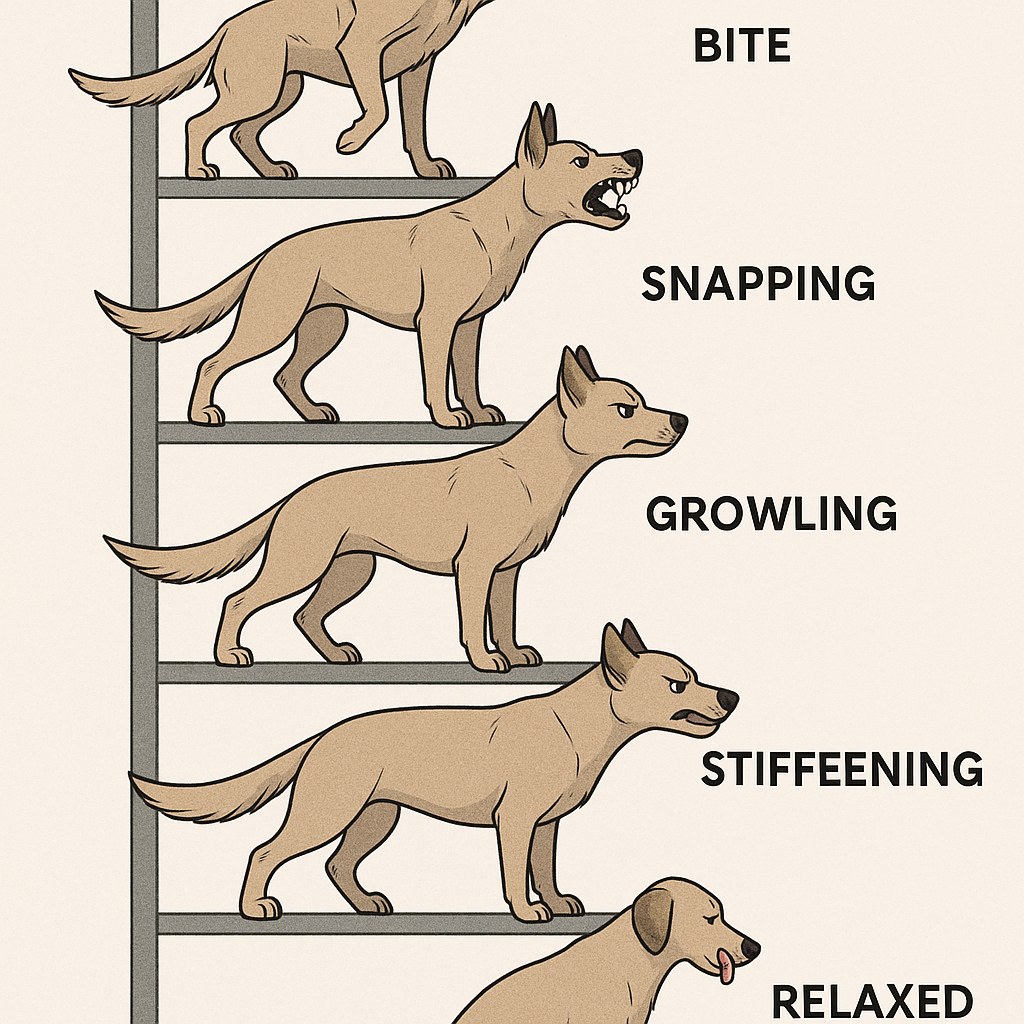
The ladder-of-aggression framework (Shepherd's adaptation of Schalke and others' work) organises canine warning signals from low-intensity to high-intensity. The progression is approximate; not every dog goes through every step in every situation. But the general structure is consistent.
Low-intensity signals (early ladder rungs):
- Lip licking and tongue flick. The dog flicks the tongue across the nose or lips — a calming signal indicating stress or discomfort.
- Yawning when not tired. Stress yawning is structurally different from sleepy yawning; the context (during interaction, in unusual situations) is the discriminator.
- Turning the head away or breaking eye contact. A "I am not in conflict with you" signal.
- Turning the body sideways. A dog who turns their body away from a stimulus is often trying to reduce the social pressure of the interaction.
- Walking away. When possible, an uncomfortable dog will move away from the source of discomfort.
- Sniffing the ground in social-pressure contexts. Displacement sniffing covered in stress-sniff article.
- Scratching or self-grooming when not itchy. Displacement behaviour.
- Body shake-off. A full shake (like after swimming) when not wet — a stress-release signal.
These signals are often missed by owners and visitors. They look like "the dog is just doing things". Recognising them as stress signals is the first level of bite-prevention awareness.
Medium-intensity signals:
- Stiff body posture. The dog's body becomes rigid; muscles visibly tense; ears alert; tail position (high or stiff). This is a substantial escalation from the low-intensity signals.
- Hard stare. Direct, fixed, sustained eye contact (covered in eye-contact-dog-human article). The hard stare is a precursor to escalation.
- Whale eye. The dog's head is turned away from the trigger but the eyes are watching it; the whites of the eyes (sclera) become visible as the eyes track laterally. A specific marker of substantial stress.
- Freezing. The dog stops moving entirely. This is often the moment immediately before a bite; recognition and immediate de-escalation matter.
- Closed mouth. A dog who has had a relaxed open mouth and suddenly closes it tightly is showing tension.
- Lifted lip showing teeth (without growling yet). A clear warning.
High-intensity signals (final ladder rungs):
- Growling. A clear vocal warning.
- Snapping. Air-snap without contact — the most explicit pre-bite warning.
- Inhibited bite. Contact bite without full pressure or with controlled tooth placement.
- Full bite. Uninhibited bite with full pressure.
The ladder progression is the dog's communication that they are increasingly unable or unwilling to tolerate the situation. Each rung is an opportunity for the human to de-escalate.
What to Do When You See Warning Signs
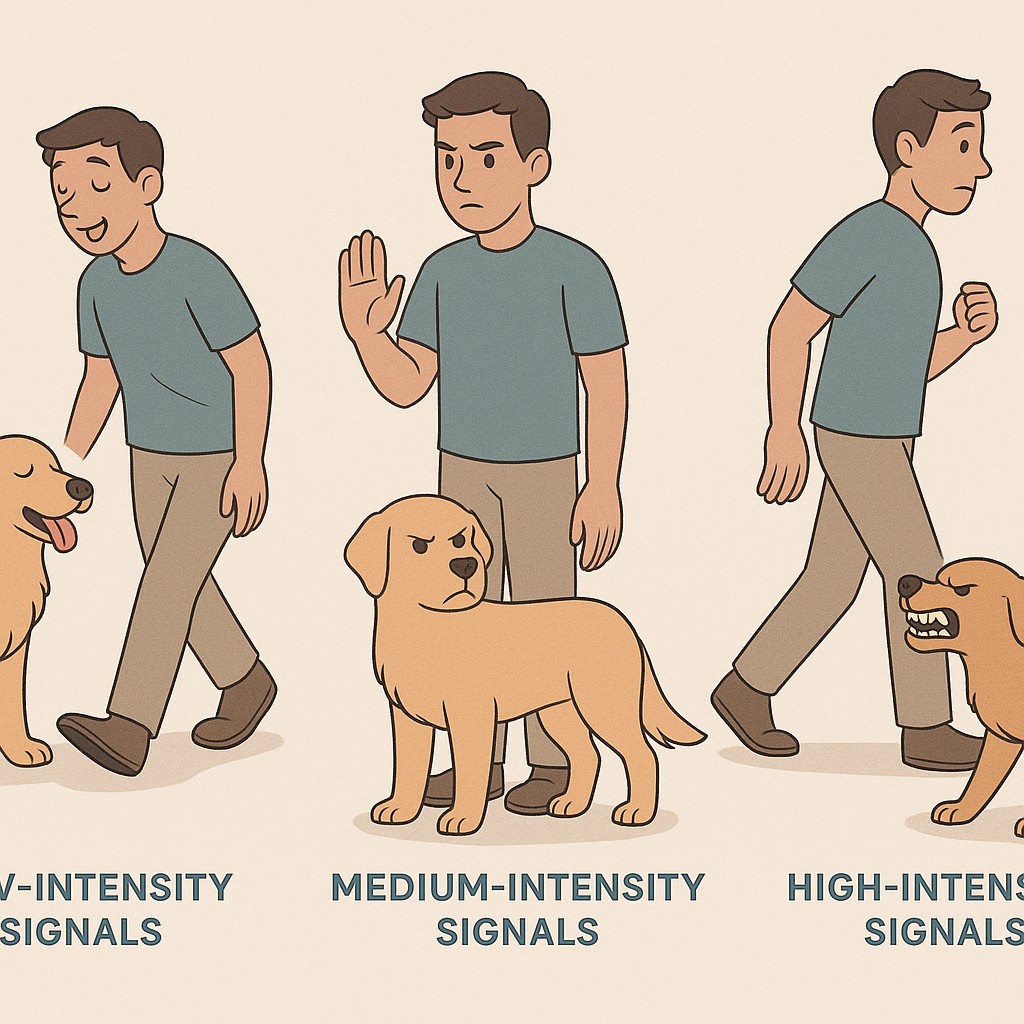
The appropriate response depends on the signal level:
Low-intensity signals.
- Recognise that the dog is uncomfortable.
- Reduce the social or environmental pressure.
- If you are interacting with the dog, give them space.
- Avoid pushing further into whatever is producing the discomfort.
- Note the context for future awareness.
Medium-intensity signals.
- Stop whatever is producing the discomfort immediately.
- Move away or facilitate the dog's movement away.
- Do not engage further; give the dog time to settle.
- Note the trigger context as a serious management point.
- Consider veterinary-behaviourist consultation if patterns are recurring.
High-intensity signals.
- The dog has already escalated markedly. Immediate disengagement is essential.
- Do not punish the warning. Punishing growling teaches the dog to skip warning signals and proceed directly to bite.
- Establish appropriate management to prevent future trigger exposure.
- Veterinary-behaviourist consultation is appropriate; the situation is beyond casual management.
The single most important practitioner-emphasised point: never punish a growl. The growl is communication; punishing it teaches the dog that the warning produces consequences while not addressing the underlying state. The dog learns to skip the growl and go directly to the bite. A growling dog is a communicating dog; that is a feature, not a problem.
Specific Bite-Risk Contexts
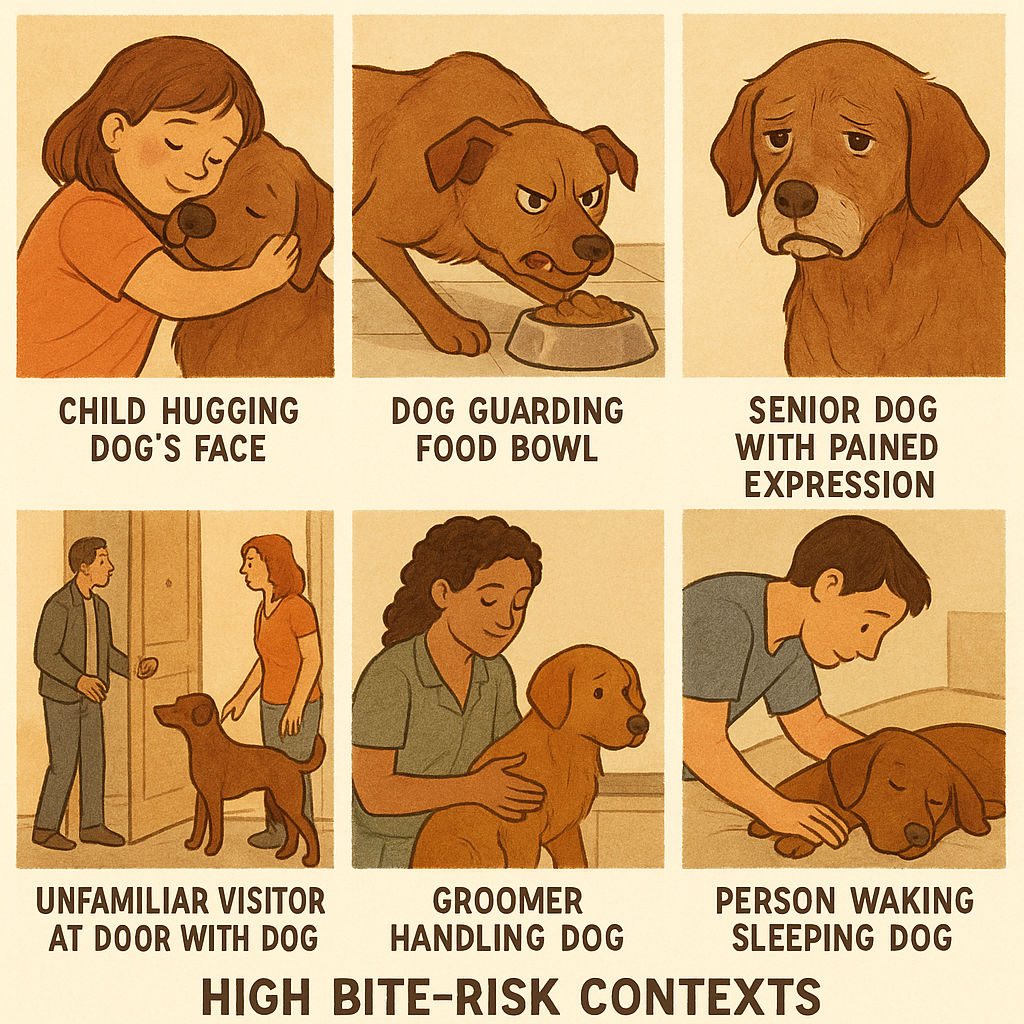
Some contexts produce elevated bite risk:
Children with dogs. Children frequently miss canine warning signals; their behaviour patterns (running, screaming, hugging, face-to-face approach) trigger many dogs. Adult supervision is essential; specific dog-and-child management is part of household responsibility (covered in the kids-dog-care article).
Resource-related interactions. Food, chews, toys, sleeping spaces — dogs guarding these resources may bite. The resource-guarding article covers the broader framework.
Pain and illness contexts. Dogs in pain are more likely to bite; medical issues warrant evaluation. Senior dogs developing cognitive issues may show changed bite-risk profiles.
Unfamiliar visitors. New people in the home, particularly children, may produce situations the dog does not know how to navigate.
Veterinary and grooming contexts. Restrained handling can produce bite-risk situations; cooperative-care training (covered in broader practitioner literature) reduces this.
Sleeping or startled dogs. Dogs woken or surprised may snap reflexively; teaching children to wake dogs gently, or to leave sleeping dogs alone, prevents specific incidents.
Multi-dog social situations. Some bites occur during dog-dog conflicts where humans intervene; understanding when to intervene and when not to matters.
The Broader Bite-Prevention Framework
A few overarching principles:
Educate yourself and your household. Recognise the warning signals; teach household members (children appropriately) to recognise them.
Trust the dog's communication. When a dog signals discomfort, take it seriously. The dog is providing useful information.
Manage rather than push through. Forced interactions, "the dog will get used to it", and "you have to show them who's boss" approaches contribute to bite incidents. Management and choice produce better outcomes.
Address underlying issues. Dogs that are biting or near-biting need professional support. The recall-rebuild article and broader behaviour-modification framework (covered in desensitization-counter-conditioning article) describe the approach for serious behavioural issues.
Veterinary-behaviourist consultation for serious cases. A diplomate of the American College of Veterinary Behaviorists can assess and treat serious bite-risk situations.
What This Does Not Imply
- All bites are 100% preventable. They are not; some specific situations are unavoidable. But the substantial majority involve recognisable preceding signals.
- Dogs that bite are "bad dogs". They are typically dogs in situations they cannot navigate; the situation matters more than the dog.
- Children are responsible for getting bitten. They are not; adults are responsible for the management that protects both children and dogs.
What Is and Is Not Settled
Settled: dog bites are typically preceded by recognisable warning signals; the ladder-of-aggression framework organises these signals coherently; punishing warnings (especially growls) is counterproductive; bite prevention through warning-sign recognition is more effective than reaction after escalation[^avsab][^jvb].
Not settled: optimal protocols for teaching warning-sign recognition to specific populations (children, elderly, new owners); the comparative effectiveness of different bite-prevention education programmes.
Key Takeaways
- Dog bites rarely come without warning; the "out of nowhere" framing is almost always wrong.
- The ladder-of-aggression framework: low-intensity (lip licking, yawning, looking away) → medium-intensity (stiff body, hard stare, whale eye, freezing) → high-intensity (growling, snapping, biting).
- Each rung is an opportunity for de-escalation through space, removing pressure, and ending the interaction.
- Never punish a growl — it is communication, and punishing it teaches the dog to skip warning and proceed directly to biting.
- Specific high-risk contexts: children, resources, pain/illness, unfamiliar visitors, veterinary/grooming, sleeping dogs, multi-dog conflicts.
- The bite-prevention framework is fundamentally about communication recognition; education for owners and household members notably reduces incidents.
Sources & further reading
- American Veterinary Society of Animal Behavior. AVSAB Bite Prevention Position Statement. AVSAB. https://avsab.org/resources/position-statements/
- Journal of Veterinary Behavior. Journal of Veterinary Behavior. Elsevier. https://www.sciencedirect.com/journal/journal-of-veterinary-behavior
- American Veterinary Medical Association. AVMA Animal Bite Prevention resources. American Veterinary Medical Association. https://www.avma.org/