What the ADA Establishes
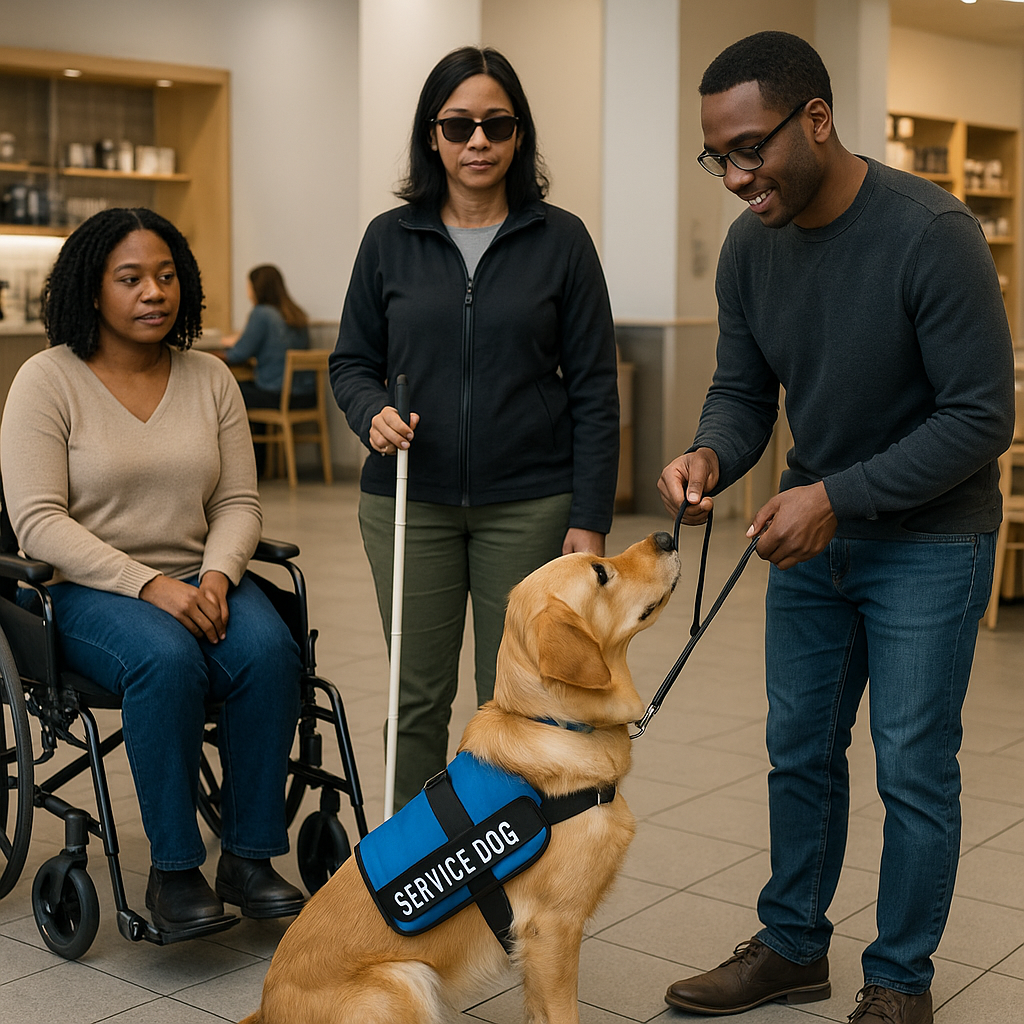
The Americans with Disabilities Act (ADA) provides federal-level public-access rights for service animals. The relevant provisions:
Service animal definition. Under the ADA, a service animal is "a dog that is individually trained to do work or perform tasks for people with disabilities". The disability can be physical, sensory, psychiatric, intellectual, or other mental disability. The animal must perform specific trained tasks directly related to the disability.
Public-access right. Service animals must be permitted in places of public accommodation — restaurants, stores, public buildings, transportation, hotels, hospitals (with specific exceptions), and other places where the public is generally welcome.
Two permissible questions. Businesses and public-facing staff may ask only two questions of a service-dog handler:
- Is the animal a service animal required because of a disability?
- What work or task has the animal been trained to perform?
Specifically not permitted:
- Asking about the handler's disability or medical history.
- Demanding documentation or certification.
- Demanding a demonstration of the task.
- Charging extra fees for the service animal.
- Requiring the animal to wear identifying markers (vests, harnesses, etc.) — though many handlers do use them voluntarily.
Documentation and certification are not required. This is a frequently misunderstood point. The ADA does not require any specific certification, registration, ID card, or documentation. Online "service animal registries" are not legitimate; they typically sell meaningless documentation that has no federal-law basis.
The intent of the limited-questions framework is to balance public-access rights for people with disabilities against legitimate verification needs of businesses, while not requiring people with disabilities to disclose private medical information.
When Service Animals Can Be Excluded
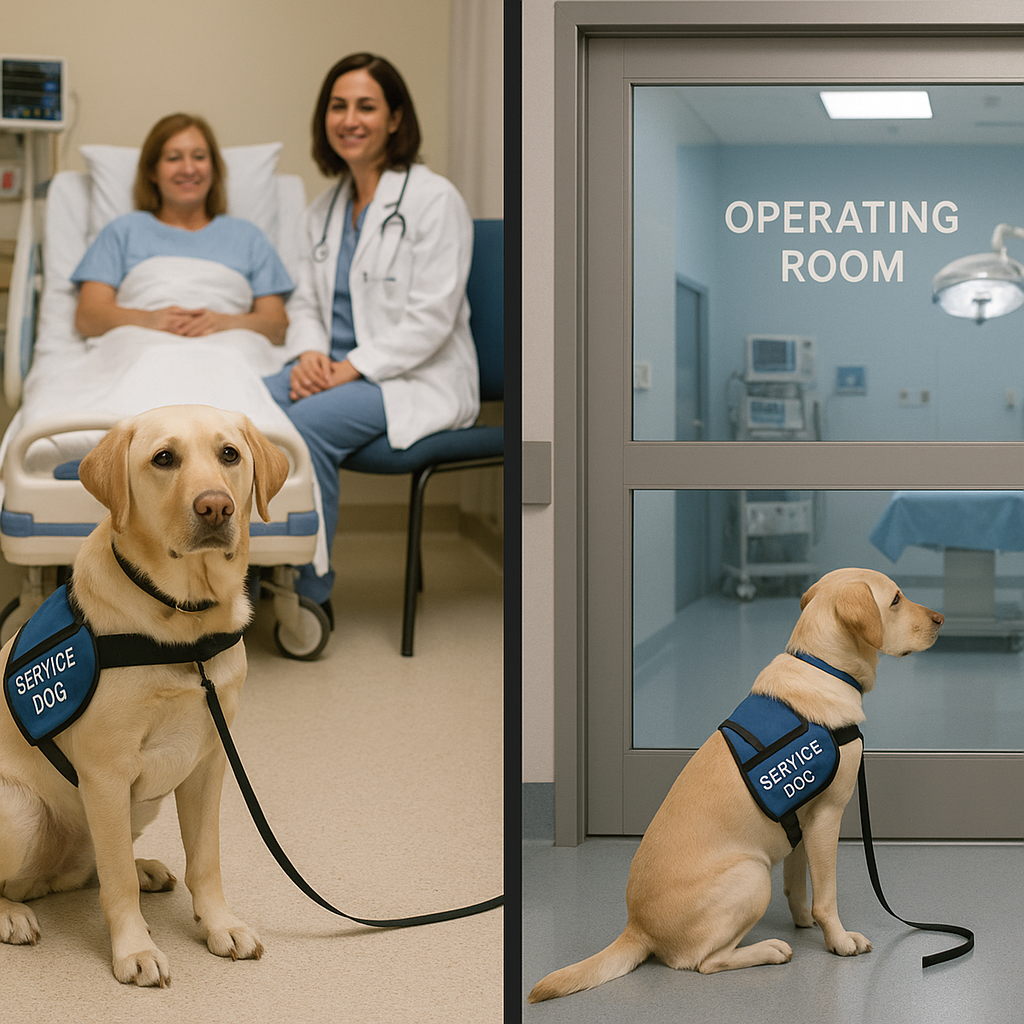
The ADA permits exclusion of service animals in specific circumstances:
Sterile zones in hospitals and similar facilities. Operating rooms, burn units, sterile areas where infection control is critical may exclude service animals. Most hospital areas (waiting rooms, exam rooms, patient rooms, hallways) must accommodate them.
Religious institutions. Religious institutions are generally exempt from ADA public-accommodation requirements. Some choose to accommodate service animals; the ADA does not require them to.
The animal is out of control and the handler does not take effective action. A service dog that is barking, running loose, or otherwise creating disruption can be removed if the handler does not control the situation.
The animal poses a direct threat. A service animal that has actively threatened or attacked others can be excluded. The threshold is "direct threat", not generic concern about the animal's species or breed.
The animal is not housebroken. A service animal that is eliminating in inappropriate places can be excluded.
Specific safety contexts. Some occupational health settings may have specific exclusions; these are narrowly construed.
In all these exclusion contexts, the ADA still requires the business to provide alternative service to the person with the disability.
State and Local Variations
State and local laws sometimes extend protections beyond ADA minimums:
Service-animal-in-training protections. Some states extend public-access rights to service animals in training; others limit to fully-trained working animals.
Service-animal misrepresentation laws. Many states have specific laws criminalising the misrepresentation of pets as service animals. Penalties vary; some states have specific civil penalties, others criminal misdemeanour charges.
Broader categories. Some states extend service-animal-equivalent protections to therapy animals or emotional support animals in specific contexts; others do not.
Housing. The Fair Housing Act covers housing accommodations for service animals and ESAs (the therapy-dogs-vs-esa article covers the housing-rights framework). Housing protections apply alongside the ADA public-access rights.
Employment. Title I of the ADA covers employment-related accommodations including service animals at workplaces.
For specific situations, consulting state-specific resources or disability-rights organisations provides current information.
Etiquette in Public Spaces
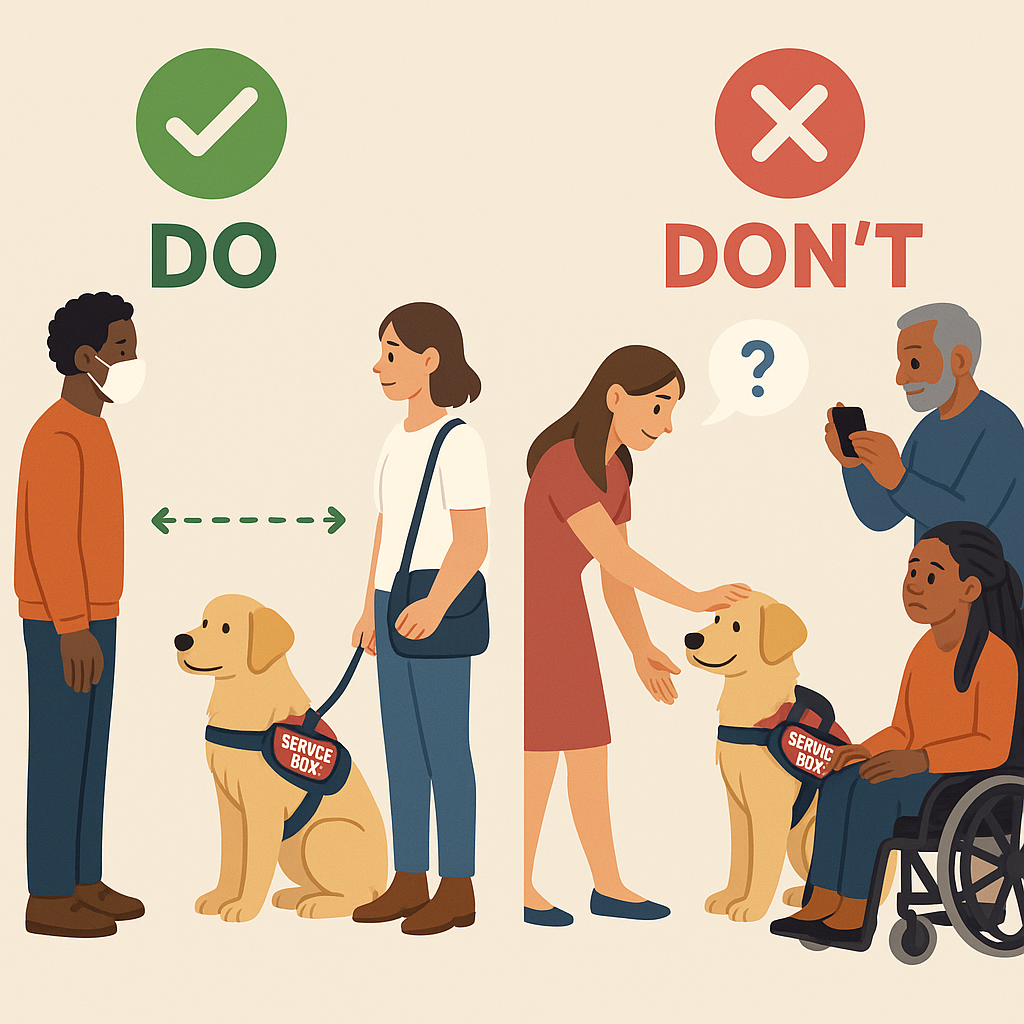
For people interacting with service-dog teams in public:
Do not pet, talk to, or otherwise interact with the dog. A service dog is working when in public; distractions can interfere with the work. The dog may be detecting medical changes, providing balance support, or doing other work that distraction disrupts.
Do not ask the handler about their disability. Many disabilities are not visible; the handler is not obligated to discuss their medical situation. Asking is intrusive.
Do not bring your pet dog into close interaction. Even friendly pet dogs can disrupt service-dog work. Maintain reasonable distance when service-dog teams are present.
Do not photograph or stare. Service-dog teams are not exhibits; they are people doing daily life with assistance.
Do not assume the dog needs help. If the handler appears to need assistance, offer politely; do not assume the dog or handler is in distress.
Educate children. Children often want to interact with service dogs; teaching children that working dogs should not be approached or touched is part of the broader etiquette.
For business owners and staff:
Know the two questions you may ask. Practice asking them. Many access disputes arise from staff demanding documentation or asking inappropriate questions.
Train your staff. ADA compliance is staff-level; consistent staff training prevents incidents.
Do not require ID, certification, or vests. None of these are required.
Charge no extra fees. Service animals are not pets; pet-related fees do not apply.
Plan for the rare exclusion situations. If the animal is genuinely out of control, the response is calm de-escalation rather than confrontational removal.
Misrepresentation and Its Consequences
The misrepresentation of pets as service animals has been a substantial problem (covered in part in the esa-system-abuse article for the ESA category). Service-animal-specific misrepresentation:
- Erodes public trust in service-animal access; makes business interactions more difficult for legitimate teams.
- Triggers regulatory backlash that can affect legitimate access.
- Is illegal in many jurisdictions under specific service-animal-misrepresentation laws.
- Creates safety concerns when untrained pets are presented as service animals (uncontrolled behaviour, lack of public-environment training).
For pet owners considering misrepresenting their pet as a service animal: don't. The harm to people with legitimate need is real, the legal exposure is real, and the alternatives (pet-friendly accommodations, ESA documentation if genuinely applicable, etc.) are available.
What Service-Animal Handlers Should Know
For people with disabilities who use service animals:
You do not need to register or certify. The ADA does not require it; online registries are not legitimate.
You do not need to disclose your disability. Businesses may ask only the two permissible questions.
You may carry documentation if you prefer. Some handlers do, even though it is not legally required, as a courtesy or for ease in border-crossing situations.
Air travel rules differ from public-access rules. Service animals retain federal air-travel protections that ESAs lost in 2021; specific airline procedures apply.
Service-animal-in-training protections vary by state. Verify your state's specific provisions.
Reasonable accommodation, not absolute right. The ADA provides robust public-access rights, not unlimited rights; the exclusion contexts above apply.
What This Does Not Imply
- Service-animal status is automatically conferred by need. The dog must be individually trained to perform specific tasks related to a disability.
- Public access is unlimited. Specific exclusions apply.
- Anyone with documentation is a legitimate handler. Documentation is not required and is not the criterion; the legitimate criterion is genuine task training for a disability.
- State variation produces a uniform picture. It does not; specific state-law context matters.
What Is and Is Not Settled
Settled: service animals have robust public-access rights under the ADA; documentation and certification are not federally required; the two-questions framework limits permissible business inquiries; specific exclusions apply (sterile zones, religious institutions, out-of-control or threatening animals, non-housebroken animals); misrepresentation is illegal in many jurisdictions and erodes legitimate access[^ada][^avma].
Not settled (in this article): broader policy questions about optimal verification frameworks; the relative effectiveness of state misrepresentation laws.
Key Takeaways
- Service animals (under the ADA) have broad public-access rights in places of public accommodation.
- Businesses may ask only two questions: is the animal a service animal required because of a disability, and what work or task has the animal been trained to perform.
- Documentation, certification, and registration are not required; online registries are not legitimate.
- Specific exclusions: sterile zones, religious institutions, out-of-control animals, animals posing a direct threat, non-housebroken animals.
- Etiquette: do not interact with working service dogs, do not ask about the handler's disability, do not bring pets into close interaction, train staff in the ADA framework.
- Misrepresentation hurts people with legitimate need and is illegal in many jurisdictions.
Sources & further reading
- U.S. Department of Justice, Civil Rights Division. ADA Service Animals FAQ. U.S. Department of Justice. https://www.ada.gov/resources/service-animals-faqs/
- American Veterinary Medical Association. AVMA Service, Emotional Support, and Therapy Animals Policy. American Veterinary Medical Association. https://www.avma.org/resources-tools/avma-policies/service-emotional-support-and-therapy-animals