What Alpha Theory Claims
The alpha-theory framework, popularised through television-trainer media and persisting in some training communities, claims that:
- Dogs operate in strict linear dominance hierarchies, like wolf packs.
- Within multi-dog households, dogs work to establish their position in the hierarchy.
- Within human-dog relationships, dogs are constantly trying to establish themselves as "alpha" over the human.
- The owner must therefore "establish themselves as the alpha" through assertive behaviours: eating before the dog, going through doorways first, "alpha rolls" (forcing the dog onto its back), and dominance-based corrections.
- Behaviour problems are interpreted as the dog "asserting dominance" and require a dominance-based response.
The framework has substantial cultural traction. It has also been comprehensively discredited by the empirical-research and veterinary-behaviour establishment over the past 25 years.
Why It Is Wrong — The Wolf-Research Story
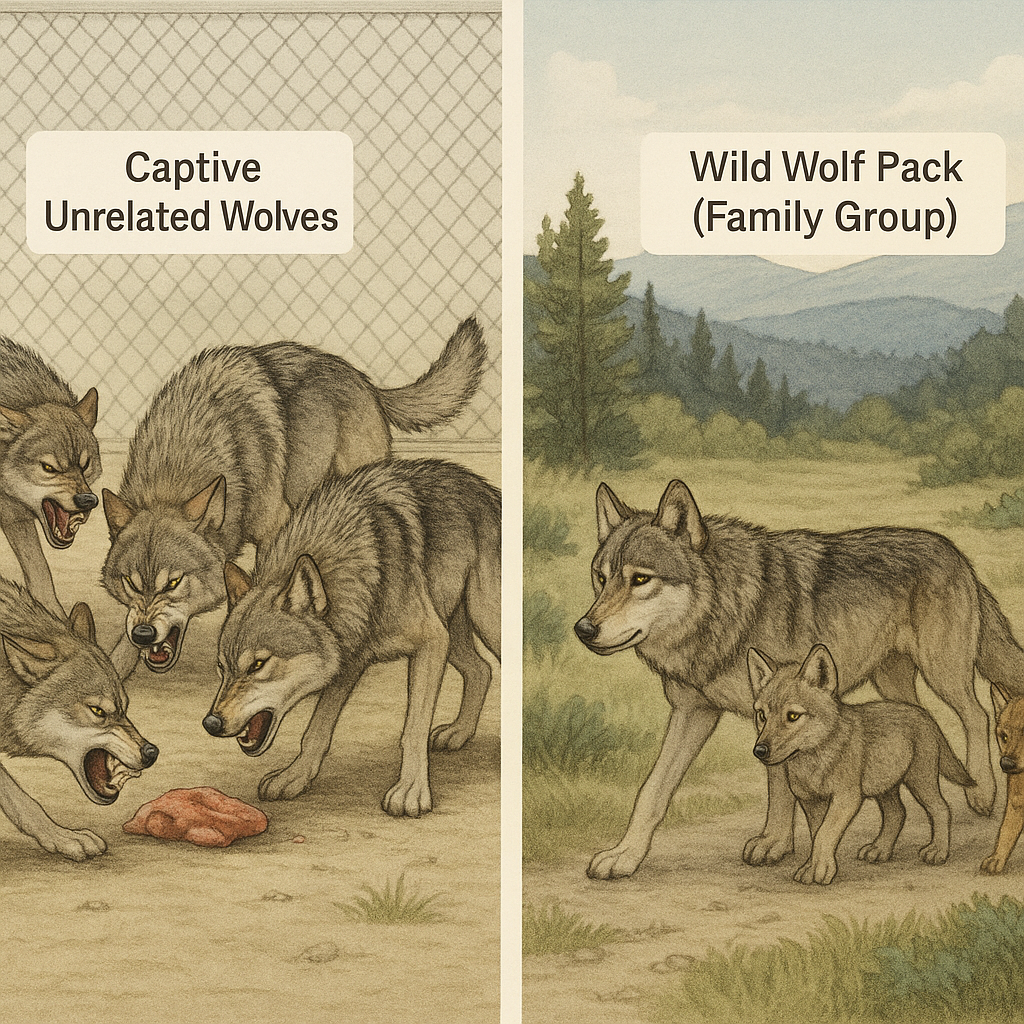
The alpha framework has its origin in early-to-mid 20th century wolf research. Studies of captive unrelated wolves placed in artificial groups (as in zoos or research facilities) showed apparent linear-dominance patterns — specific wolves displaced others from food and resting spaces; specific wolves consistently won conflicts. The "alpha wolf" terminology described the consistently-winning individual.
L. David Mech, one of the most influential wolf researchers of the 20th century, popularised the alpha-wolf framework in his 1970 book The Wolf. The framework spread from wolf science to dog-training communities, with the additional claim that dogs (descended from wolves) inherit and operate by the same dynamics.
Subsequent decades of research on wild wolf packs produced a different picture. Mech and others observed that wild wolf packs are not collections of unrelated competitors; they are family groups. Typical structure: a breeding pair (mother and father) plus their pups from the past 1-3 years. The "alpha" wolves are the parents; the rest are their offspring at varying ages. The dynamics are not dominance-driven competition; they are family-leadership dynamics, parents-leading-children.
Mech has subsequently and repeatedly written that the alpha framework as it was popularised is a misframing of wolf social structure. He has specifically requested that publications drop the alpha terminology; his position on this is unambiguous and longstanding.
The original framework was not entirely wrong about the captive-unrelated-wolf situation — those wolves did show apparent dominance patterns. The mistake was extrapolating the captive-unrelated-wolf situation to describe normal wolf behaviour, and from there to dogs.
Why It Is Wrong — The Dog-Specific Story
Even if the alpha framework accurately described wolf behaviour (which it does not), applying it to dogs would still be problematic. Dogs are not wolves:
Domestication has notably altered dog behaviour. The dog and the wolf shared a common ancestor 15,000-40,000+ years ago. Dogs have been selectively bred for thousands of generations under conditions that produced substantial behavioural differences from wolves. Dogs are generally more social, less aggressive toward humans, and behave differently in group contexts.
Free-ranging and feral dogs do not form alpha-led packs. Field research on free-ranging and feral dog populations shows loose social aggregations rather than wolf-pack structures. Cooperative pack hunting is rare or absent; feeding is largely individual; reproductive structure is different from wolves.
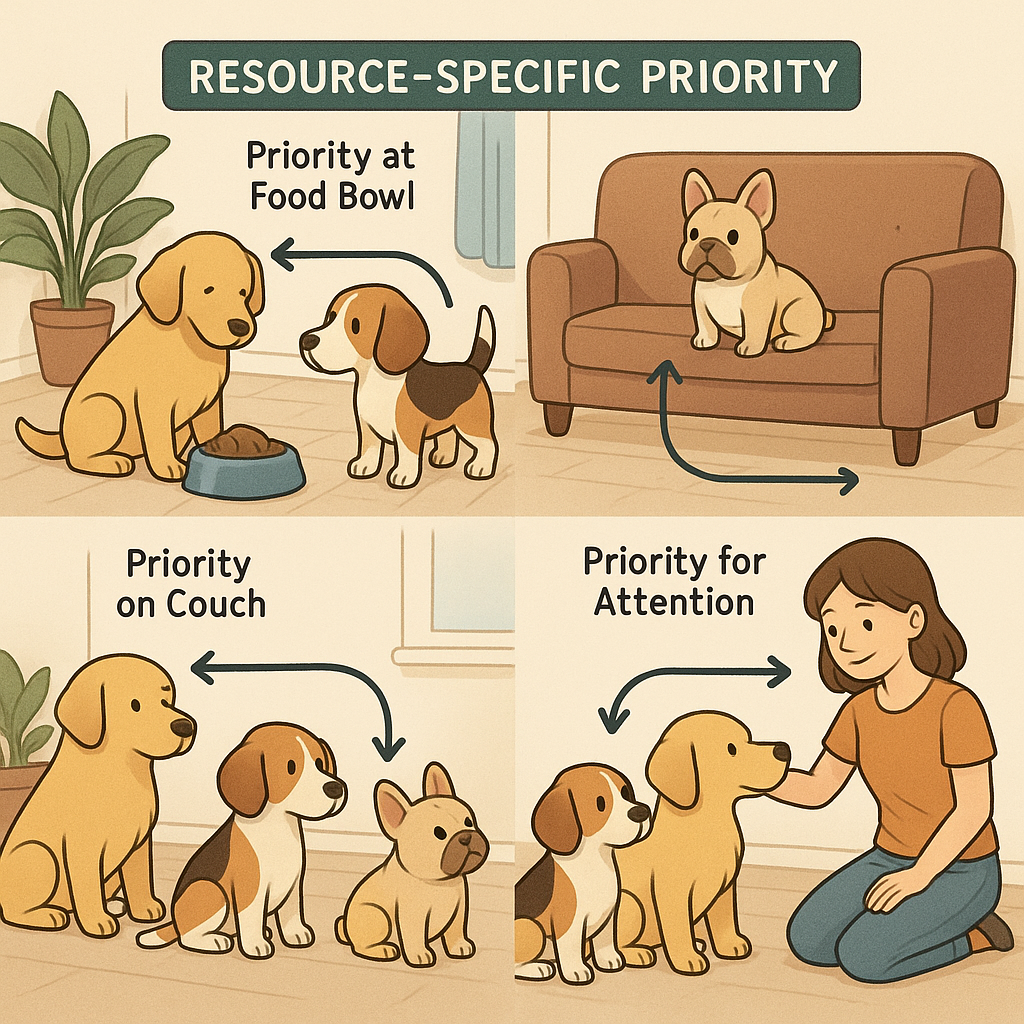
Multi-dog household research shows flexible hierarchies, not strict ones. Bradshaw and others have studied multi-dog household dynamics and found that priority-of-access patterns vary by resource, by context, and over time. Specific dogs may have priority for specific resources but not others; the priority can change with circumstances. The pattern is relationship-based and context-dependent, not a fixed linear hierarchy.
Dog-human relationships are interspecies relationships, not pack relationships. Dogs do not view their human family as a wolf pack with leadership roles to compete for. The human-dog relationship is more accurately described in attachment-relationship terms (covered in strange-situation-test article) than in pack-hierarchy terms.
The empirical picture: alpha theory does not describe dog social behaviour, dog-human relationships, or wolf social behaviour. It is a comprehensively discredited framework.
Why "Establishing Dominance" Doesn't Work
The training-and-management implications of the alpha framework — eating before the dog, going through doors first, alpha rolls, harsh corrections for "challenges to authority" — produce welfare costs without behavioural benefit:
The dog is not trying to dominate the household. A dog who jumps on people, pulls on leash, or refuses to come when called is not asserting dominance; they are showing untrained behaviour or unmet needs. Treating untrained behaviour as a dominance challenge produces wrong responses.
Aversive corrections produce welfare costs and side effects. The empirical literature on aversive training (covered in shock-collar-evidence, ethics-equipment-prong-collars, and AVSAB humane-training position) shows substantial welfare costs and elevated rates of associated problem behaviour, without superior outcomes compared to positive-reinforcement methods.
Alpha rolls and similar physical interventions are dangerous. Forcing a dog onto its back as a "submission" is not a wolf-derived natural behaviour the dog will recognise; it is a human aversive intervention that produces fear, defensive aggression, and erosion of trust.
The behaviour problem is not addressed. The dog who pulls on leash, jumps on people, or guards resources has specific issues that require specific behavioural interventions. Treating the issues as dominance challenges does not address them; the issues persist.
The veterinary-behaviour establishment has comprehensively rejected dominance-based training. The AVSAB position on dominance theory in dog training is unambiguous; the AAHA, ASPCA, APDT, and broader practitioner reference body share the position.
What Multi-Dog Households Actually Look Like
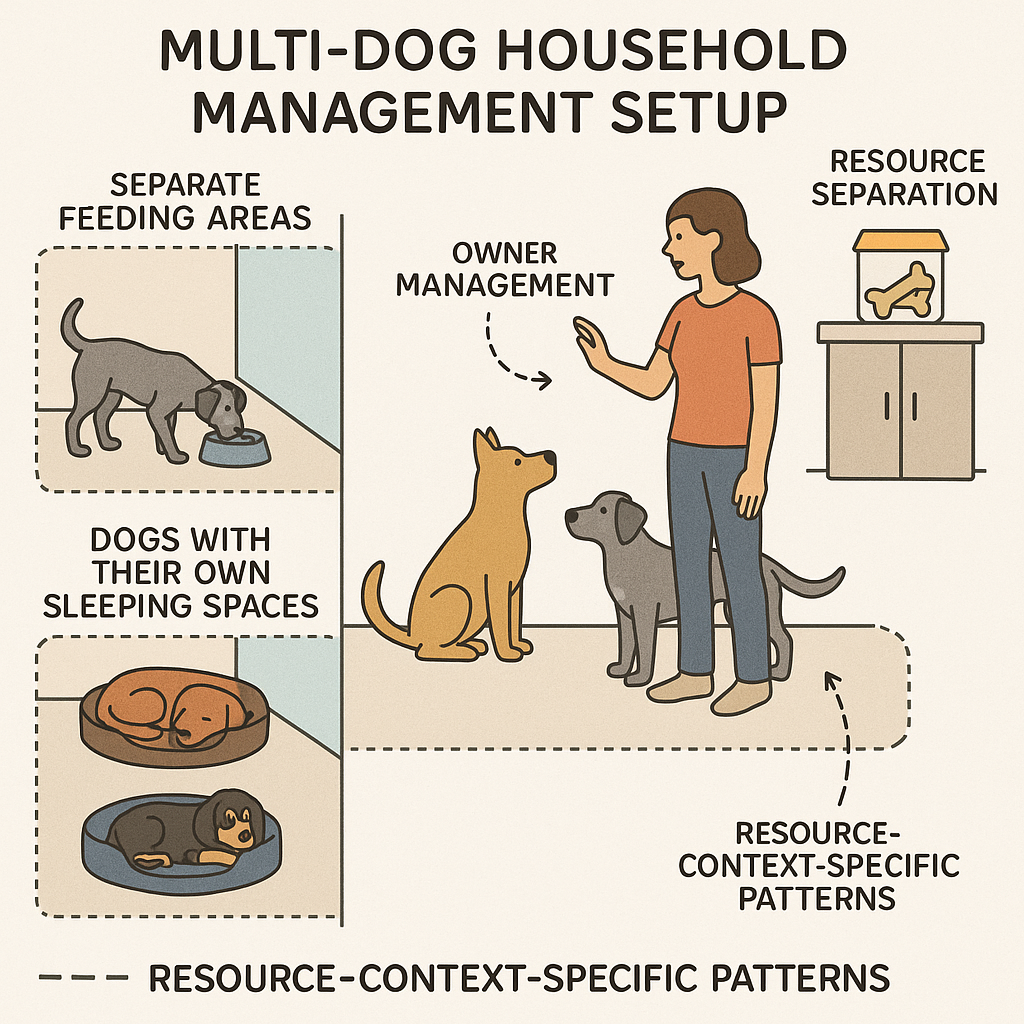
A workable framework for multi-dog dynamics:
Resource-context-specific priority patterns. Specific dogs may have priority for specific resources (a specific sleeping spot, the highest-value chew, attention from a specific household member). The priority is flexible, can change, and is not a single global hierarchy.
Relationship-based interactions. Dogs in multi-dog households have specific relationships with each specific other dog. Some pairs are close friends; others tolerate each other; others have conflict points around specific resources or contexts.
Owner management as the integrating force. The owner's role is to manage resources, prevent unnecessary conflict, support healthy interactions, and address specific issues that arise. This is not "being the alpha"; it is being the household manager.
Flexibility over time. Dogs change as they age, as new members join the household, as health changes, and as circumstances change. The household structure adapts.
Resource separation for prevention. Multi-dog feeding (covered in multi-dog-feeding article), separate sleeping areas, separation during high-value chews — these prevent conflict around the resources that produce most multi-dog tension.
What Owners Should Actually Do
Practical multi-dog management:
Provide structure, not dominance. Predictable routines, clear cues, consistent expectations. The dogs benefit from knowing what to expect, not from being dominated.
Manage resources to prevent conflict. Separate feeding, separate high-value items, supervised attention distribution. Most multi-dog conflicts are about resources; managing access reduces incidents.
Train each dog individually. Solid individual training supports household harmony better than group-based dominance approaches. A dog with reliable cues can be managed in multi-dog contexts; a dog without them cannot.
Address conflicts when they arise. Signs of escalating conflict (warning signals, specific avoidance patterns, resource competition) warrant attention. Veterinary-behaviourist consultation is appropriate for serious cases.
Recognise individual relationships. Each pair of dogs in the household has its own relationship; understand the specific dynamics rather than imposing a generic framework.
Avoid forcing interactions. Dogs who do not want to interact at a particular moment should not be forced to. Choice and space contribute to healthy relationships.
What This Does Not Imply
- Multi-dog households are unmanageable. They are not; appropriate management produces good outcomes.
- Dogs do not have any social-priority patterns. They do; the patterns are just flexible and resource-context-specific rather than fixed linear hierarchies.
- The owner has no leadership role. The owner has a household-management role; calling this "leadership" is reasonable as long as it does not entail dominance-based interventions.
What Is and Is Not Settled
Settled: the alpha-theory framework as applied to wolves and dogs is comprehensively discredited (Mech's own later work; AVSAB position; Bradshaw 2011 and broader practitioner-academic synthesis); dominance-based training produces welfare costs without behavioural benefit; multi-dog social structures are flexible, relationship-based, and resource-context-specific[^avsab][^bradshaw].
Not settled (in this article): the optimal household-management protocols across the spectrum of multi-dog dynamics; specific intervention frameworks for severe multi-dog conflict.
Key Takeaways
- The alpha-theory framework is empirically discredited; the original wolf research described captive unrelated wolves, not normal wolf behaviour, and Mech (the original popularizer) has subsequently disowned the framework.
- Dogs are not wolves; even if alpha theory described wolves, applying it to dogs would still be wrong.
- Free-ranging dog research shows loose social aggregations, not wolf-pack-style hierarchies.
- Multi-dog household research shows flexible, resource-context-specific priority patterns, not linear dominance hierarchies.
- "Establishing dominance" through assertive interventions produces welfare costs without behavioural benefit; aversive corrections are widely rejected by the modern veterinary-behaviour establishment.
- Practical multi-dog management: provide structure not dominance, manage resources to prevent conflict, train each dog individually, address conflicts when they arise, recognise individual relationships, avoid forcing interactions.
Sources & further reading
- American Veterinary Society of Animal Behavior. (2008). AVSAB Position Statement on the Use of Dominance Theory in Behavior Modification of Animals. AVSAB. https://avsab.org/resources/position-statements/
- Bradshaw, J.. (2011). Dog Sense: How the New Science of Dog Behavior Can Make You a Better Friend to Your Pet. Basic Books. https://www.johnbradshaw.com/
- Mech, L. D.. (1999). Alpha status, dominance, and division of labor in wolf packs. Canadian Journal of Zoology, 77(8), 1196-1203. https://doi.org/10.1139/z99-099