What Determines a Dog's Coat
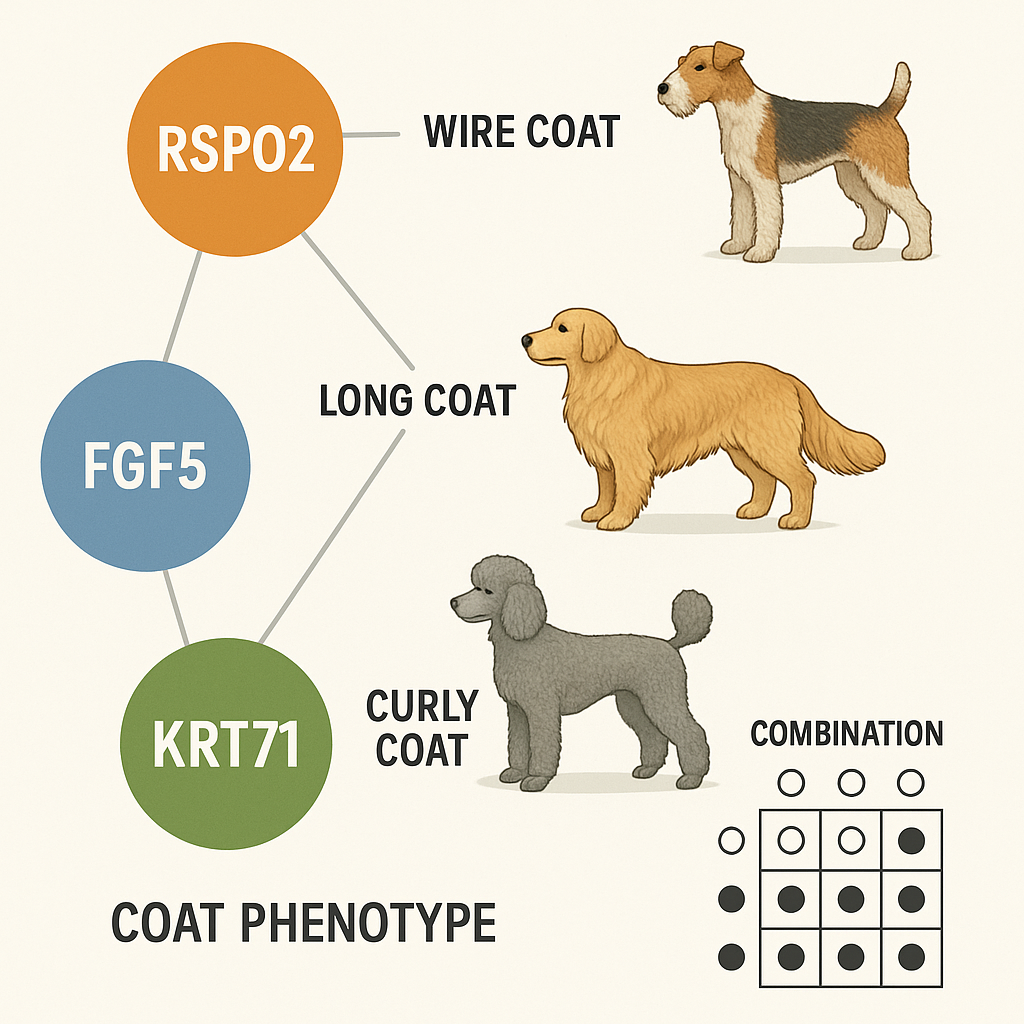
The molecular genetics of canine coat type has been worked out at the variant level over the past 15 years. Cadieu and colleagues' 2009 work in Science identified the three main genes producing most of the variation across modern breeds[^cadieu]:
- RSPO2 (R-spondin 2). A specific variant produces the wire coat with eyebrows and moustache (terriers, schnauzers, wirehaired pointers).
- FGF5 (Fibroblast Growth Factor 5). A specific variant produces long coat (Golden Retrievers, Collies, Cocker Spaniels).
- KRT71 (Keratin 71). A specific variant produces curly coat (Poodles, Portuguese Water Dogs, Bichons).
The three variants combine to produce a 2x2x2 = 8-way combination space, mapping closely to the major coat phenotypes seen across modern breeds. Most coat variation across breeds is explained by these three genes and a few smaller-effect variants (length, density, undercoat presence).
The coat type is not an arbitrary breed feature; it is genetically determined and produces specific functional consequences for grooming, shedding, weather tolerance, and skin health.
The Major Coat Types and Their Grooming Needs
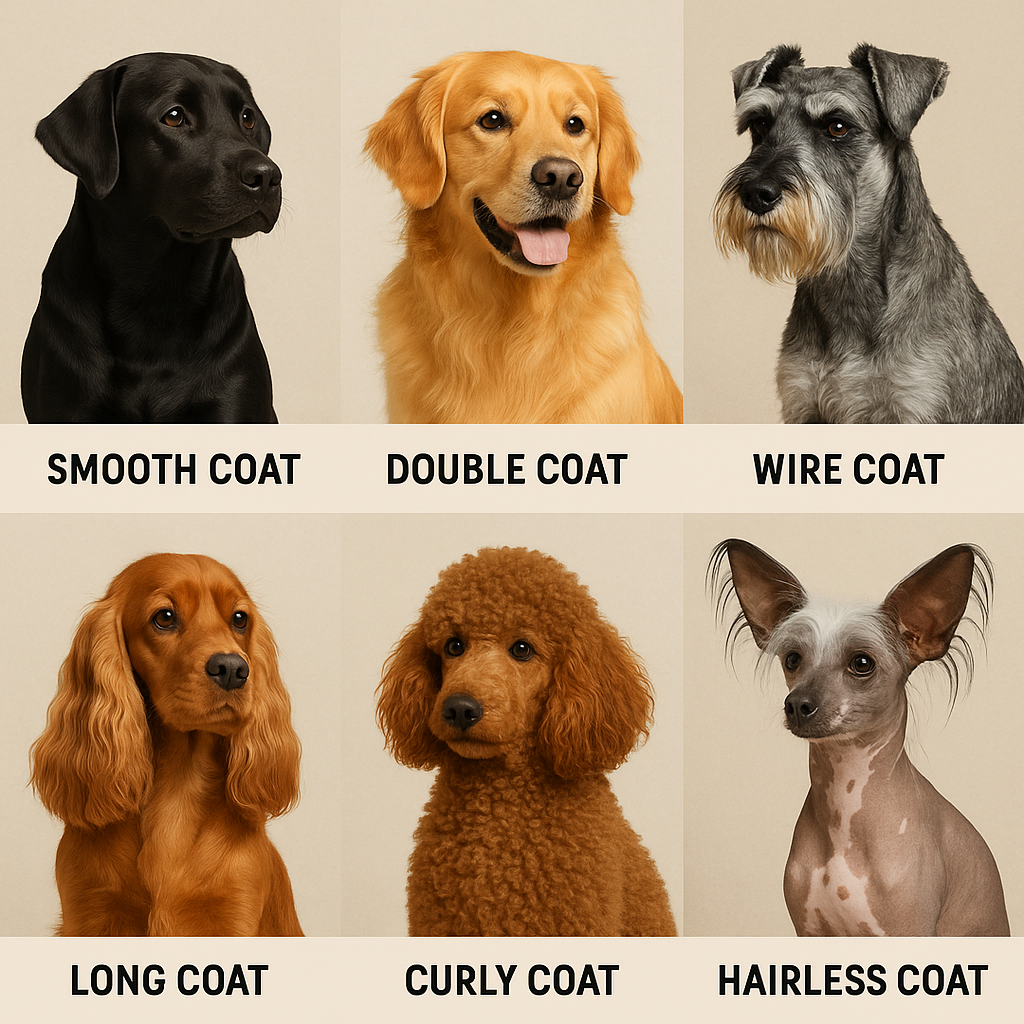
Smooth coat (short, single-layer or thin double-layer). Examples: Greyhound, Whippet, Doberman, Boxer, Beagle, Dalmatian, Labrador (smooth-coat type), German Shorthaired Pointer.
- Grooming: weekly brushing with a rubber curry brush or grooming mitt. The hair is short and does not mat.
- Shedding: continuous low-to-moderate; some breeds (Labradors) shed more than appearances suggest.
- Bathing: every 1-2 months as needed.
- Special considerations: thin-coated breeds need cold-weather management (jackets, limited cold exposure); some are sun-sensitive.
Double coat (dense undercoat plus protective topcoat). Examples: Labrador (double-coat type), Golden Retriever, German Shepherd, Husky, Akita, Border Collie, Bernese Mountain Dog, Saint Bernard.
- Grooming: weekly brushing during low-shed periods; daily during seasonal shedding.
- Shedding: heavy seasonal shedding ("blowing coat") in spring and fall, with continuous moderate shedding year-round.
- De-shedding tools (Furminator-type) and slicker brushes are useful during heavy shedding.
- Bathing: every 6-12 weeks; over-bathing can damage the coat.
- Critical: never shave the double coat. The double coat regulates temperature in both heat and cold; shaving disrupts this and can produce coat-growth abnormalities. The myth that shaving keeps double-coated dogs cool is the opposite of true.
Wire coat (rough, harsh outer coat). Examples: Wire Fox Terrier, Schnauzer, Border Terrier, Wirehaired Pointing Griffon, Airedale Terrier.
- Grooming: hand-stripping every 3-6 months for show coat; clipping for pet maintenance (clipping over time changes the coat texture and softens it).
- Brushing: weekly to prevent tangles.
- Shedding: minimal compared to many other coat types; wire-coated dogs are often (incorrectly) called "hypoallergenic" — they shed less but allergens are still produced.
- Special considerations: hand-stripping is a learned skill; pet owners typically use professional groomers familiar with the breed.
Long coat (single or double, with extended hair length). Examples: Cocker Spaniel, Cavalier King Charles, Maltese, Yorkshire Terrier, Afghan Hound, Lhasa Apso, Shih Tzu.
- Grooming: daily brushing to prevent matting. This is non-negotiable for many long-coated breeds; matting develops within days without consistent brushing.
- Bathing: every 2-4 weeks, with appropriate conditioner.
- Professional grooming: typically every 6-8 weeks for trimming, sanitary care, ear cleaning.
- Special considerations: matting is painful and produces skin problems; severe matting requires shaving, which is welfare-relevant. Owners who cannot commit to daily brushing should consider keeping the coat shorter.
Curly coat. Examples: Poodle (all sizes), Portuguese Water Dog, Bichon Frise, Lagotto Romagnolo, Spanish Water Dog.
- Grooming: daily brushing to prevent matting; the curly hair tangles into mats easily.
- Bathing: every 3-4 weeks with conditioner.
- Professional grooming: every 4-6 weeks for clipping and shaping.
- Shedding: minimal (the curly coat retains shed hair within the coat structure, requiring brushing to remove it).
- Special considerations: regular grooming is essential; the coat does not self-maintain. Owners who do not commit to the grooming routine end up with severely matted dogs requiring shaving.
Hairless and sparse-coat. Examples: Chinese Crested, Xoloitzcuintli (Mexican Hairless), American Hairless Terrier.
- Grooming: skin care rather than coat care. Sun protection, moisturising, regular bathing for skin oils.
- Special considerations: temperature sensitivity (no insulation); skin-condition susceptibility.
Common Owner Mismatches
A few patterns where owners and coats are mismatched:
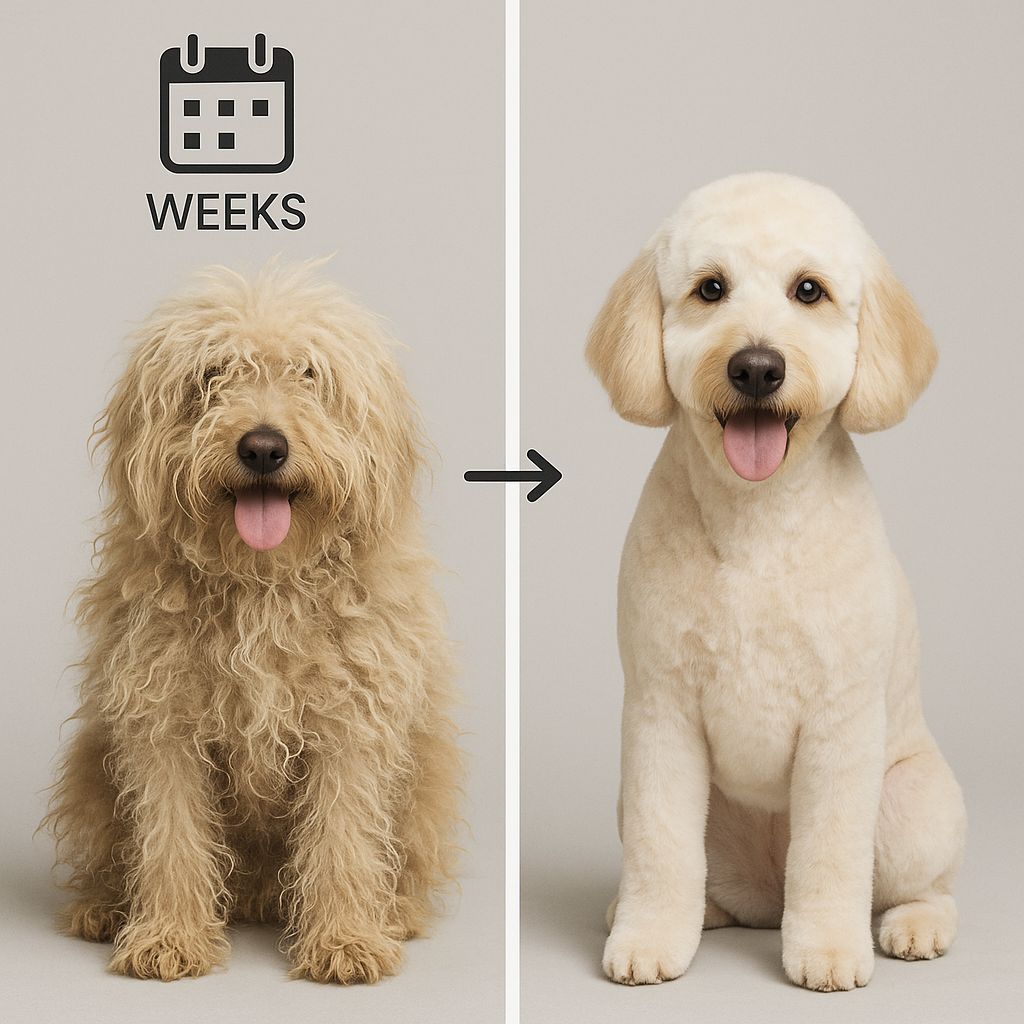
The "looks easy" mismatch. A first-time owner falls for a Cocker Spaniel based on looks without realising the coat needs daily brushing plus 6-8-week professional grooming. After several months, the dog has matting, ear infections, and the owner is overwhelmed. The realistic option is keeping the coat shorter than the breed standard via routine clipping, accepting the change in look in exchange for manageable maintenance.
The "shave for summer" mismatch. Owners shaving double-coated dogs (Huskies, Goldens, German Shepherds) thinking it will cool them. The double coat does not work that way; shaving disrupts the temperature regulation, can damage the coat permanently, and exposes the skin to sunburn and other issues. Heavy shedding management, swimming, and shade are the appropriate cooling approaches.
The "hypoallergenic" misframing. Some breeds (Poodles, Portuguese Water Dogs, certain Doodle crosses, wire-coated terriers) are marketed as hypoallergenic. Most allergen reactions to dogs are to dander and saliva, not to hair itself; "low-shed" breeds may produce fewer airborne allergens but they are not hypoallergenic in any absolute sense. People with severe allergies should test exposure with the specific dog before commitment.
The "self-grooming" assumption. No domestic dog coat self-maintains adequately. Even smooth-coat breeds benefit from regular brushing; long, curly, and wire coats absolutely require routine maintenance.
Practical Owner Choices
Before adopting a specific breed, the realistic grooming commitment matters:
- Daily brushing willing? Long, curly, double-coat seasonal-shed-heavy breeds are options.
- Weekly brushing only? Smooth-coat breeds, double-coat breeds with occasional season-long management.
- Professional grooming budget for every 4-8 weeks? Long, curly, wire-coat breeds become viable.
- Minimal grooming engagement? Smooth-coat breeds; some sparse-coat or short-double-coat breeds.
The mismatch between the breed's grooming requirements and the owner's actual willingness to do them is one of the most common reasons for "I love my dog but the coat is too much" complaints. The realistic option is matching the breed to the lifestyle; the secondary option is professional grooming compensating for owner-time limits.
What This Does Not Imply
- Coat genetics is fully solved. The three-gene framework explains most variation; some details remain.
- Mixed-breed coats are predictable. They follow Mendelian patterns from the parents but can produce unexpected combinations; coat genetic testing is available for some applications.
- Hypoallergenic breeds cure allergies. They do not; reduced-allergen exposure is helpful for some allergic individuals but not universally protective.
What Is and Is Not Settled
Settled: three main genes (RSPO2, FGF5, KRT71) explain most canine coat-type variation (Cadieu et al. 2009 and succeeding work)[^cadieu]; the practical grooming requirements follow from coat type and are well-characterised across breeds; double coats should not be shaved; matting is a welfare issue requiring proactive management.
Not settled: optimal grooming protocols for specific cross-breed coat combinations; the comparative effectiveness of specific de-shedding tools across coat types.
Key Takeaways
- Three main genes (RSPO2, FGF5, KRT71) produce most canine coat-type variation (Cadieu 2009).
- Major coat types: smooth, double, wire, long, curly, hairless — each with different grooming requirements.
- Double coats should not be shaved; the coat regulates temperature in both heat and cold.
- Long and curly coats require daily brushing plus professional grooming every 4-8 weeks; failure to maintain produces welfare-relevant matting.
- "Hypoallergenic" is misleading; low-shed breeds reduce but do not eliminate allergen exposure.
- Match the coat to the lifestyle; the most common owner-coat mismatch produces avoidable welfare and frustration issues.
Sources & further reading
- Cadieu, E.; Neff, M. W.; Quignon, P.; Walsh, K.; Chase, K.; Parker, H. G.; VonHoldt, B. M.; Rhue, A.; Boyko, A.; Byers, A.; Wong, A.; Mosher, D. S.; Elkahloun, A. G.; Spady, T. C.; André, C.; Lark, K. G.; Cargill, M.; Bustamante, C. D.; Wayne, R. K.; Ostrander, E. A.. (2009). Coat variation in the domestic dog is governed by variants in three genes. Science, 326(5949), 150-153. https://doi.org/10.1126/science.1177808
- American Kennel Club. AKC Breed Coat Standards. American Kennel Club. https://www.akc.org/
- World Small Animal Veterinary Association. WSAVA Global Guidelines. World Small Animal Veterinary Association. https://wsava.org/global-guidelines/