The Conformation in Question
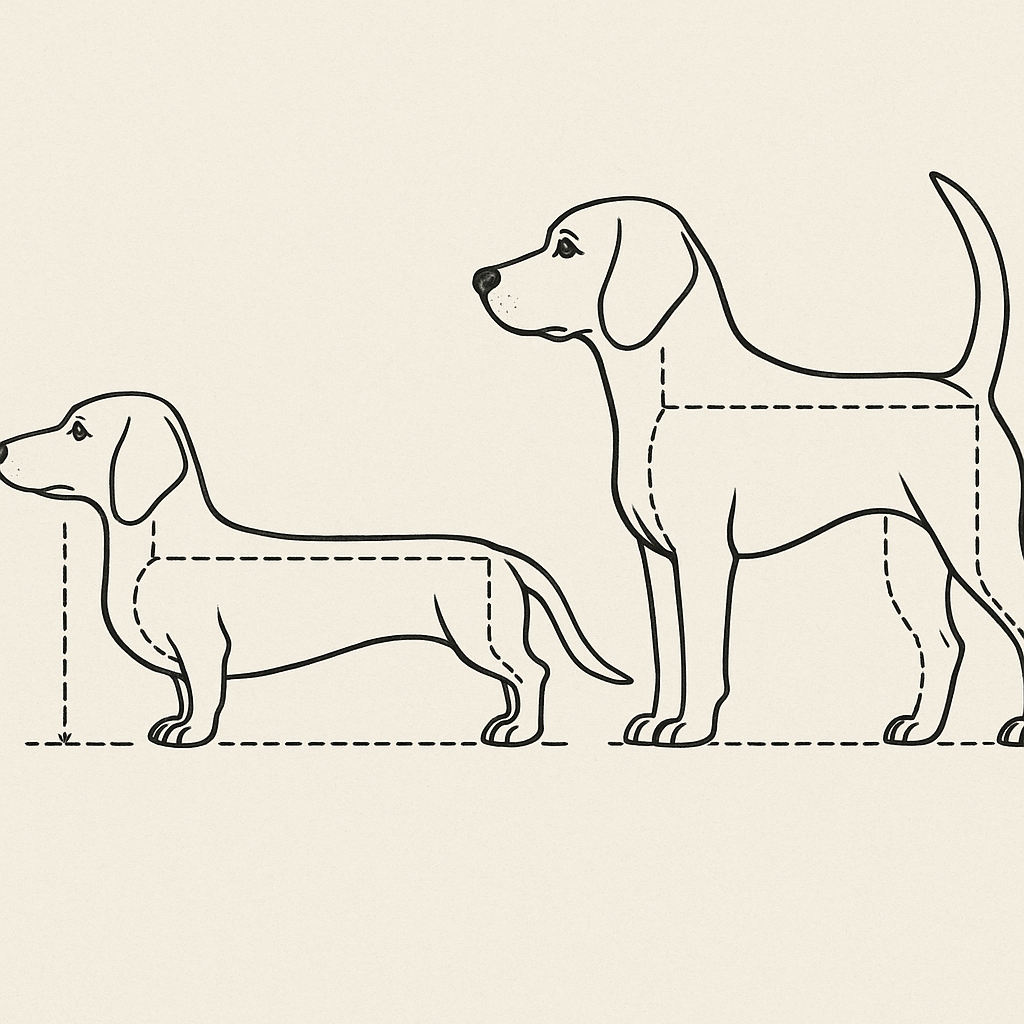
The dachshund breed standard (across major kennel clubs) describes a dog with:
- Disproportionately short legs relative to body length.
- Elongated body with a long back and deep chest.
- Specific gait described as "efficient with good reach and drive" — meaning the dog should move with the rhythmic forward-and-back leg extension that characterises efficient quadrupedal locomotion in dogs of normal proportions.
- Specific topline — a level back without sagging or arching.
The "long and low" silhouette is the breed's defining feature. It is not an accident of breeding; it is the explicit goal of the standard. Without this conformation, the dog is not recognisably a dachshund.
The standard also requires the dog to move "well" — efficiently, with good motion, with appropriate reach. This is where the paradox emerges: the conformation that produces the iconic look produces structural compromises that make truly efficient locomotion difficult, and produces health vulnerabilities that affect the dog's welfare across their life.
The Underlying Genetics — FGF4 Retrogene
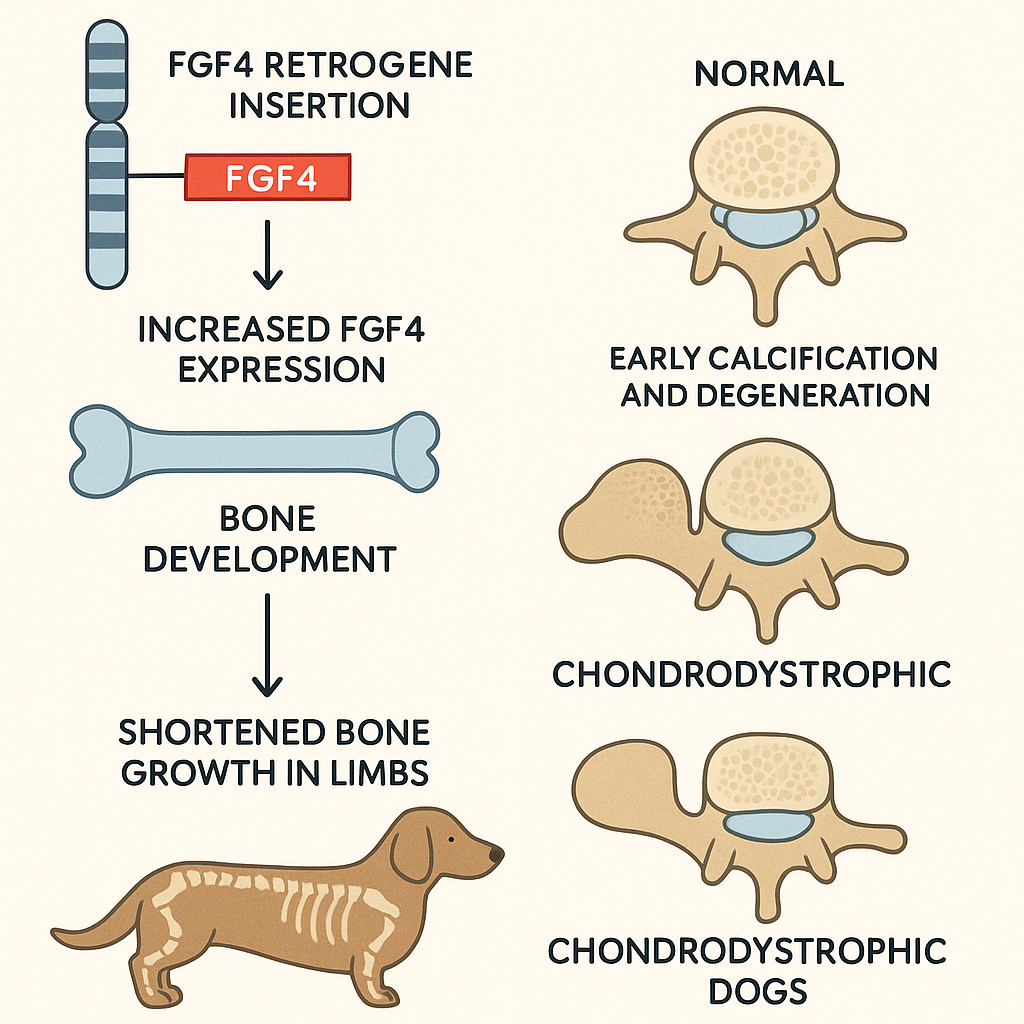
The genetic basis of the dachshund's conformation has been worked out over the past two decades. Parker et al. (2009) and ensuing work, notably Brown et al. (2017), identified that the chondrodystrophic phenotype across multiple short-legged breeds (dachshunds, basset hounds, corgis, Pekingese, Shih Tzus, French Bulldogs, others) is driven by retrogene insertions of the FGF4 (fibroblast growth factor 4) gene on chromosome 18 (chondrodysplasia in some breeds) and chromosome 12 (chondrodystrophy in dachshunds and others)[^parker][^brown].
The FGF4 retrogenes increase FGF4 expression during development, which alters bone growth. The result is the disproportionately short legs.
Critically, the same genetic mechanism that produces the short legs is also associated with the early disc degeneration that leads to intervertebral disc disease (IVDD). The disc material in chondrodystrophic dogs undergoes early calcification and is more prone to extrusion than the disc material in non-chondrodystrophic dogs. The Bannasch group at UC Davis has characterised the IVDD-FGF4 association in detail. The dachshund's elevated IVDD risk — roughly 1 in 4 dachshunds shows clinical IVDD across their lifetime, with appreciably higher rates of subclinical disc calcification — is a direct consequence of the genetic mechanism that produces the conformation.
The conformation and the disease are not independent risks that happen to coexist in the breed. They are linked by shared genetic basis. Selecting for one selects for the other.
Why the "Good Gait" Requirement Is Part of the Paradox
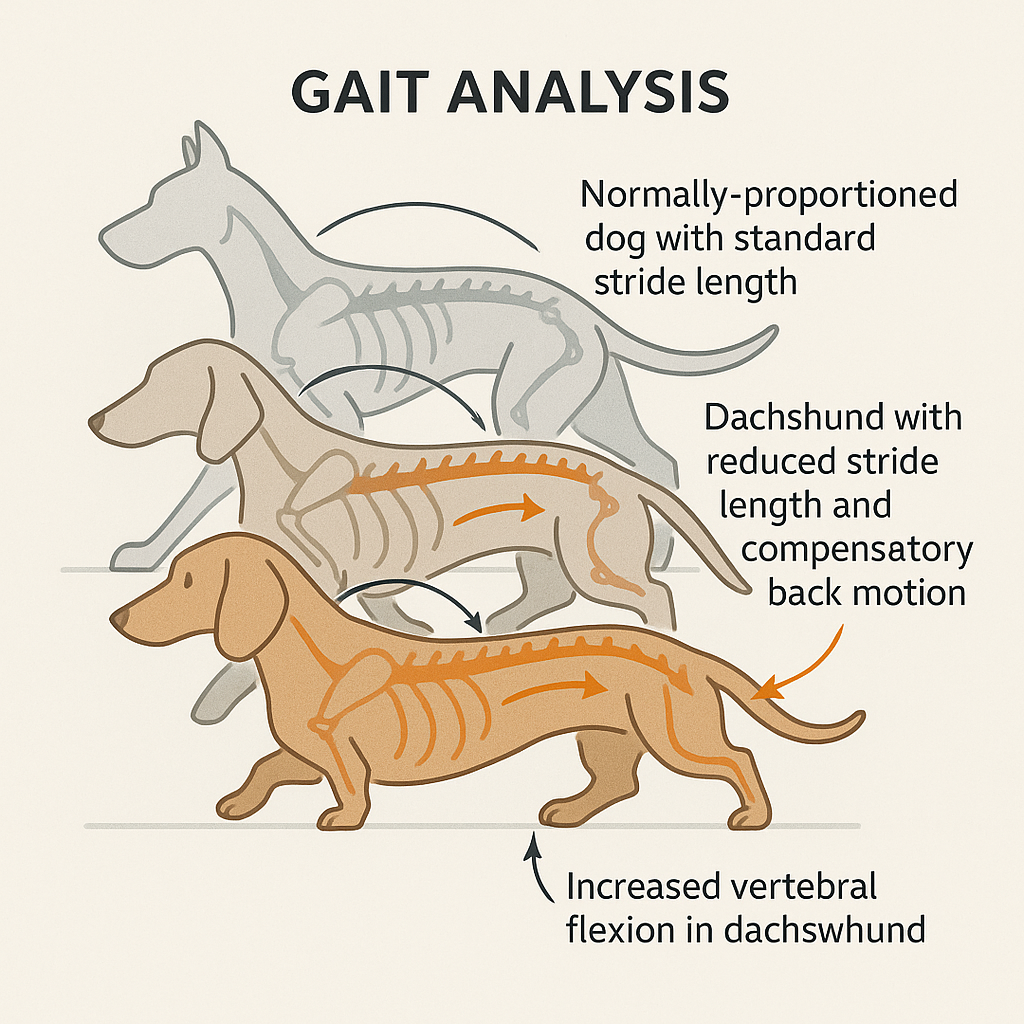
The breed standard requires efficient gait. The conformation produces:
- Reduced stride length because of the short legs.
- Compensatory back motion to make up for the reduced leg reach — the dog moves their body more than a typical dog because they have less leg to move.
- Increased vertebral motion during gait because of the long back and the compensatory body motion.
- Mechanical loading on the back that exceeds what the spine of a normally-proportioned dog experiences during equivalent activity.
The "free-flowing gait" of the standard is achieved partly by selecting against the most exaggerated forms of the conformation (extremely short legs, extremely long backs would impede gait further). But the conformation that makes the dog recognisable as a dachshund is fundamentally not a conformation built for efficient long-distance locomotion. It is a hunting-and-burrowing conformation, optimised for a specific work context, generalised to a companion-pet role where the work context no longer applies.
The "paradox" — wanting both the iconic conformation and good gait, both desirable in the breed standard, both at tension with each other — is a structural feature of the breed, not a problem with the standard's writers.
The Health Cost
Beyond IVDD, the dachshund's conformation produces several health vulnerabilities:
- Spinal disease. The most prominent. IVDD, vertebral instability, and chronic spinal disease across the lifespan.
- Patella luxation. More common in toy and small breeds with conformation extremes.
- Joint disease. Modified joint loads from the disproportionate proportions.
- Obesity sensitivity. A long-backed dog with limited spinal reserve is particularly vulnerable to weight-related orthopedic problems; even modest excess weight has outsized mechanical consequences.
- Reproductive complications. Dystocia is more common in some short-legged breeds.
The cumulative welfare impact is real. An average dachshund will likely have at least one significant orthopedic event in their life; many will have more.
What Owners and Breed Communities Can Do
The conformation is genetically embedded; eliminating the chondrodystrophic phenotype would mean eliminating the breed. But several intermediate steps reduce the welfare cost:
For owners of dachshunds:
- Strict weight management. Lean body condition (BCS 4-5/9) substantially reduces orthopedic risk. The body-condition-scoring article covers BCS.
- Avoidance of jumping from furniture and stairs. Mechanical events that load the spine acutely are common precipitants of IVDD; ramps reduce the risk.
- Awareness of early IVDD signs. Early recognition matters considerably for outcome (covered in the IVDD article).
- Genetic testing. FGF4-related testing is available and identifies dogs at elevated IVDD risk; this informs breeding decisions and household management.
For breed communities and breeders:
- Selecting against extreme conformations within the breed. Even within the dachshund standard, dogs vary in how exaggerated the proportions are. Selecting against the most extreme phenotypes within the breed range reduces health cost.
- Health-screening breeding stock. Hip evaluations, IVDD screening (where possible), eye exams, and other standard health screens.
- Considering FGF4 genotype in breeding decisions.
- Ongoing welfare-research engagement. Breed clubs that engage with researchers studying breed-specific health issues advance the field.
For prospective owners:
- Understanding the structural health implications before adopting. Dachshunds are wonderful dogs and many live full lives without major orthopedic events; the elevated risk is real but it is a probability, not a certainty.
- Choosing breeders who screen breeding stock and select against conformation extremes.
The Broader Lesson
The dachshund paradox is not unique to dachshunds. Any breed whose defining conformation is structurally extreme — brachycephalic breeds (the breathing-and-eye health complications covered in brachycephalic-syndrome-boas), giant breeds (the cardiac and orthopedic costs of size), heavy-coat breeds in hot climates — has similar conformation-vs-health tensions.
The structural insight: when a breed's standard specifies a conformation extreme as its defining feature, the breed has a built-in welfare cost. The cost can be modulated by breeding decisions and management, but not eliminated without eliminating the conformation that defines the breed.
The discussion is not anti-breed; many breed enthusiasts are deeply engaged with the welfare-vs-conformation tension and working to reduce the cost. The discussion is about being honest about the tension that does exist.
What This Does Not Imply
- Dachshunds should not exist as a breed. They do exist, are well-loved, and the welfare cost is real but manageable.
- Every dachshund will have IVDD. Most do not develop clinical IVDD; the elevated risk is at population level.
- Breeders are uniformly the problem. Many breeders are working actively on welfare improvement; the systemic structure of the breed is the deeper issue.
- The kennel club standard alone causes the welfare cost. The genetics underlying the conformation produce the cost; the standard codifies what selection has produced.
What Is and Is Not Settled
Settled: the FGF4 retrogene mechanism producing chondrodystrophy is well-characterised (Parker 2009; Brown 2017; broader Bannasch corpus)[^parker][^brown]; chondrodystrophy is genetically linked to early disc degeneration and elevated IVDD risk; the dachshund breed standard specifies the conformation extreme that produces both the look and the health cost.
Not settled: optimal breeding strategies for reducing within-breed health cost while maintaining breed identity; the comparative effectiveness of management interventions (ramps, weight control, genetic screening) on long-term welfare outcomes.
Key Takeaways
- The dachshund breed standard specifies a conformation (long, low body with short legs) whose genetic basis (FGF4 retrogene, Parker 2009, Brown 2017) is the same genetic basis as the elevated IVDD risk.
- The "paradox" is not coincidence; the conformation and the disease share genetic origin.
- Welfare cost is real but modulable: weight management, avoidance of jumping, early IVDD recognition, genetic screening.
- Breed communities have multiple intermediate steps: selecting against conformation extremes within the breed range, health-screening breeding stock, considering genetic testing.
- The broader lesson generalises across other breeds with extreme conformations.
Sources & further reading
- Parker, H. G.; VonHoldt, B. M.; Quignon, P.; Margulies, E. H.; Shao, S.; Mosher, D. S.; Spady, T. C.; Elkahloun, A.; Cargill, M.; Jones, P. G.; Maslen, C. L.; Acland, G. M.; Sutter, N. B.; Kuroki, K.; Bustamante, C. D.; Wayne, R. K.; Ostrander, E. A.. (2009). An expressed Fgf4 retrogene is associated with breed-defining chondrodysplasia in domestic dogs. Science, 325(5943), 995-998. https://doi.org/10.1126/science.1173275
- Brown, E. A.; Dickinson, P. J.; Mansour, T.; Sturges, B. K.; Aguilar, M.; Young, A. E.; Korff, C.; Lind, J.; Ettinger, C. L.; Varon, S.; Pollard, R.; Brown, C. T.; Raudsepp, T.; Bannasch, D. L.. (2017). FGF4 retrogene on CFA12 is responsible for chondrodystrophy and intervertebral disc disease in dogs. Proceedings of the National Academy of Sciences, 114(43), 11476-11481. https://doi.org/10.1073/pnas.1709082114
- American Kennel Club. AKC Dachshund Breed Standard. American Kennel Club. https://www.akc.org/
- American Animal Hospital Association. AAHA conformation-health resources. American Animal Hospital Association. https://www.aaha.org/