What Designer Dogs Are
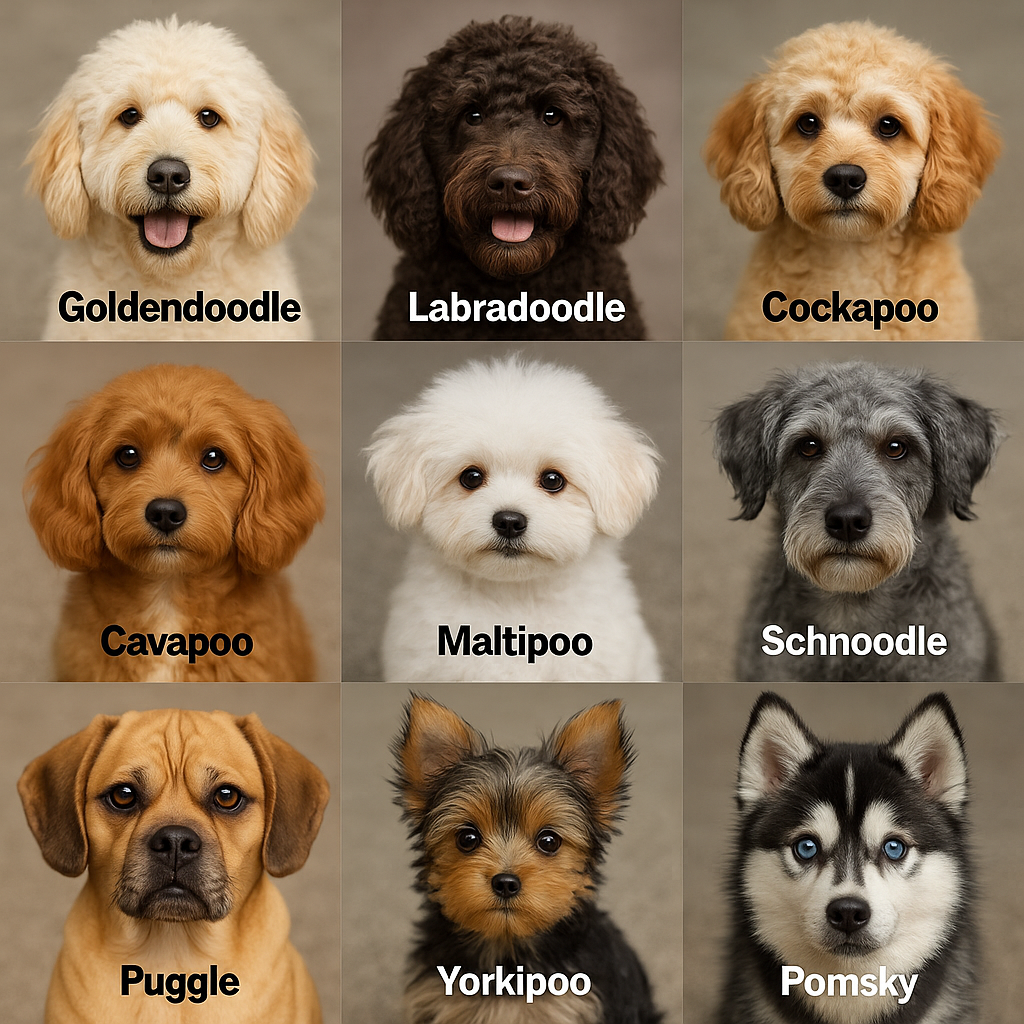
The "designer dog" category refers to deliberate F1 (first-generation) or follow-up-generation crosses between two purebred parent breeds, with a marketed identity. Common examples:
- Goldendoodle (Golden Retriever × Poodle)
- Labradoodle (Labrador Retriever × Poodle)
- Cockapoo (Cocker Spaniel × Poodle)
- Cavapoo (Cavalier King Charles × Poodle)
- Maltipoo (Maltese × Poodle)
- Schnoodle (Schnauzer × Poodle)
- Puggle (Pug × Beagle)
- Yorkipoo (Yorkshire Terrier × Poodle)
- Pomsky (Pomeranian × Husky)
The Poodle prominence reflects the marketing emphasis on "low-shed" coats; Poodle crosses dominate the designer market. The marketing is typically "best of both breeds" plus various claims about hypoallergenic coats, reduced health problems through hybrid vigor, and matched temperaments.
The reality is more nuanced.
Hybrid Vigor — What It Is and What It Is Not
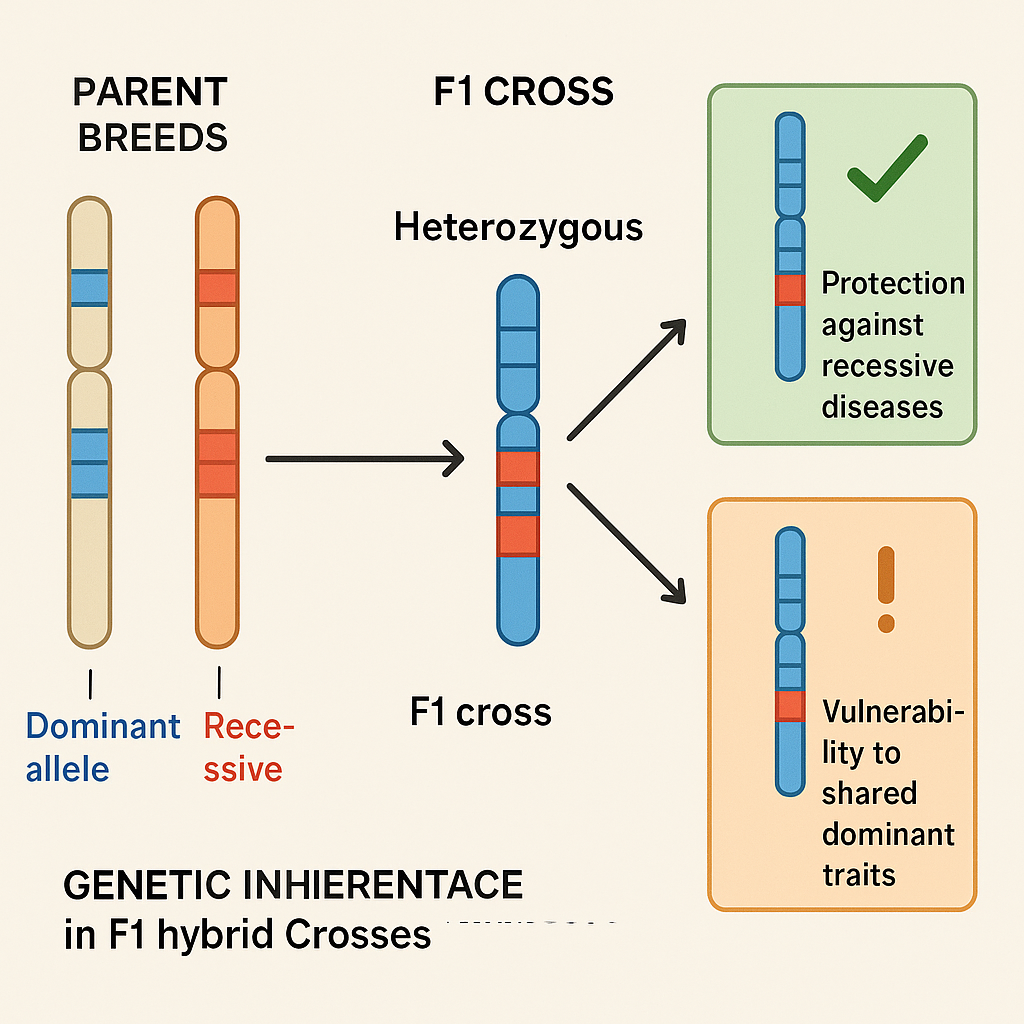
Hybrid vigor (heterosis) is a real genetic phenomenon: F1 crosses between unrelated lines often show improvement in some traits, particularly traits affected by accumulated recessive deleterious alleles in inbred lines. The mechanism: rare recessive disease alleles present in one parent breed are unlikely to be present in the other parent breed; F1 offspring are heterozygous and the recessive alleles are not expressed. The hybrid-vigor article covers this in more detail.
The limitation: hybrid vigor does not protect against:
- Health risks shared by both parent breeds. If both Goldens and Poodles have elevated hip dysplasia risk (as they do), the F1 Goldendoodle inherits hip dysplasia risk from both sides. Hybrid vigor does not help.
- Dominant or polygenic disease risks. Most common canine diseases (hip dysplasia, cancer, atopy, allergies) are not single-gene recessive conditions; they are polygenic with multiple contributing variants, often shared across breeds.
- Conformation-related risks. A Puggle inheriting brachycephalic conformation from the Pug parent has the brachycephalic-respiratory-and-ocular issues regardless of the Beagle contribution.
Designer-dog marketing often overstates the hybrid-vigor protection. The accurate claim is that some specific rare recessive diseases may be reduced in F1 crosses; the broader claim of "fewer health problems" is not supported.
Specific Designer Cross Considerations
Goldendoodles.
- Hip dysplasia. Both parent breeds have elevated risk; F1 cross inherits the risk. Health-screened parents (OFA hip evaluation Good or better) reduce but do not eliminate the risk.
- Cancer. Goldens have the highest documented breed cancer rate (60-65% lifetime — covered in golden-retriever-cancer-rates). Goldendoodles inherit this risk at half the magnitude on average.
- Cardiac. Both breeds have some cardiac concerns; combined inheritance varies.
- Atopy and skin allergies. Both breeds prone; F1 cross often inherits.
- Coat unpredictability. F1 crosses produce highly variable coats. Some Goldendoodles shed substantially; the "hypoallergenic" claim is unreliable.
Labradoodles.
- Similar hip dysplasia inheritance.
- Cancer risks from Labrador (modestly elevated population baseline).
- Atopy and ear infections are common.
- Coat variability similar to Goldendoodles.
Cavapoos and Cavachons.
- Mitral valve disease. Cavalier King Charles Spaniels have very high rates of early-onset mitral valve disease (essentially universal by old age). F1 Cavapoos inherit this risk at substantial magnitude.
- Syringomyelia. Cavaliers have specific neurological issues from skull conformation; F1 crosses with smaller Poodles may inherit some risk.
- Atopy.
Puggles.
- Brachycephalic issues. From the Pug parent. The F1 Puggle may have a moderately brachycephalic conformation rather than the full Pug extreme, with correspondingly moderated but still elevated risks.
- Skin folds and ear issues common.
- Ophthalmic concerns from Pug parent.
Pomskies (Pomeranian × Husky).
- Highly variable size and conformation — F1 Pomskies range from 4-25 kg depending on which parent's size genes dominate.
- Patellar luxation (Pomeranian).
- Eye conditions (some shared between parent breeds).
- Energy and exercise needs highly variable.
Maltipoos, Yorkipoos, and other small Poodle crosses.
- Patellar luxation common.
- Dental disease (small breeds).
- Tracheal collapse in some lines.
- Atopy.
The "Hypoallergenic" Issue
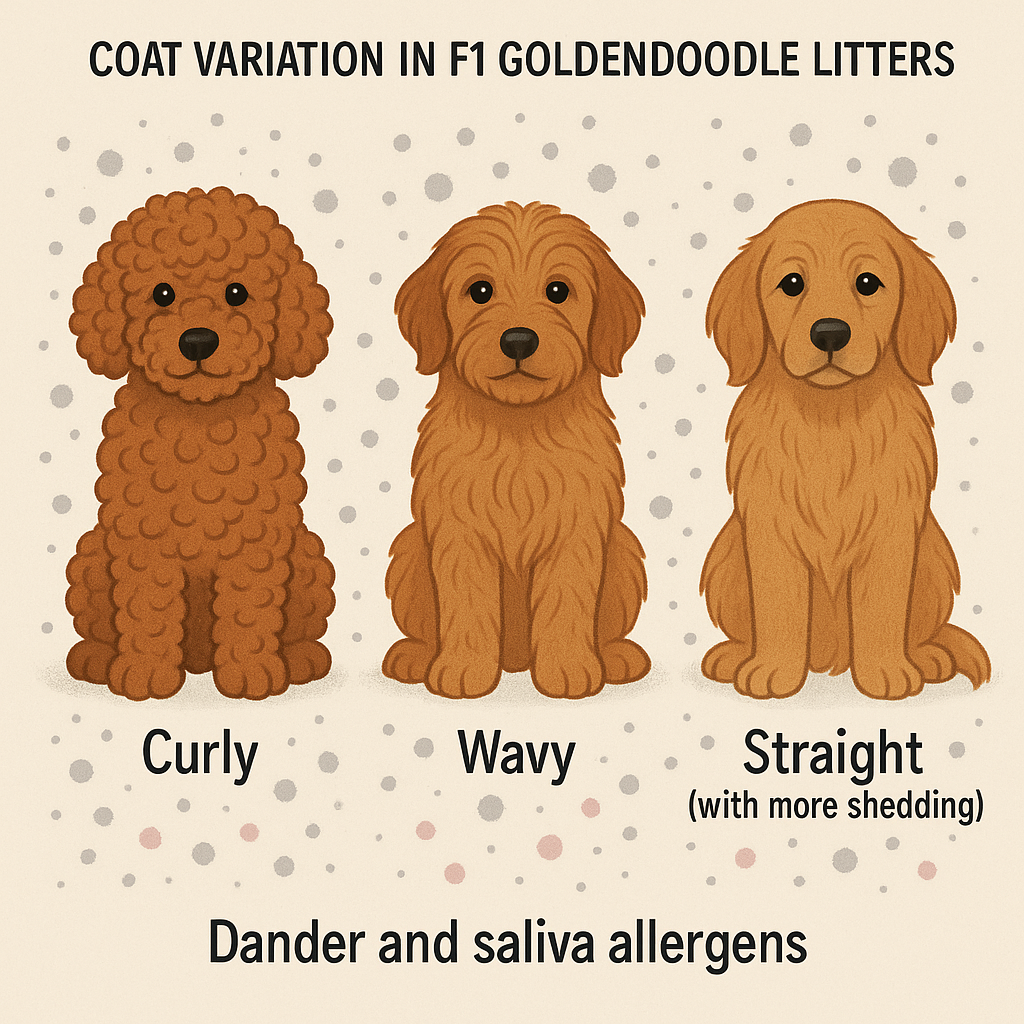
Designer dogs (particularly Poodle crosses) are often marketed as hypoallergenic. The claim is misleading:
- Most allergic responses to dogs are to dander and saliva, not to hair. Reduced shedding does not eliminate allergen exposure.
- F1 crosses show variable coat phenotypes. A Goldendoodle may have a Poodle-like curly low-shed coat, a Golden-like double coat that sheds considerably, or any phenotype in between.
- Even Poodles produce allergens — they shed less but their dander and saliva contain the same allergenic proteins as other dogs.
- People with severe allergies should test exposure with the specific dog before commitment; "hypoallergenic" marketing should not substitute for personal allergy testing.
Breeder Quality Variation
Designer-dog breeder quality varies markedly. The market includes:
- High-quality breeders doing health screening on both parent breeds (OFA hips, eye exams, breed-specific genetic panels) and selecting for temperament. These breeders' dogs typically have lower health risk than the population average for either parent breed.
- Lower-quality breeders breeding without health screening, often producing the F1 cross simply for the market premium. Their dogs inherit the full risk of both parent breeds without any selection benefit.
- Puppy mill operations producing designer crosses at scale with welfare concerns and minimal health screening.
The breeder evaluation should match the evaluation framework for purebred breeders (covered in the ethical-breeder-identification article). Designer-cross status alone is not a quality marker; breeder practice is.
What This Does Not Imply
- Designer dogs are unhealthy. Many are healthy and fine companions.
- F1 crosses always produce intermediate phenotypes. Coat, size, temperament can vary notably across littermates.
- Designer crosses are inherently unethical. The ethical question is breeder practice, not the cross itself.
- Hybrid vigor is meaningless. It is real for specific recessive disease alleles; the limitation is on shared health risks and polygenic conditions.
What Is and Is Not Settled
Settled: shared health risks across parent breeds are inherited by F1 crosses at full rate (well-established in canine genetics literature); "hypoallergenic" claims are misleading; breeder practice variation produces substantial variation in designer-dog health outcomes.
Not settled: precise quantitative magnitude of hybrid vigor across specific designer crosses; long-term health outcomes for the modern designer-dog population.
Key Takeaways
- Designer dogs (Goldendoodle, Labradoodle, Cavapoo, Puggle, others) are deliberate F1 crosses between purebred parent breeds.
- Hybrid vigor reduces risk for some rare recessive diseases but does not protect against shared parent-breed health risks (hip dysplasia, cancer, atopy, conformation issues).
- "Hypoallergenic" marketing is misleading; F1 coat phenotypes are variable; allergens are produced by all dogs.
- Specific cross health considerations: hip dysplasia (most Poodle crosses), cancer (Goldendoodles), brachycephalic (Puggles), mitral valve (Cavapoos), dental and patellar issues (small Poodle crosses).
- Breeder practice variation considerably affects health outcomes; designer-cross status alone is not a quality marker.
Sources & further reading
- American Kennel Club. AKC Breed Standards. American Kennel Club. https://www.akc.org/
- American Veterinary Medical Association. AVMA designer-dog and breed-health resources. American Veterinary Medical Association. https://www.avma.org/
- Journal of Veterinary Behavior. Journal of Veterinary Behavior. Elsevier. https://www.sciencedirect.com/journal/journal-of-veterinary-behavior