The Empirical Picture
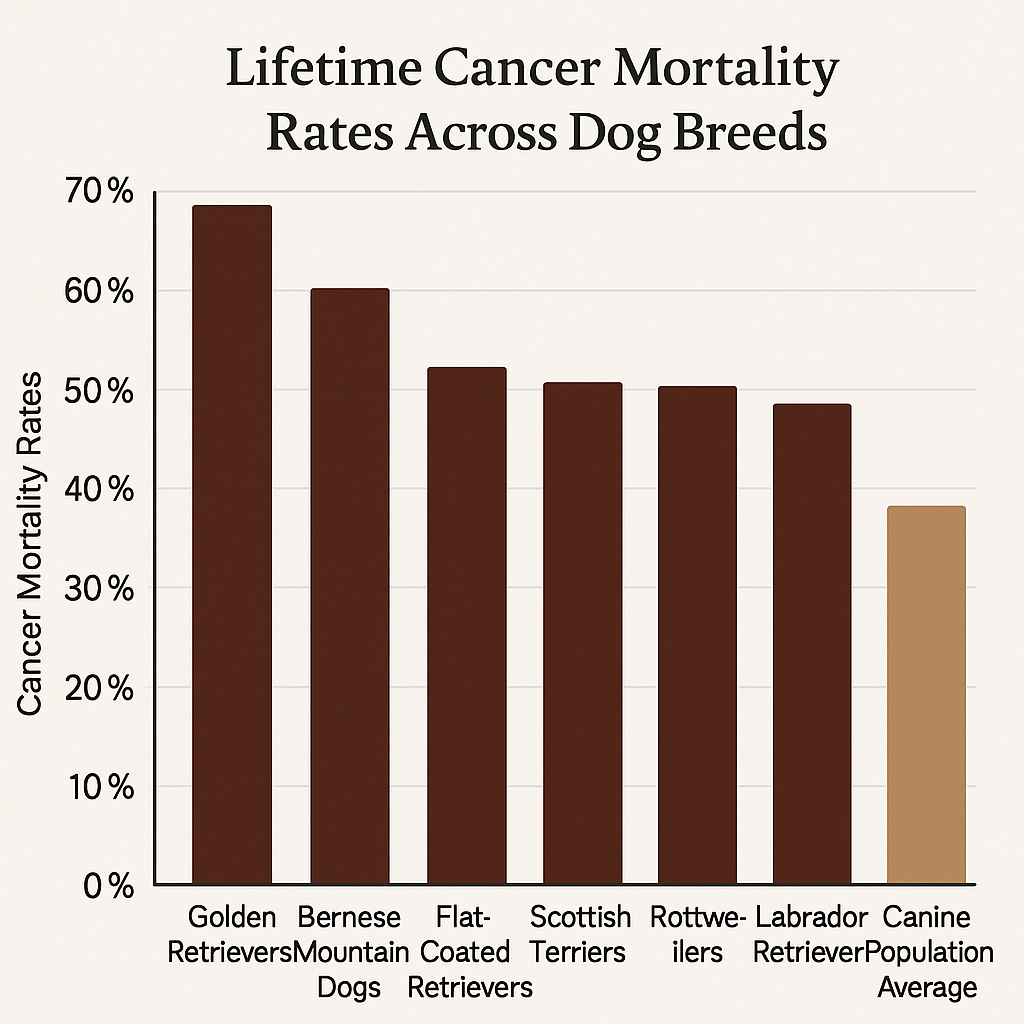
Golden Retrievers have the highest documented lifetime cancer rates among common companion-dog breeds. Estimates from multiple sources converge on roughly 60-65% lifetime cancer mortality — meaning that 60-65% of Golden Retrievers will eventually die of cancer. The canine population average is around 27%; Goldens are roughly 2-2.5x the average.
This is not a small effect. It is one of the more dramatic breed-cancer-rate disparities in companion-animal medicine, and it has shaped how the breed is discussed and managed within veterinary oncology and breed communities.
Other breeds with substantially elevated cancer rates (above the population average) include:
- Bernese Mountain Dogs — particularly histiocytic sarcoma; around 50% lifetime cancer mortality.
- Boxers — multiple cancer types, particularly mast cell tumours, lymphoma, and brain tumours.
- Flat-Coated Retrievers — particularly histiocytic sarcoma and other cancers.
- Scottish Terriers — bladder cancer (transitional cell carcinoma) at considerably elevated rates.
- Rottweilers — osteosarcoma and lymphoma.
- Labrador Retrievers — modestly elevated rates compared to overall average.
Goldens stand out partly because of the absolute rate and partly because of the breed's enormous popularity — a rate that affects 60% of an extraordinarily numerous breed produces a huge number of affected dogs in absolute terms.
The Most Common Cancers in Goldens
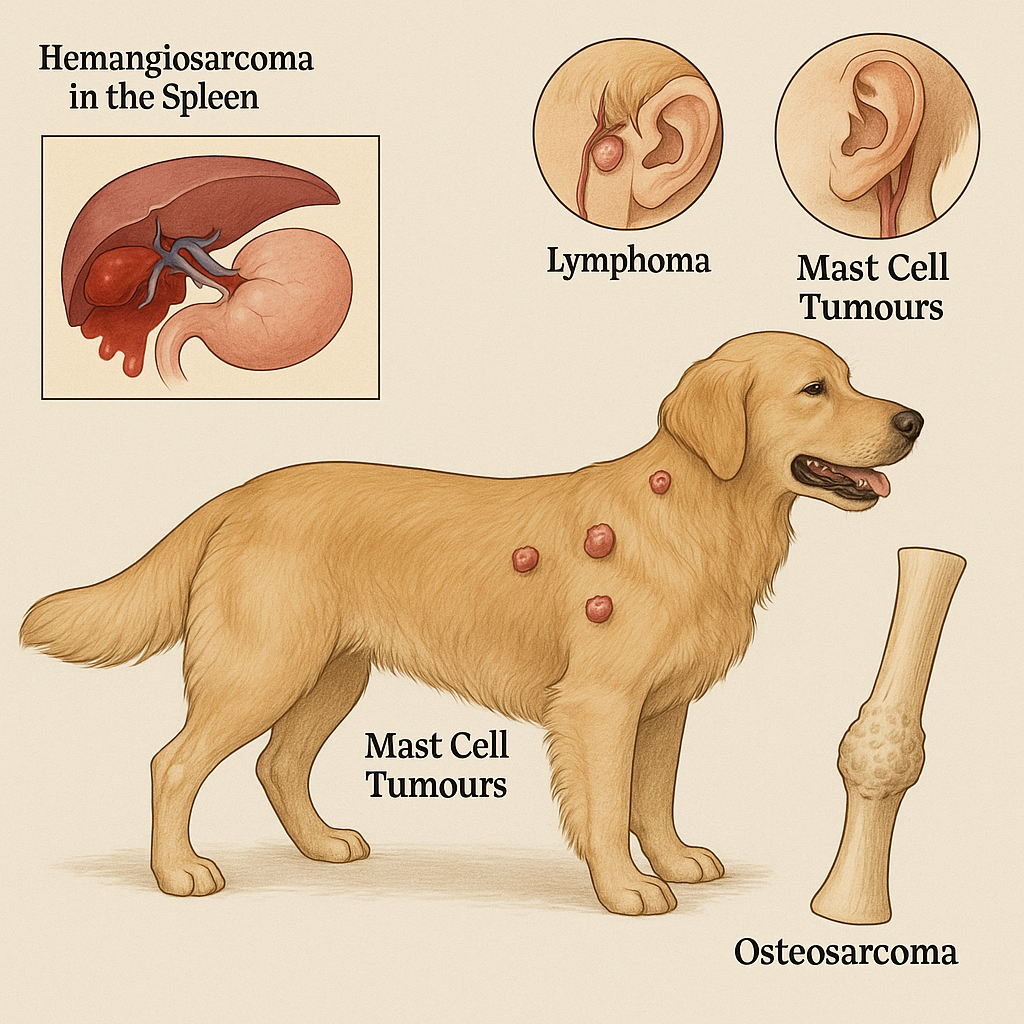
Four cancer types dominate the Golden Retriever cancer profile:
Hemangiosarcoma. A cancer of blood-vessel-lining cells, typically presenting in the spleen, heart, or liver. Often presents acutely with collapse from internal bleeding (the splenic mass ruptures producing hemoabdomen). Median survival even with surgery is short (months); this is one of the most consistently fatal canine cancers. Goldens have markedly elevated hemangiosarcoma rates.
Lymphoma. Covered in detail in the lymphoma article. Goldens are among the breeds most over-represented for lymphoma, often presenting with the multicentric form. Treatment with CHOP can produce 12-14 months survival in B-cell lymphoma; T-cell phenotype (also over-represented in Goldens) carries shorter expected survival.
Mast cell tumours. Skin and subcutaneous tumours that can range from low-grade (locally curable with surgery) to high-grade (aggressive, metastatic, with notably worse prognosis). Goldens are among the breeds most affected; they are also among the breeds where mast cell tumour patterns include atypical or multiple-tumour presentations.
Osteosarcoma. Bone cancer, typically in the long bones (limb amputation is a frequent surgical approach combined with chemotherapy). Most common in larger breeds; Goldens have elevated rates compared to mid-sized population average.
The Golden Retriever Lifetime Study
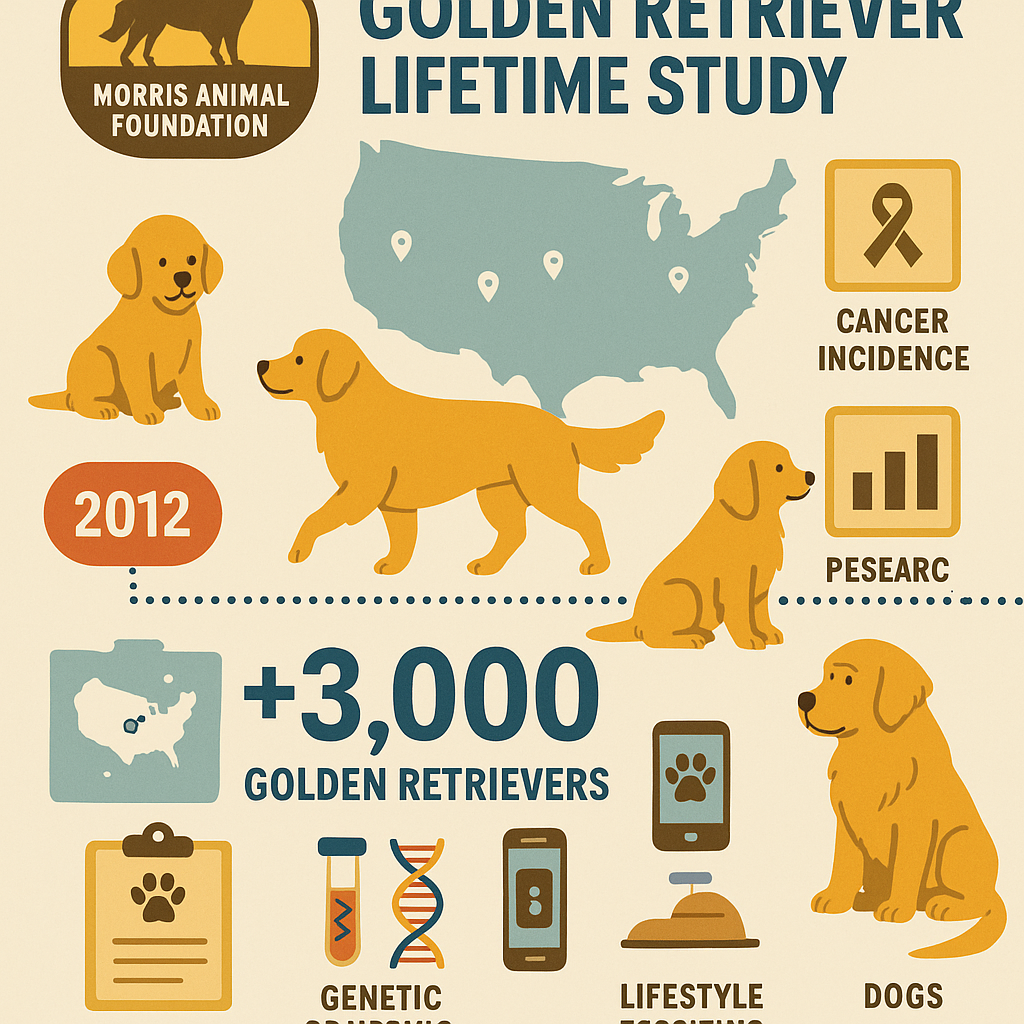
The Morris Animal Foundation's Golden Retriever Lifetime Study (GRLS) is a prospective cohort study following 3,000+ Golden Retrievers from puppyhood through their lives. The dogs are owned by participating families across the United States; data on diet, exercise, environment, medical events, lab results, and outcomes is collected periodically across the dogs' lives. The study began enrollment in 2012 and is ongoing; many of the dogs are now in middle-to-senior age.
The GRLS is one of the most ambitious veterinary cohort studies undertaken. It is generating data on:
- Cancer incidence and risk factors — environmental, dietary, genetic, and lifestyle factors associated with cancer development.
- Specific cancer types — patterns of diagnosis and outcomes for the major Golden cancers.
- Genetic studies — genome-wide association studies linking specific genetic variants to cancer risk.
- Other health conditions — joint disease, atopy, endocrine disease, and other breed-relevant outcomes.
Preliminary findings have been published with more in development. Some findings already in circulation:
- Specific haplotypes associated with elevated hemangiosarcoma and lymphoma risk in Goldens have been identified.
- The cancer-rate estimates have been refined and remain in the high range (50-60%+ lifetime).
- Environmental and lifestyle factors are being studied for associations.
The GRLS is generating the most informative dataset on breed-specific cancer that any breed has had to date. The findings will continue to develop over the coming years.
What This Means for Prospective and Current Owners
A few practical implications:
For prospective Golden Retriever owners:
- The elevated cancer risk is real and should be part of the decision. Many owners go forward knowing the risk; the breed has many redeeming qualities and many Goldens live full lives.
- Breeders varied in their approach to cancer-related selection. Some are working with researchers and using available genetic information; others are not.
- Pet insurance is worth considering more carefully than for some other breeds, given the high probability of cancer treatment costs.
- The lifespan expectation should be calibrated: median survival in Goldens is around 10-12 years, somewhat shorter than the breed's potential lifespan would suggest, partly due to cancer mortality.
For current Golden Retriever owners:
- Routine senior screening. The geriatric-screening article covers the broader framework. For Goldens, periodic abdominal ultrasound to screen for hemangiosarcoma is reasonable in mid-to-late life, though the cost-effectiveness at the population level is debated.
- Awareness of cancer signs. Lethargy, weight loss, lumps, distended abdomen, exercise intolerance, lameness — these warrant prompt veterinary evaluation in a Golden, particularly in middle age and beyond.
- Weight management. Obesity is associated with elevated cancer risk in some studies; lean body condition is part of the long-term welfare picture.
- Environment and lifestyle. Certain environmental factors (lawn herbicides for some bladder cancers, second-hand smoke, certain industrial exposures) have associations with specific cancers. The strongest evidence is in specific breed-cancer pairings; broader lifestyle factors are areas of active research.
For breed communities:
- Engagement with the GRLS and other research is the path to understanding and addressing the breed's cancer burden.
- Genetic-screening approaches as the relevant variants become better characterised may inform breeding decisions.
- Some community discussions have addressed whether outcrossing or other approaches might address the cancer burden; these are ongoing within the breed.
Why the Cancer Rate Is So High in Goldens
The cancer-rate elevation in Goldens reflects a combination of factors:
- Genetic bottleneck. The breed's modern gene pool descends from a relatively small number of founders, and limited genetic diversity has accumulated cancer-predisposing variants at high population frequency.
- Specific genetic variants. Specific haplotypes associated with hemangiosarcoma and lymphoma have been identified; these variants are present at high frequency in the breed.
- Possible interactions with environment, diet, neutering practices, and other factors. The interactions are areas of active research.
The hereditary basis means that solving the problem is not straightforward. Eliminating the predisposing variants while preserving the breed's other traits would require either substantial outcrossing (which the breed community has historically been resistant to) or extensive selective breeding against affected lines (which is happening to some degree but is constrained by the variants' high frequency).
What This Does Not Imply
- Every Golden Retriever will get cancer. 35-40% will not. Many live full lives without cancer.
- Goldens should not be adopted. They remain wonderful family dogs; the cancer burden is part of the picture, not a disqualifying factor.
- Breeders are uniformly the problem. Many breeders are deeply engaged with cancer research and selection; the systemic breed-genetic structure is the deeper issue.
What Is and Is Not Settled
Settled: Goldens have lifetime cancer mortality of approximately 60-65%, considerably elevated above the canine population average; hemangiosarcoma, lymphoma, mast cell tumours, and osteosarcoma are the most common cancers; specific genetic variants associated with hemangiosarcoma and lymphoma in Goldens have been identified.
Not settled: optimal screening protocols for early cancer detection in Goldens; the precise contributions of environment, diet, and lifestyle to cancer development; the optimal breeding-strategy approach to reducing the breed's cancer burden over time.
Key Takeaways
- Golden Retrievers have about 60-65% lifetime cancer mortality, vs. ~27% canine population average.
- Most common cancers: hemangiosarcoma, lymphoma, mast cell tumours, osteosarcoma.
- The Morris Animal Foundation's Golden Retriever Lifetime Study (3,000+ dogs followed prospectively) is generating the most informative dataset on breed-specific cancer to date.
- Genetic predisposition is partly understood; specific haplotypes are identified.
- Implications for owners: real cancer-risk awareness, routine senior screening, prompt evaluation of cancer signs, lean body condition.
- The breed-genetic structure makes the problem non-trivial to solve; ongoing research and breed-community engagement are the path forward.
Sources & further reading
- Morris Animal Foundation. Golden Retriever Lifetime Study. Morris Animal Foundation. https://www.morrisanimalfoundation.org/golden-retriever-lifetime-study
- Glickman, L. T.; Glickman, N. W.; Thorpe, R.. (1999). The Golden Retriever Club of America National Health Survey 1998-1999. Golden Retriever Club of America. https://www.grca.org/
- American Kennel Club. AKC Golden Retriever Breed Standard. American Kennel Club. https://www.akc.org/
- American Veterinary Medical Association. AVMA Cancer Resources. American Veterinary Medical Association. https://www.avma.org/
- Journal of Veterinary Behavior. Journal of Veterinary Behavior. Elsevier. https://www.sciencedirect.com/journal/journal-of-veterinary-behavior