What Dog Fighting Is
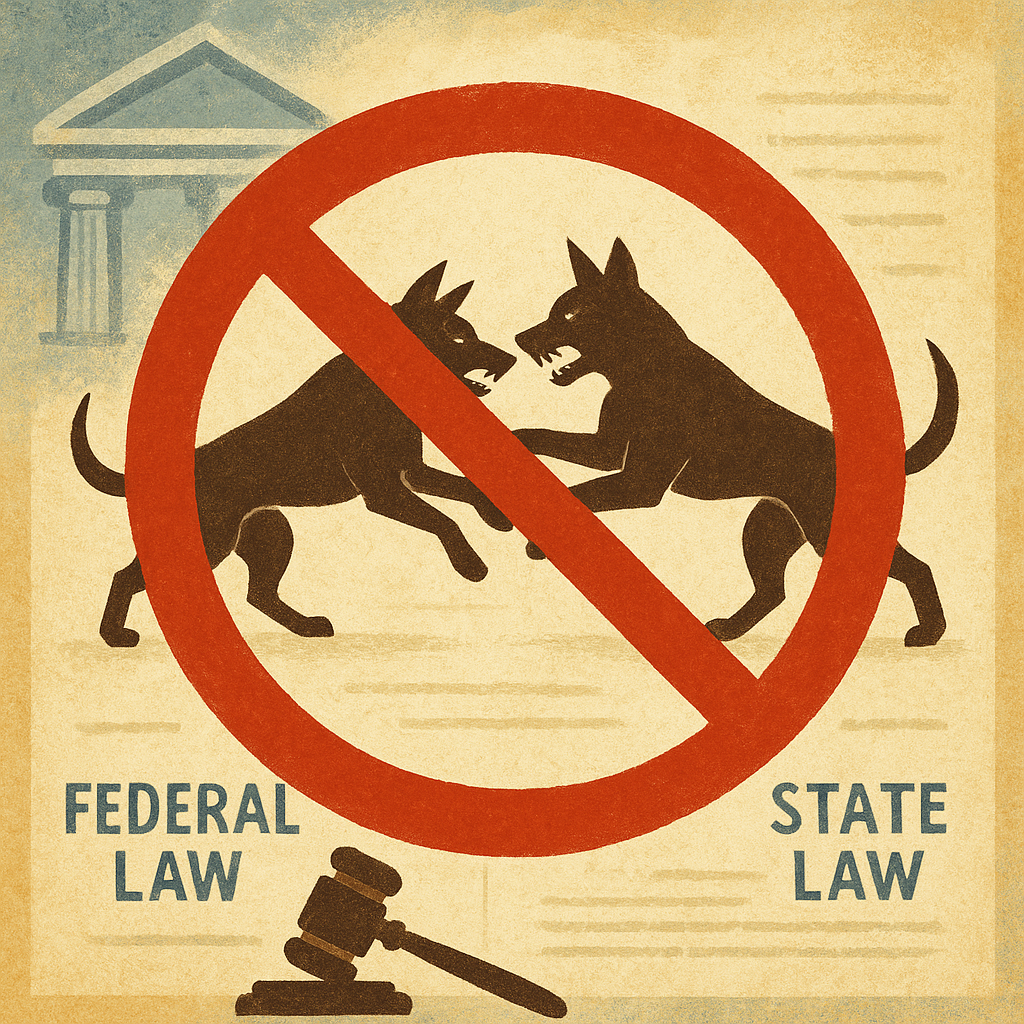
Dog fighting is the deliberate organisation of fights between dogs, typically associated with gambling, often as part of broader criminal enterprises. The activity is illegal felony-level in all 50 U.S. states and federally under the Animal Welfare Act and the Animal Fighting Prohibition Enforcement Act. Possession of a dog with intent to use in fighting, attendance at a dog fight, training dogs for fighting, and breeding fighting dogs are all federally criminalised.
The activity persists despite criminalisation. Estimates of the number of dogs involved in U.S. dog-fighting operations are in the tens of thousands annually. The activity ranges from "street-level" individual fights to organised "professional" operations with substantial resources and structure.
The welfare costs to fighting dogs are severe:
- Chronic injuries from fights — facial wounds, limb injuries, internal injuries.
- Untreated medical conditions — fighters typically receive minimal veterinary care.
- Severe behavioural deformation from training that pairs aggression with reward and punishes any submission or retreat.
- Social isolation from continuous tethering or kennel-based confinement.
- Eventual death in fights or by deliberate disposal when no longer "useful".
- Cumulative chronic stress at levels far exceeding standard welfare benchmarks.
Recognition Signs
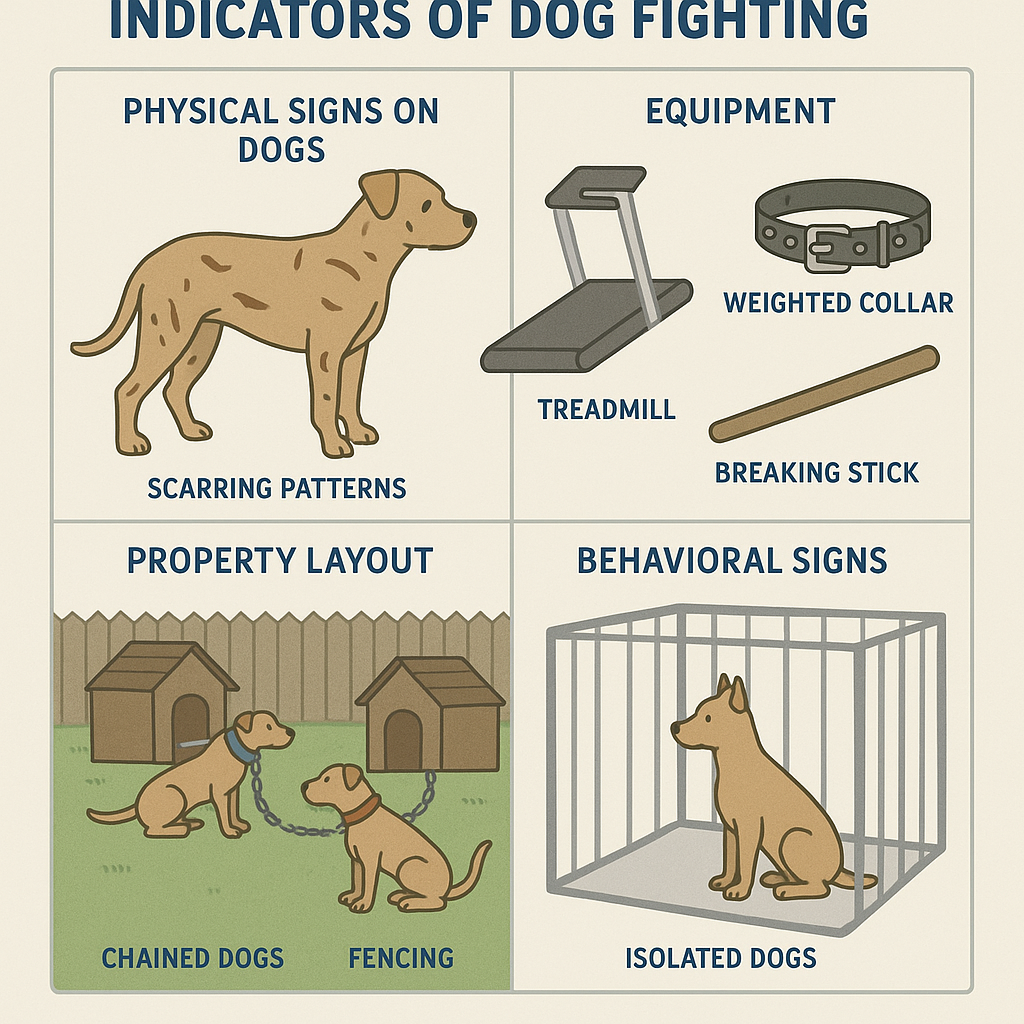
A list of indicators that suggest a dog-fighting operation. No single sign is definitive; the combination is what raises concern.
Physical signs in dogs:
- Scarring on the face, head, and forelegs. Classical fighting injuries leave characteristic patterns. Multiple healed wounds in characteristic distributions.
- Cropped ears, particularly aggressively cropped. Some fighting operations crop ears severely (different from the breed-standard cropping covered in tail-docking-ear-cropping article).
- Fresh wounds without evident veterinary care. Bites, lacerations, infected wounds.
- Specific muscular development. Fighters are often heavily conditioned with weight-pulling and treadmill work; the resulting body type is recognisable.
- Specific breeds in specific conditions. Pit-bull-type dogs (American Pit Bull Terrier, American Staffordshire Terrier, similar) are most common in U.S. fighting; specific breeds are over-represented in other countries (Tosa Inu in Japan; Dogo Argentino, Cane Corso, and others in some regions).
Equipment signs at a property:
- Treadmills and slat mills for conditioning.
- Weighted collars and chains for muscle development.
- Spring poles or hanging implements for jaw strength training.
- Breaking sticks (used to separate dogs in fights).
- Veterinary equipment without veterinary credentials (sutures, IV equipment, antibiotics — used to address fight injuries without professional veterinary care).
- Pit constructions in basements, sheds, or specific outbuildings.
- Multiple chains anchored at intervals across a yard or kennel area with isolated dogs at each.
Housing patterns:
- Multiple chained dogs in an isolated configuration. Each dog on a heavy chain, individual configurations preventing dogs reaching each other, often with shelter that is minimal.
- Predominantly intact male dogs. Fighting operations typically maintain intact males; the absence of females or the absence of neutered dogs is a pattern.
- Property layout designed for isolation. Privacy fencing, lack of visibility from streets, security beyond what would be expected for a residential property.
- Frequent visitors at unusual hours — particularly late evenings and weekends.
Behavioural signs in dogs and humans:
- Dogs displaying severely deformed social behaviour. Inability to interact appropriately with other dogs, extreme reactivity to specific triggers, profound social isolation.
- Owner discussing dogs with specific terminology. "Game" describes a dog willing to fight; specific scoring and breeding language characterises serious operations.
- Specific events. "Conventions" or organised gatherings, sometimes advertised on dark-web channels.
What to Do With Suspicion
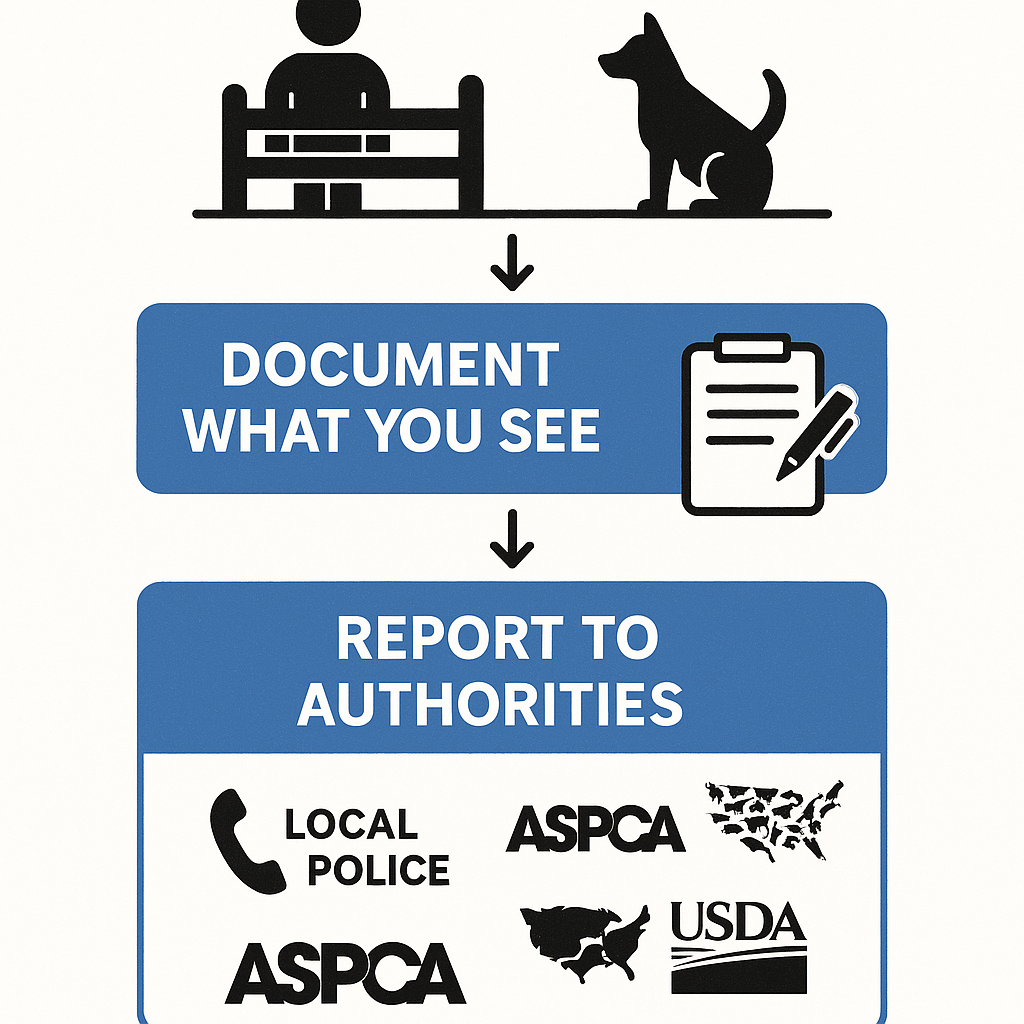
If signs suggest a possible dog-fighting operation:
Do not approach the property or attempt personal investigation. Dog-fighting operations are often associated with broader criminal activity (drugs, weapons, gambling). Personal investigation produces danger to the investigator and may compromise law-enforcement investigation.
Document what you can safely observe. From your position outside the property, note specific signs. Photographs from public spaces (street, public areas) of visible patterns may be helpful.
Report to appropriate authorities. Multiple channels exist:
- Local animal-welfare law enforcement. Many jurisdictions have specific animal-welfare investigators or units within the police or sheriff's department.
- Local police or sheriff (non-emergency line). General law enforcement can route the report appropriately.
- ASPCA Animal Cruelty Tip Line. The ASPCA accepts tips on suspected dog fighting and other animal-welfare crimes; tips are referred to appropriate jurisdictions.
- HSUS (Humane Society of the United States) Animal Cruelty Tip Line. Similar function; rewards are sometimes available for tips leading to convictions.
- Federal-level reports. USDA Animal Welfare investigators handle interstate and federal-jurisdiction cases.
Provide what information you have. Specific addresses, observed patterns, time of day of activities, vehicle descriptions if applicable. The more specific the report, the more actionable for investigators.
Anonymous reporting options exist. Most channels allow anonymous reporting; the reporting person's identity is generally not required for investigation to proceed.
Follow up if appropriate. If no apparent action results, consider escalating to alternative channels (ASPCA, HSUS) or contacting elected officials about animal-welfare-investigation resources.
Why Reporting Matters
Several reasons community reporting is important:
Investigations rely on community information. Law enforcement does not typically have proactive surveillance for dog-fighting operations; investigations begin with tips. Without community reporting, operations persist.
Concurrent criminal-activity context. Dog fighting frequently co-occurs with drug, weapons, and gambling activity. Investigation often produces concurrent cases.
Welfare urgency. Dogs in fighting operations face ongoing severe welfare costs; intervention sooner produces better welfare outcomes.
Community-impact effects. Dog-fighting operations affect surrounding communities through noise, traffic, security concerns, and the broader criminal-activity context. Investigation supports community welfare beyond the dogs.
Specific Considerations
Be cautious about confounding patterns. Some patterns superficially resemble dog-fighting indicators but reflect different (legal) activities — multiple chained outdoor dogs may be a tethering-welfare concern (covered in tethering-chaining-welfare) without being a fighting operation. Pit-bull-type dogs in the home are not by themselves an indicator. Reporting based on combined-pattern concerns is appropriate; reporting based on a single ambiguous indicator is less so.
Recognise that some legitimate activities involve some of these tools. Treadmill work, weight-pulling, and similar conditioning activities are part of some dog-sport contexts (weight-pull as an organised sport; conditioning for working-dog applications). The combination of the equipment with other concerning signs is what indicates a fighting context.
The line between "tough breed enthusiast" and "fighter" can be subtle but is real. Casual breed enthusiasts do not maintain operations with multiple chained intact males with fight-injury patterns. The full pattern is what indicates a fighting operation.
What This Does Not Imply
- Pit-bull-type dogs are inherently dog-fighting dogs. They are not. The breed group has been targeted by some fighting operations, but the vast majority of pit-bull-type dogs in the U.S. are pet dogs in normal homes.
- Reporting always produces immediate intervention. Investigations take time; not all reports lead to action.
- Personal intervention is appropriate. It is not. Reporting to authorities is the appropriate channel.
What Is and Is Not Settled
Settled: dog fighting is illegal felony-level activity nationwide; recognition signs include specific scarring patterns, specific equipment, specific housing configurations, and specific behavioural markers; community reporting through appropriate channels is the primary mechanism by which investigations begin; welfare costs to fighting dogs are severe[^aspca][^avma].
Not settled (in this article's scope): broader policy questions about regulation, prosecution rates, and rehabilitation of fighting-dog survivors.
Key Takeaways
- Dog fighting is illegal felony-level criminal activity in all U.S. states and federally.
- Recognition signs include physical signs in dogs (specific scarring, fresh untreated wounds, specific muscular development), equipment (treadmills, weighted collars, breaking sticks), housing patterns (multiple chained intact males, isolated configurations), and behavioural and contextual signs.
- Do not approach the property or attempt personal investigation; report to appropriate authorities.
- Reporting channels: local animal-welfare law enforcement, police non-emergency, ASPCA, HSUS, USDA federal investigators.
- Anonymous reporting is generally available.
- Community reporting is the primary mechanism by which dog-fighting investigations begin.
Sources & further reading
- American Society for the Prevention of Cruelty to Animals. ASPCA Dog Fighting Resources and Reporting. ASPCA. https://www.aspca.org/
- American Veterinary Medical Association. AVMA Animal Fighting Policy. American Veterinary Medical Association. https://www.avma.org/
- Humane Society of the United States. HSUS Animal Cruelty Reporting. HSUS. https://www.humanesociety.org/