Reference Catalog
This article is a lookup reference covering breeds with conformation-driven welfare concerns. The structure is by anatomical or genetic category rather than by breed, with the specific breeds listed within each category. The broader ethics framing is in the conformation-shows-welfare-concerns article and the brachycephalic-breeding-reform article; this article is the empirical-reference companion.
Brachycephalic Conformation (Short, Flat-Faced)
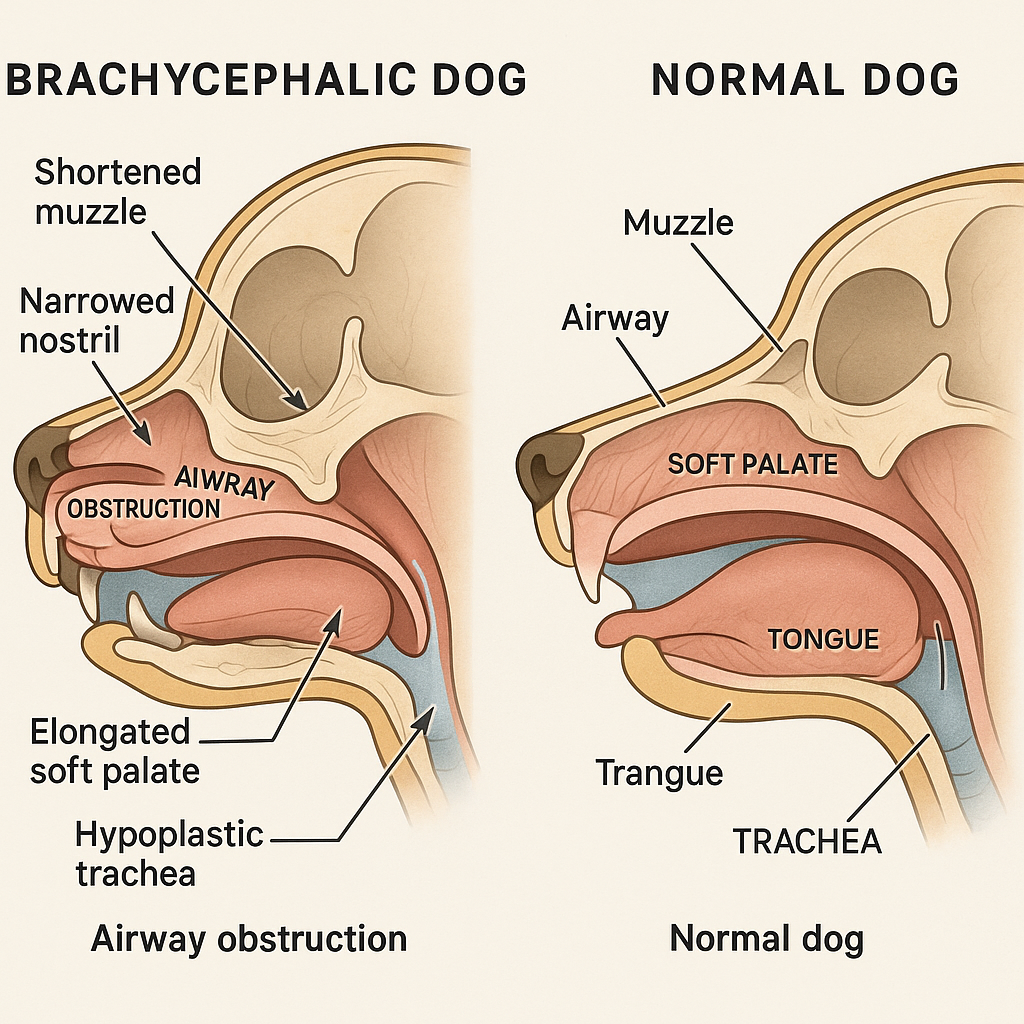
Affected breeds: Pug, French Bulldog, English Bulldog, Boston Terrier, Boxer, Pekingese, Shih Tzu, Lhasa Apso, Cavalier King Charles Spaniel (mild brachycephalic), Brussels Griffon, Japanese Chin, Affenpinscher, English Toy Spaniel.
Anatomical features: Shortened muzzle, narrowed nostrils (stenotic nares), elongated soft palate, hypoplastic trachea, narrowed pharynx and laryngeal saccules, shallow orbits, often with skin folds.
Welfare consequences:
- Brachycephalic Obstructive Airway Syndrome (BOAS). Chronic respiratory effort, exercise intolerance, heat intolerance, sleep-disordered breathing. Covered in brachycephalic-syndrome-boas article.
- Ocular issues including corneal ulceration, proptosis, dry eye, pigmentary keratitis. Covered in brachycephalic-ocular-health article.
- Dental crowding from shortened jaw with full tooth complement.
- Dystocia in many brachycephalic breeds; cesarean delivery rates are considerably elevated.
- Anesthetic risk elevated.
Prevalence: BOAS affects substantial fractions of the affected breeds — estimates of 50%+ in Pugs and French Bulldogs by some surveys.
Sources: O'Neill VetCompass studies on Pug, French Bulldog, Bulldog disease burden; Asher 2009; multiple subsequent specific epidemiology studies.
Chondrodystrophic Conformation (Disproportionately Short Legs)
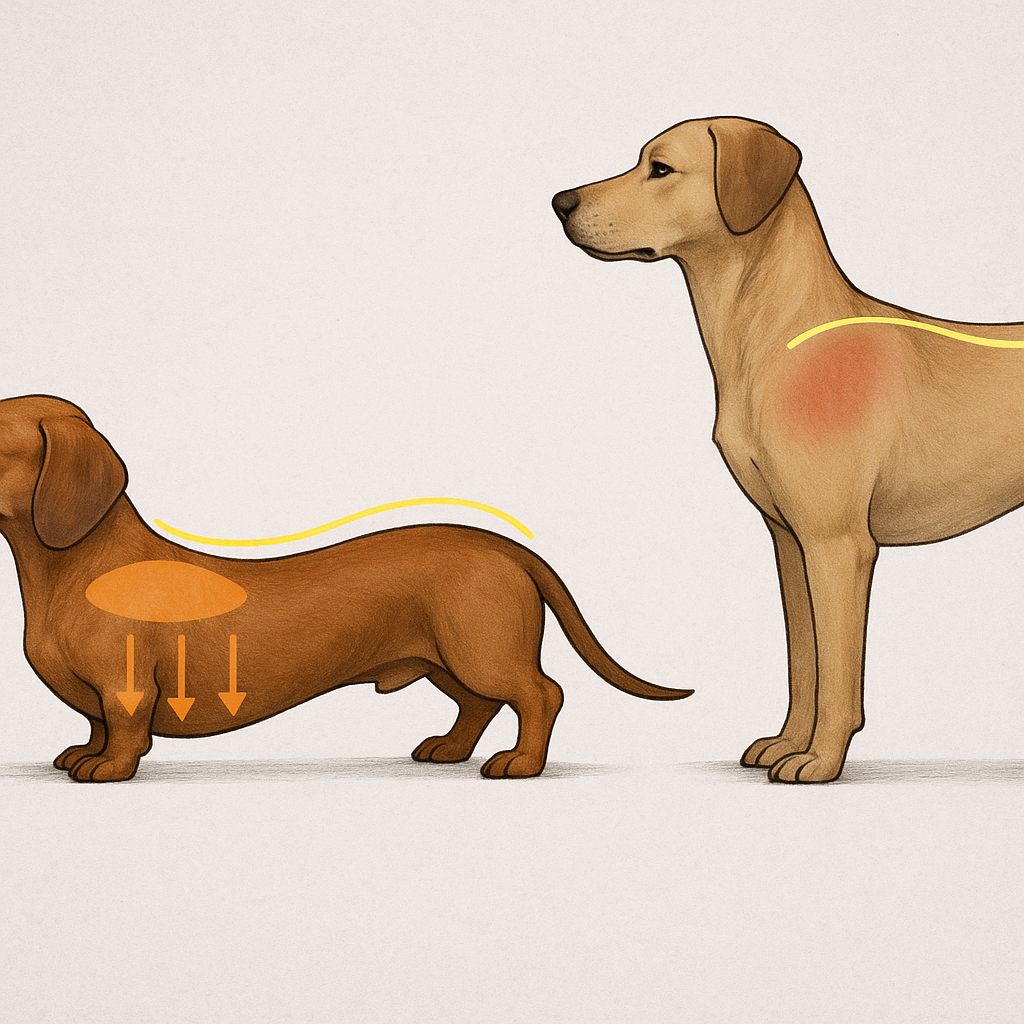
Affected breeds: Dachshund (all sizes), Welsh Corgi (Pembroke and Cardigan), Basset Hound, Beagle (mild), Pekingese, Shih Tzu, French Bulldog, English Bulldog, American Cocker Spaniel, Tibetan Spaniel, several others.
Genetic features: FGF4 retrogene insertions on chromosome 18 (chondrodysplasia in some breeds) and chromosome 12 (chondrodystrophy in dachshunds and others). The same genetic mechanism produces both the short legs and the early disc degeneration.
Welfare consequences:
- Intervertebral disc disease (IVDD). The most prominent. Covered in IVDD article. 1 in 4 dachshunds shows clinical IVDD across the lifespan.
- Patellar luxation in some chondrodystrophic small breeds.
- Joint disease modulated by the modified weight-bearing structure.
- Reproductive complications in some chondrodystrophic breeds.
Prevalence: Variable by breed; substantial across the chondrodystrophic group.
Sources: Parker et al. 2009 (Science); Brown et al. 2017 (PNAS); Bannasch group at UC Davis. The dachshund-paradox article covers the dachshund-specific case.
Extreme Size (Giant Breeds)
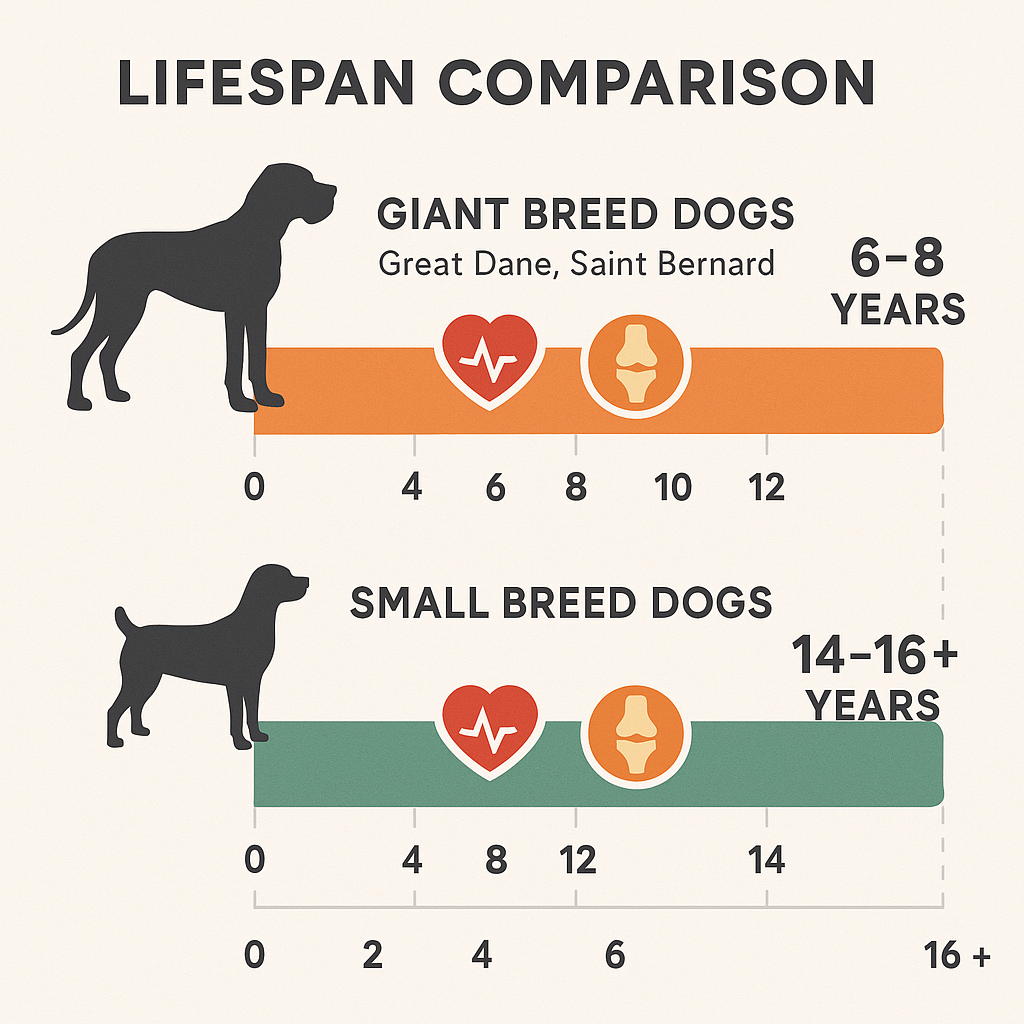
Affected breeds: Great Dane, Saint Bernard, Newfoundland, Mastiff (English, Neapolitan, Tibetan), Irish Wolfhound, Scottish Deerhound, Leonberger, Anatolian Shepherd, several others.
Anatomical features: Body mass exceeding 45 kg / 100 lbs (often appreciably more), with corresponding skeletal and cardiovascular demands.
Welfare consequences:
- Substantially shortened lifespan. Giant breeds typically live 6-8 years, vs. 14-16+ years for small breeds. Covered in size-lifespan article.
- Dilated cardiomyopathy (DCM) at elevated rates in several giant breeds.
- Gastric dilatation-volvulus (GDV) / bloat at elevated rates due to deep-chested conformation. Covered in food-puzzles article.
- Orthopedic disease including hip dysplasia, elbow dysplasia, osteosarcoma at elevated rates.
- Cardiovascular demands of supporting the large body mass.
- Pain and welfare costs of the cumulative orthopedic, cardiac, and other body-mass-related issues.
Skin Folds
Affected breeds: Shar-Pei (extreme), English Bulldog, Pug, French Bulldog (skin folds), Neapolitan Mastiff, Bullmastiff, Bloodhound (less extreme), Saint Bernard.
Welfare consequences:
- Skin-fold dermatitis from moisture and microbiome disturbance in skin folds.
- Eye-related complications when skin folds contact the eye (covered in brachycephalic-ocular article).
- Specific to Shar-Peis: familial Shar-Pei fever (autoinflammatory disorder linked to the genetic basis of the breed's hyaluronic-acid-rich skin).
Sources: Asher 2009; UFAW Shar-Pei welfare profile.
Merle Homozygosity
Affected breeds: Australian Shepherd, Border Collie, Cardigan Welsh Corgi, Catahoula Leopard Dog, Dachshund (dapple), Great Dane (harlequin and merle), Shetland Sheepdog, Old English Sheepdog, several others.
Genetic features: Merle is a heterozygous coat-pattern allele at the SILV/PMEL locus. Heterozygous merles (Mm) show the mottled coat pattern with no special health concerns. Homozygous merles (MM, "double merles") have substantial welfare problems.
Welfare consequences in double merles:
- Deafness in roughly 25-50% of double merles.
- Eye abnormalities including microphthalmia, colobomas, blue eyes with vision deficits.
- Skin and other developmental issues.
- Substantially elevated welfare cost vs. heterozygous merles.
Origin of the problem: Breeding two merle dogs together produces approximately 25% double-merle puppies. The breeding pattern is often deliberate (some breeders pursue specific colour patterns by merle-to-merle breeding) but produces predictable welfare costs.
Sources: UFAW Genetic Welfare Problems; multiple peer-reviewed papers on merle genetics and double-merle welfare consequences.
Brachycephalic-Plus-Extreme-Body-Type
Affected breeds: English Bulldog (severe brachycephalic + skin folds + chondrodystrophic + extreme conformation cumulative effects); French Bulldog (brachycephalic + chondrodystrophic + skin folds in some lines).
Welfare consequences: The combined conformation features compound welfare costs. The English Bulldog's modern conformation is particularly extreme; substantial reform efforts have been ongoing in some kennel-club contexts.
Sources: O'Neill VetCompass studies on Bulldog disease burden documented substantial welfare costs across multiple body systems.
Other Specific Conformation Concerns
Deep chest in Great Danes and other giant breeds. Elevated GDV / bloat risk.
Oversized heads in some breeds (English Bulldogs, French Bulldogs). Elevated dystocia rates requiring cesarean delivery.
Cardiac conformation concerns in Cavalier King Charles Spaniels. Mitral valve disease essentially universal in older Cavaliers; the Mitral Valve Disease Breeding Scheme (UK Kennel Club) attempts to address this through screening.
Syringomyelia in Cavalier King Charles Spaniels. Skull conformation produces brain-spinal cord interface issues. The Brachycephaly-Hydrocephalus-Chiari-Like-Malformation cluster of issues.
Wrinkled skin in Shar-Peis and Mastiffs. Skin-fold dermatitis as above; specific Shar-Pei autoinflammatory issues.
Tail-related issues in Pugs and Bulldogs (screw tails). Spinal abnormalities.
Using This Catalog
The catalog is intended as a lookup reference. For specific breed evaluation:
- Identify the breed of interest.
- Locate the relevant conformation category or categories.
- Review the welfare consequences.
- Consult the cited sources (Asher 2009; VetCompass; UFAW database) for specific epidemiologic data.
- For prospective owners, integrate the welfare information with broader breed-selection considerations.
- For breed-community engagement, use the catalog as a starting point for breed-health-improvement conversations.
The catalog is not a comprehensive dog-health reference; it is specifically focused on conformation-driven welfare concerns. Many breeds have additional health concerns not driven by conformation that are covered elsewhere in the corpus.
What This Catalog Does Not Imply
- All affected dogs experience all listed welfare consequences. Many dogs in the affected breeds have unremarkable health; the elevated risk is at population level.
- The breeds should not exist. The catalog is a reference, not an argument for breed elimination. The broader ethics is in companion articles.
- Individual dogs can be predicted to have specific outcomes. The catalog provides population-level information.
What Is and Is Not Settled
Settled: the catalog of conformation-related welfare concerns is well-established in the empirical literature (Asher 2009; VetCompass O'Neill corpus; UFAW database)[^asher][^vetcompass][^ufaw]; specific anatomical and genetic mechanisms are characterised for many of the listed concerns; population-level welfare costs are documented.
Not settled: optimal breed-improvement strategies for reducing welfare cost while preserving breed identity; comparative cost-benefit of different reform approaches.
Key Takeaways
- This article is a reference catalog, not a polemic; the broader welfare ethics is in companion articles.
- Major conformation categories with welfare concerns: brachycephalic, chondrodystrophic, extreme size, skin folds, merle homozygosity, brachycephalic-plus-extreme-body-type combinations, and several specific concerns.
- Each category lists the affected breeds, anatomical or genetic features, welfare consequences, and relevant sources.
- The catalog is for lookup and population-level information; individual dog outcomes vary.
- Sources: Asher 2009 (50 popular UK breeds review); VetCompass O'Neill epidemiology; UFAW Genetic Welfare Problems database; specific peer-reviewed papers cited per breed.
Sources & further reading
- Asher, L.; Diesel, G.; Summers, J. F.; McGreevy, P. D.; Collins, L. M.. (2009). Inherited defects in pedigree dogs. Part 1: disorders related to breed standards. The Veterinary Journal, 182(3), 402-411. https://doi.org/10.1016/j.tvjl.2009.08.033
- Royal Veterinary College VetCompass programme (O'Neill et al.). VetCompass breed-specific epidemiology studies. Royal Veterinary College. https://www.rvc.ac.uk/vetcompass
- Universities Federation for Animal Welfare. UFAW Genetic Welfare Problems database. Universities Federation for Animal Welfare. https://www.ufaw.org.uk/dogs/dogs