What Continuous Tethering Is
Tethering — keeping a dog attached to a fixed point by a chain, rope, or cable — has been a traditional method of outdoor dog containment in some contexts. The welfare-relevant distinction is between:
Brief, supervised tethering. A dog tethered for a short period during an outdoor activity (e.g., tying the leash to a post while the owner enters a shop briefly) with the owner nearby and the duration measured in minutes. This is not the welfare concern.
Continuous or near-continuous tethering. Dogs kept outdoors on chains, ropes, or cables for substantial portions of the day (or 24 hours), often without consistent shelter, social interaction, or appropriate care. This is the welfare concern that the empirical literature and regulatory framework address.
The article focuses on continuous tethering. The behaviour problems and welfare costs are concentrated in this pattern.
The Behavioural Consequences
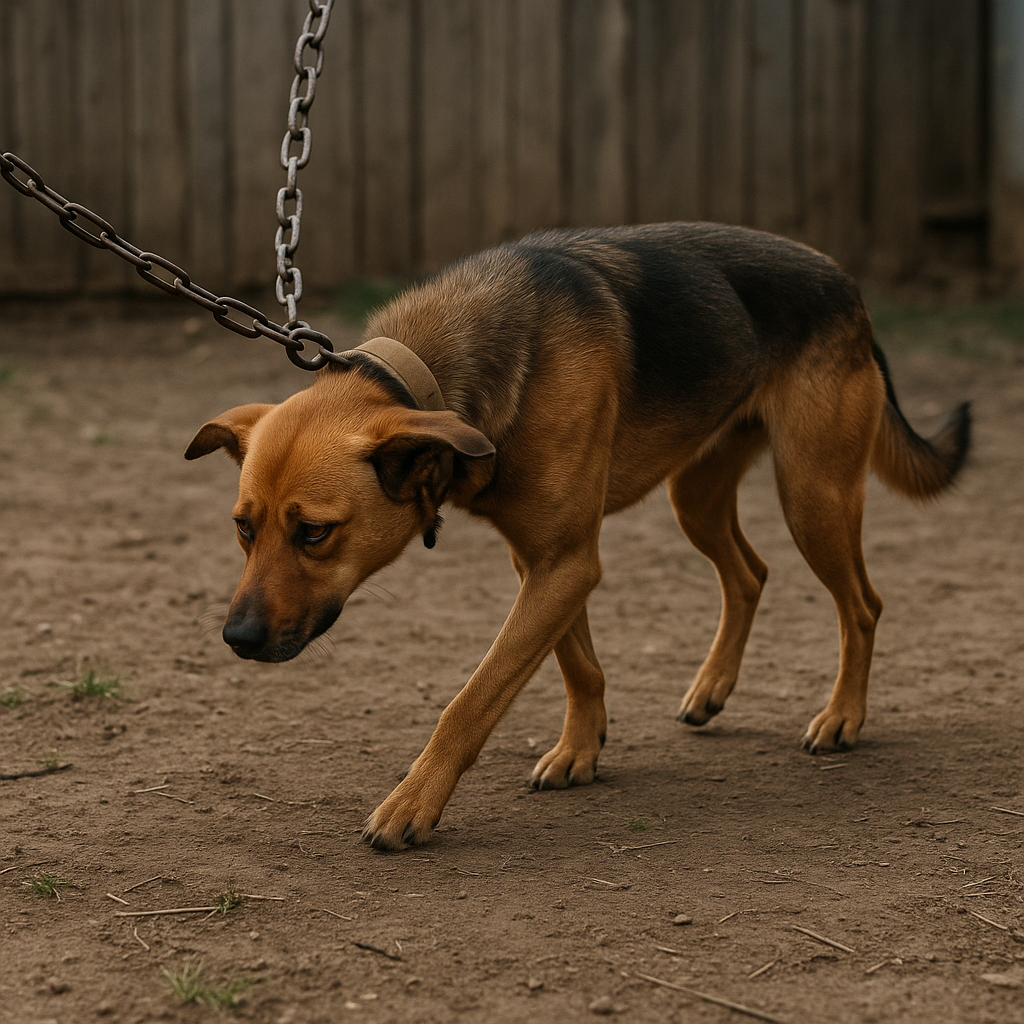
A consistent picture across the empirical literature:
Elevated aggression rates. Chained dogs are considerably over-represented in serious bite incidents in the U.S. and other countries. Some surveys have reported that chained dogs are 2-3x more likely to bite than non-chained dogs of similar profile. The mechanism plausibly involves: chronic stress and frustration, restricted ability to use distance as a coping strategy (the chain prevents retreat), territorial defensive behaviour around the tethering area, and lack of social and environmental input that supports normal behavioural development.
Stereotypic behaviours. Continuous tethering is associated with elevated rates of pacing, spinning, self-licking lesions, self-biting, and other stereotypic patterns. These are markers of chronic stress and behavioural dysregulation.
Social isolation effects. Dogs are highly social animals. Continuous tethering typically involves limited social interaction with humans or other dogs; the social-isolation effects compound the chronic-stress consequences.
Inability to perform species-typical behaviours. Tethered dogs cannot engage in normal exploratory behaviour, appropriate exercise, varied environmental interaction, or species-typical social behaviour with other dogs.
Hyperreactivity to environmental stimuli. Tethered dogs often develop intense reactivity to passers-by, other dogs, vehicles, and environmental events because (a) they are unable to retreat from triggers, and (b) the chronic-stress baseline elevates reactivity to all stimuli.
Specific patterns of fear and aggression toward strangers approaching the tethering area. This is the basis of the bite-risk elevation; tethered dogs often defend the tether area as territory while being unable to retreat from threats.
The Physical Consequences
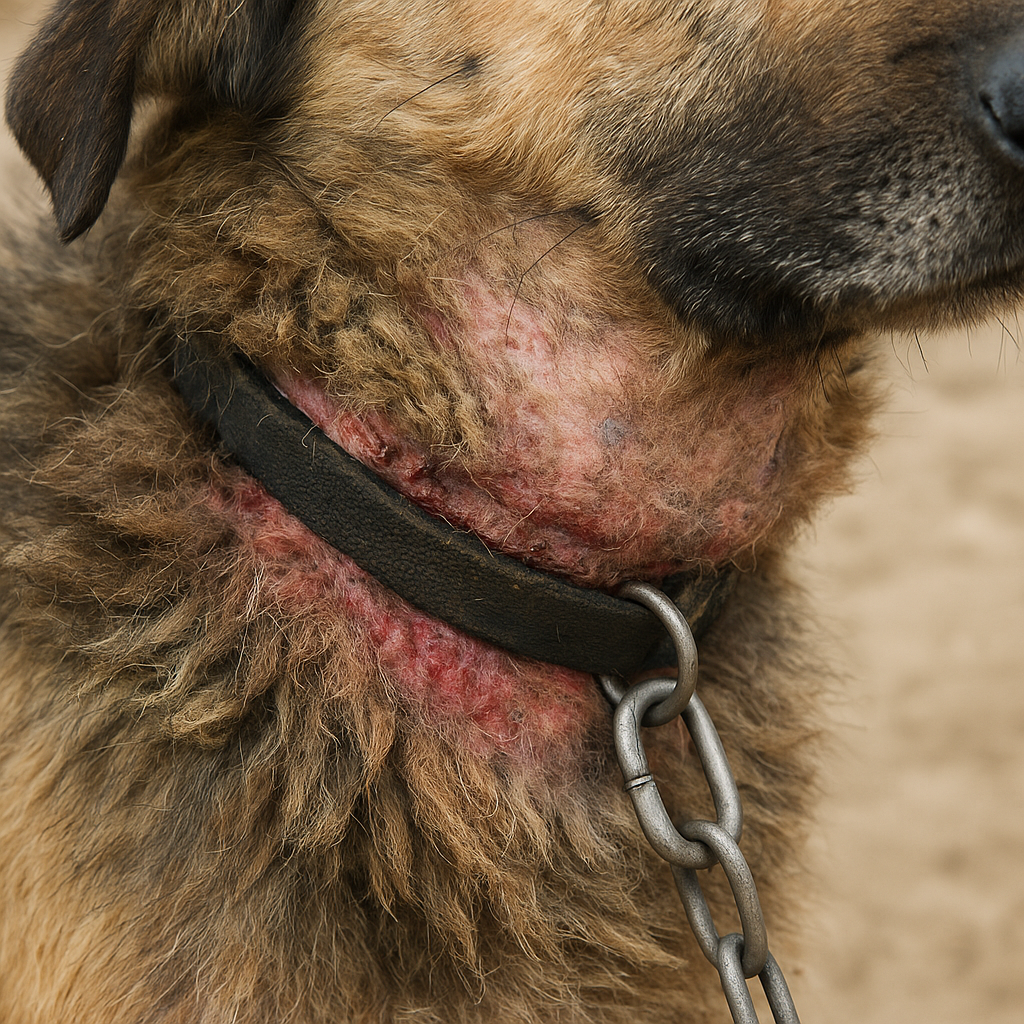
Beyond the behavioural costs:
Neck and collar injuries. Constant pulling against the tether, sudden lunges arrested by the chain, and pressure from the collar produce neck-and-throat injuries. Chronic embedded collars (where the collar grows into the neck tissue as the dog grows or gains weight) are particularly severe.
Exposure-related issues. Without consistent appropriate shelter, tethered dogs face heat stress, cold stress, wet-weather complications, and other exposure-related welfare costs. Inadequate shelter in extreme weather has been associated with serious injury and death in tethered dogs.
Musculoskeletal effects. Restricted movement over years produces effects on the musculoskeletal system; muscular atrophy, joint stiffness, and other physical-condition consequences accumulate.
Entanglement risks. Chains and ropes can entangle the dog, producing strangulation risk, restricted breathing, or inability to access water and shelter. Entanglement deaths occur.
Inadequate hygiene. Continuously tethered dogs often live in conditions where the immediate area accumulates feces, urine, and parasites. Skin disease, parasitic disease, and related conditions are elevated.
Inability to escape immediate threats. Other dogs, wild animals, or human cruelty can produce harm that the tethered dog cannot escape.
The Regulatory Trends
Over the past 15-20 years, many jurisdictions have enacted or considered anti-tethering ordinances:
Municipal-level ordinances. Many U.S. cities and counties have anti-tethering ordinances varying from outright bans on continuous tethering to specific time limits, shelter requirements, and other conditions. Major cities including some in Texas, North Carolina, Maryland, California, and others have such ordinances.
State-level legislation. Some U.S. states have passed comprehensive anti-tethering legislation. Texas, California, Michigan, Connecticut, and others have state-level frameworks of varying scope.
Common features of anti-tethering legislation.
- Time limits on tethering (often 1-3 hours total per day, sometimes specific hours).
- Tether length and weight requirements (preventing entanglement; preventing excessively heavy chains).
- Shelter requirements (appropriate shelter, water, food access).
- Weather-condition exceptions (no tethering during extreme weather).
- Age and condition exceptions (no tethering of puppies, sick or injured dogs, or pregnant or nursing bitches).
- Enforcement provisions and penalties.
International picture. Many countries have animal-welfare frameworks that prohibit continuous tethering under broader welfare provisions even without specific anti-tethering laws. European Union countries generally have more restrictive frameworks than U.S. baseline.
The trend is toward more restriction. Specific local regulations should be consulted; the regulatory landscape continues to develop.
What Owners Should Do
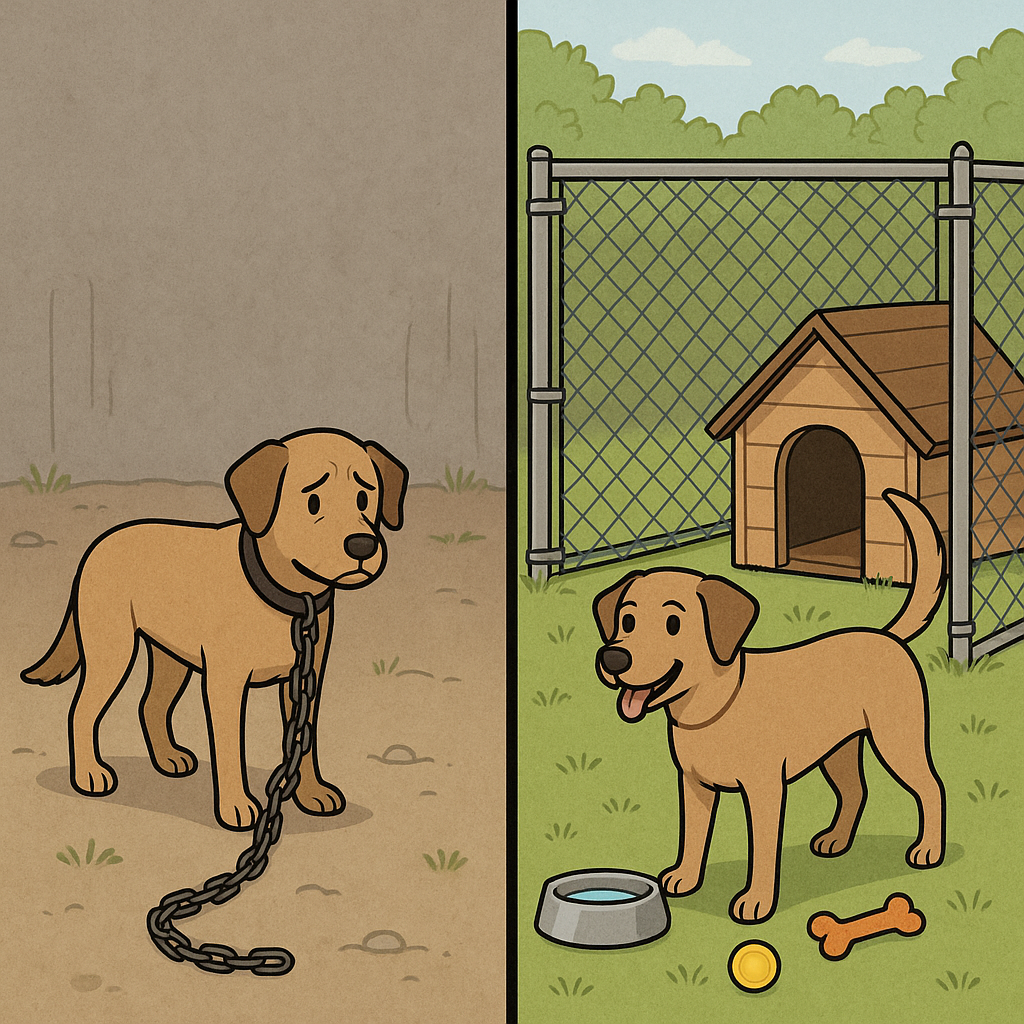
For owners who use tethering as a containment method:
Consider why you are using tethering. Is the issue lack of fencing? Cost? Specific dog behaviour (escapes from yard)? The right alternative depends on the underlying issue.
Adequate fencing is the standard alternative. Most owners who can afford appropriate fencing find it produces better welfare and management outcomes than tethering.
Indoor housing as the primary living context. The contemporary welfare consensus is that dogs are family pets best housed indoors with the family, with outdoor time for exercise, elimination, and play rather than as the primary living context.
Dog runs or kennels with adequate space. For situations requiring outdoor containment (e.g., during specific work hours, during specific weather), a properly sized and constructed dog run with shelter, water, and adequate space is preferable to tethering.
Brief supervised tethering for specific contexts. Tethering the dog briefly while the owner is engaged in nearby activity is different from continuous unsupervised tethering and is not the welfare concern.
Recognise when tethering reflects broader welfare issues. Continuous tethering is often a marker of broader welfare neglect; the dog's full situation (nutrition, social interaction, veterinary care, training) often warrants attention.
What This Does Not Imply
- Brief tethering during specific activities is welfare-harmful. It is not, in the brief-and-supervised pattern.
- All outdoor containment is harmful. Properly designed outdoor housing with adequate space, shelter, social interaction, and care can be welfare-acceptable.
- Tethering is the only welfare problem in any particular dog's situation. Often co-occurring with other welfare concerns; the broader picture matters.
- Anti-tethering ordinances eliminate the problem entirely. Enforcement varies; many problematic situations persist despite regulations.
What Is and Is Not Settled
Settled: continuous tethering produces substantial behavioural and physical welfare harm including elevated aggression rates, stereotypic behaviours, social isolation effects, and physical injury risks; the behavioural-welfare evidence is consistent; many jurisdictions have moved toward regulatory restriction[^aspca][^avma][^jvb].
Not settled: optimal regulatory frameworks (the variation across jurisdictions reflects different policy approaches); the most effective enforcement and intervention strategies for the broader welfare context tethering often reflects.
Key Takeaways
- Continuous tethering of dogs produces substantial welfare harm: elevated aggression, stereotypic behaviours, social isolation effects, physical injuries, exposure-related issues.
- The behavioural welfare consequences are well-documented; chained dogs are over-represented in serious bite incidents.
- Many U.S. municipalities and some states have anti-tethering ordinances with various provisions (time limits, shelter requirements, weather exceptions, age exceptions).
- The contemporary welfare consensus favours indoor-primary housing with adequate fencing for outdoor time over continuous tethering.
- Brief supervised tethering during specific activities is different from continuous unsupervised tethering and is not the welfare concern.
Sources & further reading
- American Society for the Prevention of Cruelty to Animals. ASPCA Tethering Resources and Position. ASPCA. https://www.aspca.org/
- American Veterinary Medical Association. AVMA position on tethering and chaining. American Veterinary Medical Association. https://www.avma.org/
- Journal of Veterinary Behavior. Journal of Veterinary Behavior. Elsevier. https://www.sciencedirect.com/journal/journal-of-veterinary-behavior
- Beerda, B.; Schilder, M. B. H.; van Hooff, J. A. R. A. M.; de Vries, H. W.. (1997). Manifestations of chronic and acute stress in dogs. Applied Animal Behaviour Science, 52(3-4), 307-319. https://doi.org/10.1016/S0168-1591(96)01131-8