What the Question Actually Means
Theory of mind (ToM), in the cognitive-science literature, is the capacity to attribute mental states — perceptions, intentions, knowledge, beliefs — to others, and to use those attributions to predict behaviour. In humans it is usually probed with false-belief tasks: scenarios in which the participant has to predict that another agent will act on a belief about the world that the participant knows is wrong. This is the version typically taken as the signature of full ToM, and it is the version most often used to ask whether dogs "have" ToM.
The complication is that ToM is not one thing. The capacity to read another agent's current attentional state (where they are looking, whether they can see something) is a different cognitive operation from the capacity to represent another agent's belief about the world. A species can be very good at the first and limited on the second. This is, on the available evidence, where dogs sit.
What Dogs Read Reliably
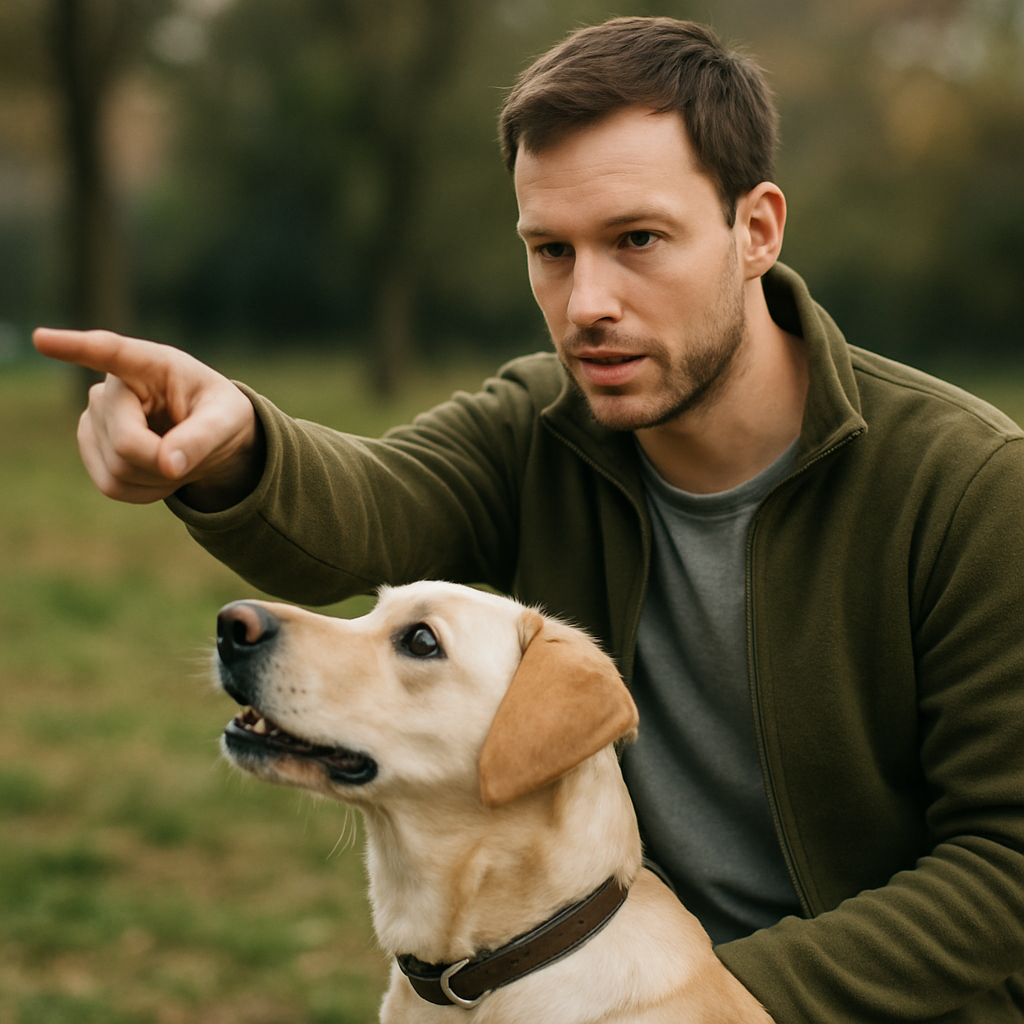
The cleanest demonstration of attention-state sensitivity in dogs is Call and colleagues (2003). In a series of experiments where the dog was forbidden from taking a piece of food, the dog was much more likely to take the food when the human had their back turned, eyes closed, or was distracted, than when the human was watching directly[^call2003]. The dog tracked not just whether the human was present, but the human's current visual access to the food.
The dog's ability to follow human communicative cues — pointing, gaze direction, head turns — is unusually strong by comparative standards. In hidden-food tasks, dogs follow a human pointing gesture to find food at well-above-chance rates from puppyhood; chimpanzees, in matched tasks, perform much worse[^brauer2006]. This is the finding that motivates the "social dog, causal ape" framing: dogs are attuned to people in ways the typical ape, in human-designed tasks, is not.
Topál and colleagues (2009) further showed that the social-cognition profile of dogs is shifted toward the human-infant pattern of cue-following — dogs respond to ostensive communicative signals (eye contact, infant-directed prosody) much as human infants do, in a way that wolves raised under similar conditions do not[^topal2009]. The shape of the toolkit looks more like a domesticated social adaptation than a generic mammalian capacity.
What Dogs Do Not Reliably Show
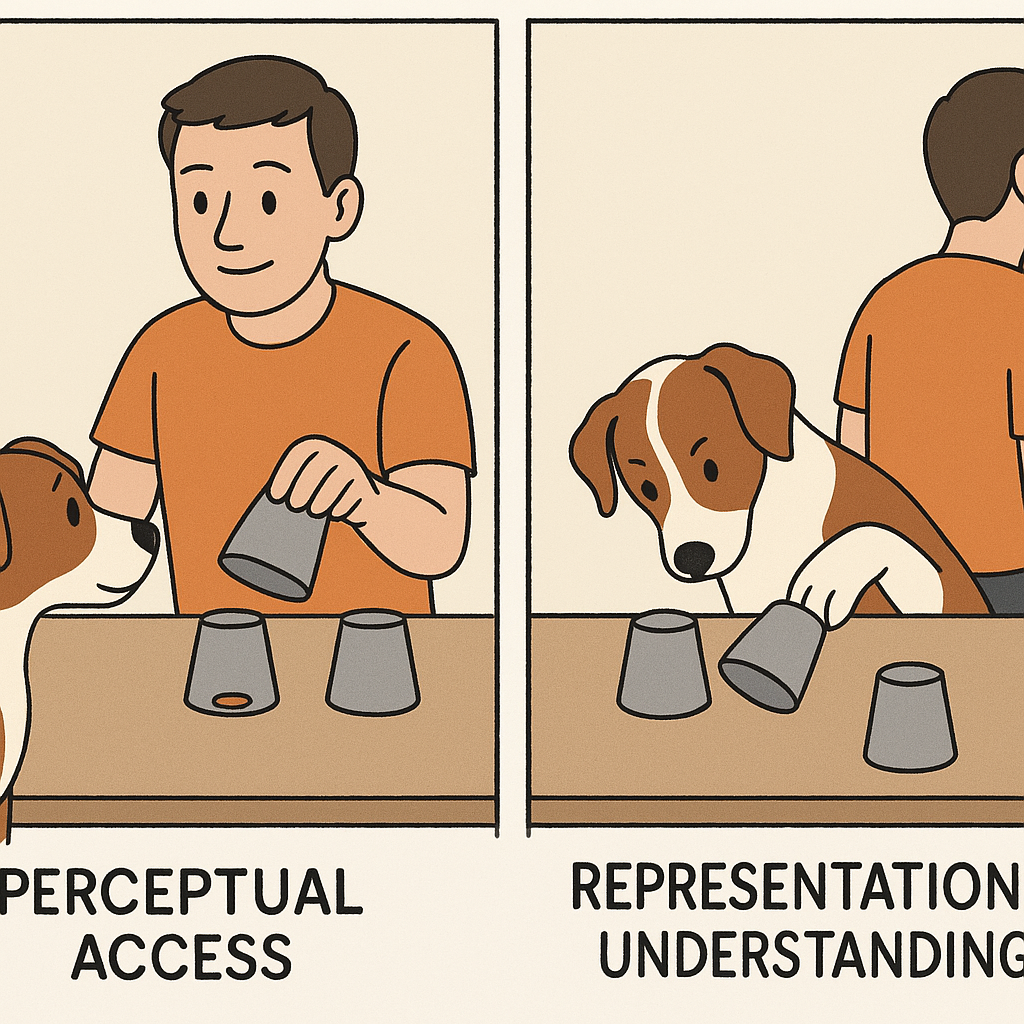
The picture is markedly weaker on representational tasks.
False-belief tasks adapted for dogs have produced largely negative results: dogs do not show evidence of representing what a human "thinks" is true when the dog itself knows the world to be different. The same broad picture holds for tasks that require attributing knowledge states based on the human's prior experience rather than their current perceptual access. The dog's social cognition is, on the available evidence, perceptually anchored — what the human can see now, where the human is pointing now — rather than representational.
Within the perceptual domain itself, the picture is mixed. Some studies find that dogs adjust food-stealing behaviour based on the lighting condition in the room (taking less from the table when a light is on, even when the human's eyes are closed), which can be read either as a representational signal or as a learned association from prior contexts. The conservative reading of the literature is that the perceptual capacity is robust; representational ToM, in the strong human sense, is not demonstrated.
What This Means for the "My Dog Knows How I Feel" Experience
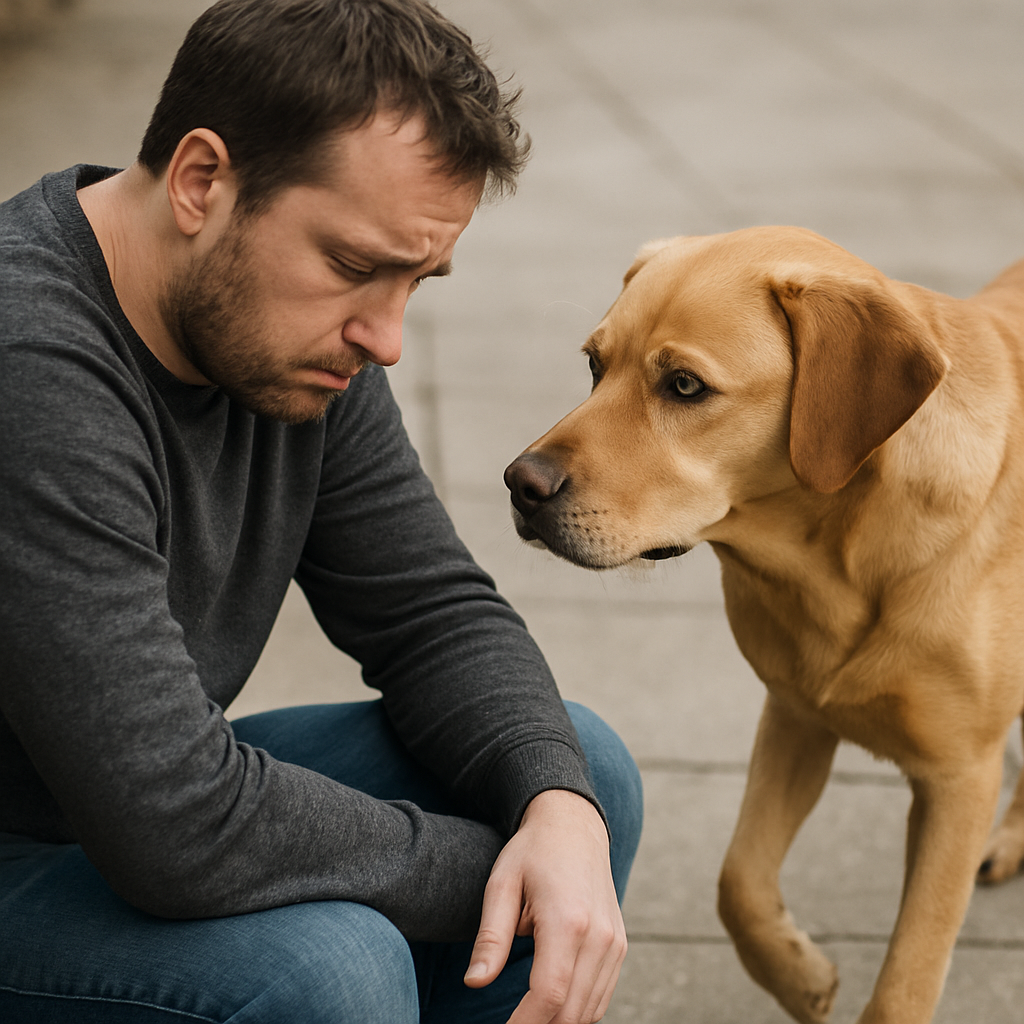
The everyday experience that the dog reads the handler's emotional state is, on the evidence, real, but it is mostly the perceptual capacity at work — the dog is reading body, voice, and gaze cues, not the handler's mental state in the sense that a friend asking "are you ok?" is. This is a substantively impressive capacity in its own right; it does not need the false-belief overlay to be remarkable.
The places where the popular framing tends to overshoot are emotionally specific:
- "Guilt." What looks like guilt at the chewed shoe is appeasement behaviour in response to handler tone and posture, not retrospective self-attribution of wrongdoing. The classic Horowitz (2009) experimental-and-trade-book treatment unpacks this in detail[^horowitz2009].
- "Empathy." Dogs respond to human distress, sometimes by approaching, sometimes by avoiding. Whether this is empathy in any rich sense, or perceptual sensitivity to a salient stimulus, is not settled by the available evidence.
- "Knowing what you want." The dog reading where the handler is looking and walking toward the door is not the same as the dog representing the handler's plan; it is the dog acting on the perceptual cue.
The point is not that the dog's behaviour is uninteresting; it is that the cognitive operation behind it is more constrained than the popular framing assumes.
Practical Implications
For owners, the practical translation of the cognitive picture is clear:
- Lean on perceptual cues. Dogs follow gaze, body orientation, pointing, and tone reliably. These are the signals to use deliberately.
- Do not assume conceptual understanding. A dog does not understand "why" the handler is upset; it reads the surface signals. "Lecturing" the dog after a misbehaviour is not communicating with the dog; it is producing a stress signal the dog will read as threat.
- Use the social orientation deliberately. The dog's strong attunement to the handler is a training resource. Eye contact, name response, and orientation cues work because the dog is built to read them.
Key Takeaways
- Dogs show robust perceptual social cognition: they read human attention, gaze, and pointing at unusually high rates compared with most other species (Call 2003; Bräuer 2006; Topál 2009).
- Dogs do not show convincing evidence of representational theory of mind in false-belief tasks; the cognitive toolkit is heavy on the perceptual side, light on the representational side.
- The everyday "my dog reads me" experience is real and is mostly the perceptual capacity at work; popular emotional overlays (guilt, empathy in a rich sense) overshoot the evidence.
- Practical training works with the perceptual cues the dog actually reads — gaze, body, tone — rather than the mental states it does not.
Sources & further reading
- Call, J.; Bräuer, J.; Kaminski, J.; Tomasello, M.. (2003). Domestic dogs (Canis familiaris) are sensitive to the attentional state of humans. Journal of Comparative Psychology, 117(3), 257-263. https://doi.org/10.1037/0735-7036.117.3.257
- Bräuer, J.; Kaminski, J.; Riedel, J.; Call, J.; Tomasello, M.. (2006). Making inferences about the location of hidden food: social dog, causal ape. Journal of Comparative Psychology, 120(1), 38-47. https://doi.org/10.1037/0735-7036.120.1.38
- Topál, J.; Gergely, G.; Erdőhegyi, Á.; Csibra, G.; Miklósi, Á.. (2009). Differential sensitivity to human communication in dogs, wolves, and human infants. Science, 325(5945), 1269-1272. https://doi.org/10.1126/science.1176960
- Horowitz, A.. (2009). Inside of a Dog: What Dogs See, Smell, and Know. Scribner. https://www.simonandschuster.com/books/Inside-of-a-Dog/Alexandra-Horowitz/9781416583431