Two Kinds of Sniffing
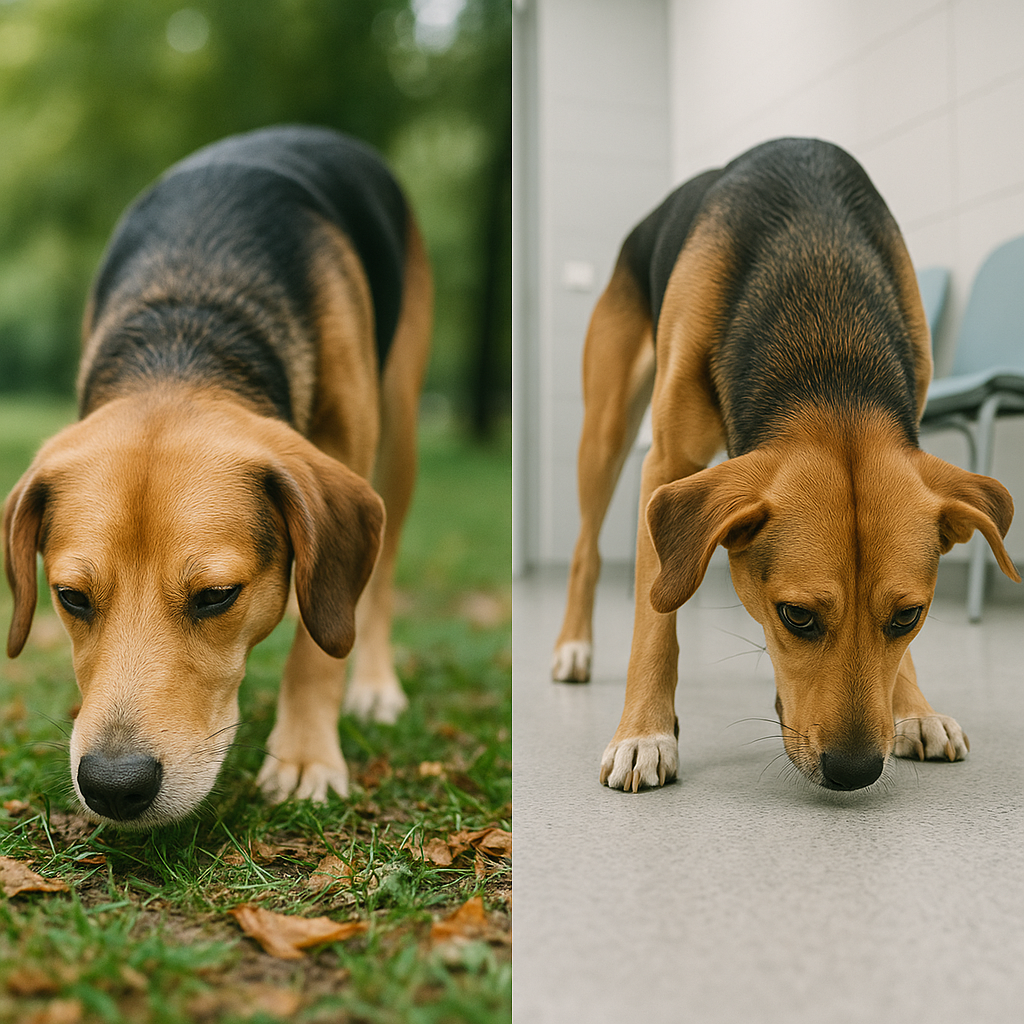
Sniffing is a dog's primary information-gathering behaviour. The canine olfactory system has roughly 200 to 300 million olfactory receptors (compared to roughly 5 million in humans), and the brain area devoted to scent processing is proportionally far larger than in humans. For most of a dog's day, sniffing is the equivalent of a human reading the news, scrolling through social media, and chatting with neighbours combined: it is how the dog knows what is happening in their world.
That kind of sniffing — exploratory, investigatory, information-gathering — is the dominant kind. The dog sniffs because the world is interesting and they have a sensory system that makes sniffing rewarding.
But sniffing also appears in another context that has nothing to do with information-gathering: as a displacement behaviour. The dog is stressed, conflicted, or under pressure they cannot resolve, and the displaced motor output is sniffing — directed at the ground, often with no obvious investigative target, often when the situation is socially or environmentally demanding. This is stress sniffing, and it is a different behaviour with different meaning.
What Displacement Behaviour Is
In ethology, a displacement behaviour is a behaviour that appears when the animal is in an internal-conflict state — conflicting motivations, unresolvable demands, anxiety without a clear behavioural escape — and the behavioural output "spills over" into a behaviour from a different motivational system. The behaviour is real, it occupies the animal's attention, but it is not directly addressed at the situation that produced the conflict.
In dogs, common displacement behaviours include:
- Sudden ground-sniffing in social contexts.
- Lip-licking when not eating.
- Yawning when not tired.
- Paw-lifting (a brief raised paw, not the offered paw of a trained behaviour).
- Body-shaking (a full shake-off, like after swimming) outside of being wet.
- Scratching when not itchy.
- Sudden grooming.
These behaviours are normal, common, and not pathological in themselves. They are the dog's nervous system processing a situation that exceeds the dog's immediate capacity to resolve. The clinical relevance is what they indicate about the dog's state, not the behaviours themselves.
The Rugaas "calming signals" framework popularised the recognition of these behaviours among trainers. The Beerda group's empirical work measured these behaviours as indicators of stress in controlled studies and confirmed their association with stressful conditions[^beerda].
Distinguishing Exploratory From Displacement Sniffing
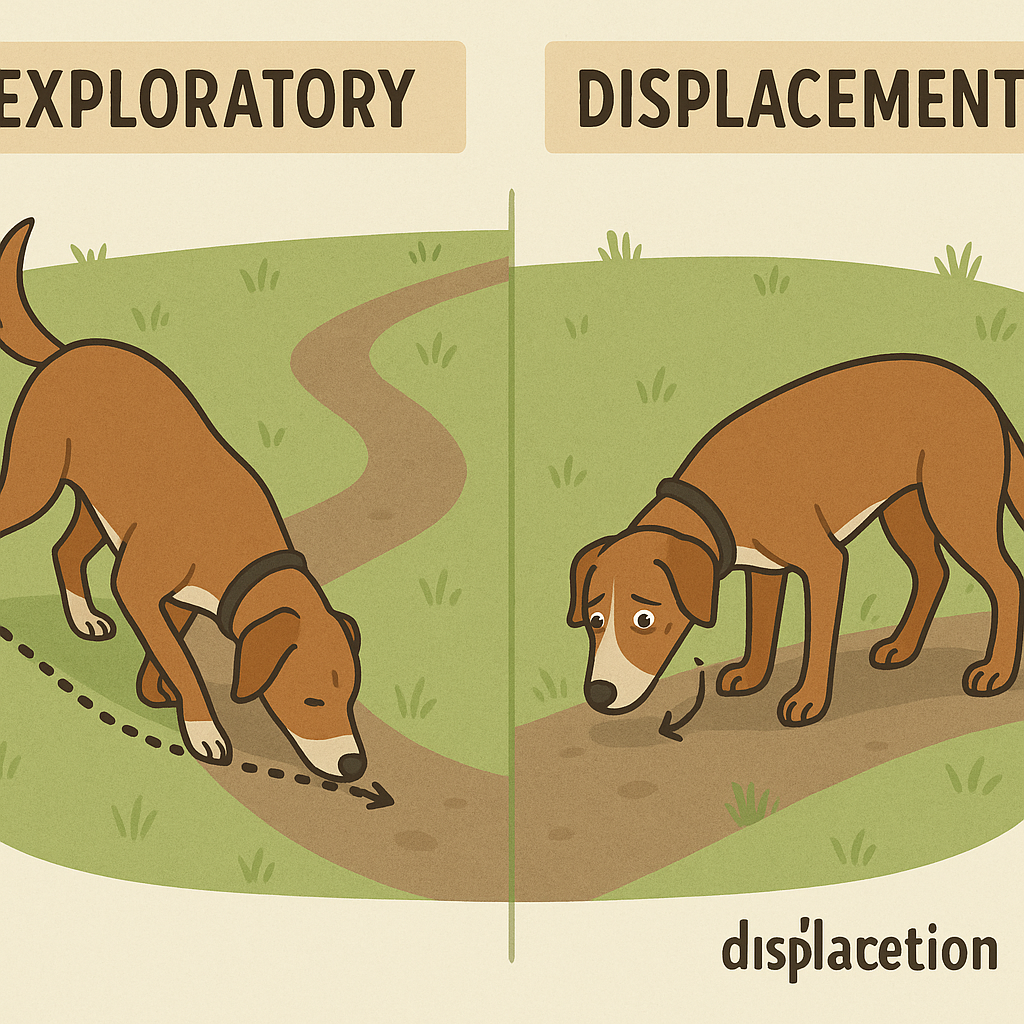
The behaviours look superficially similar — both involve the dog's nose to the ground — but the context and pattern differ:
Exploratory sniffing:
- Has an apparent target (a specific spot, a piece of grass, an object).
- Persists with intentional movement (the dog tracks a scent, follows a trail).
- Occurs in low-pressure contexts (calm walks, novel environments, off-leash exploration).
- The dog is otherwise relaxed in body language.
- The dog can be redirected without showing other stress signs.
Displacement (stress) sniffing:
- No apparent target — the dog is sniffing the ground in front of them with no direction.
- Brief and repeated rather than sustained tracking.
- Occurs in pressure contexts (training sessions where errors are happening, social encounters, vet visits, novel environments with intimidating elements).
- Co-occurs with other displacement behaviours (lip-licking, yawning, looking-away).
- The dog's body language shows additional stress signs (tense posture, low tail, pinned ears, "whale eye").
- The sniffing is doing the dog something — it does not look like investigation.
A useful test: in the same context, does the dog also show other stress signals? If yes, the sniffing is more likely displacement. If the dog is otherwise calm, with relaxed body language, and the sniff has a clear target, it is more likely exploratory.
Common Contexts for Stress Sniffing
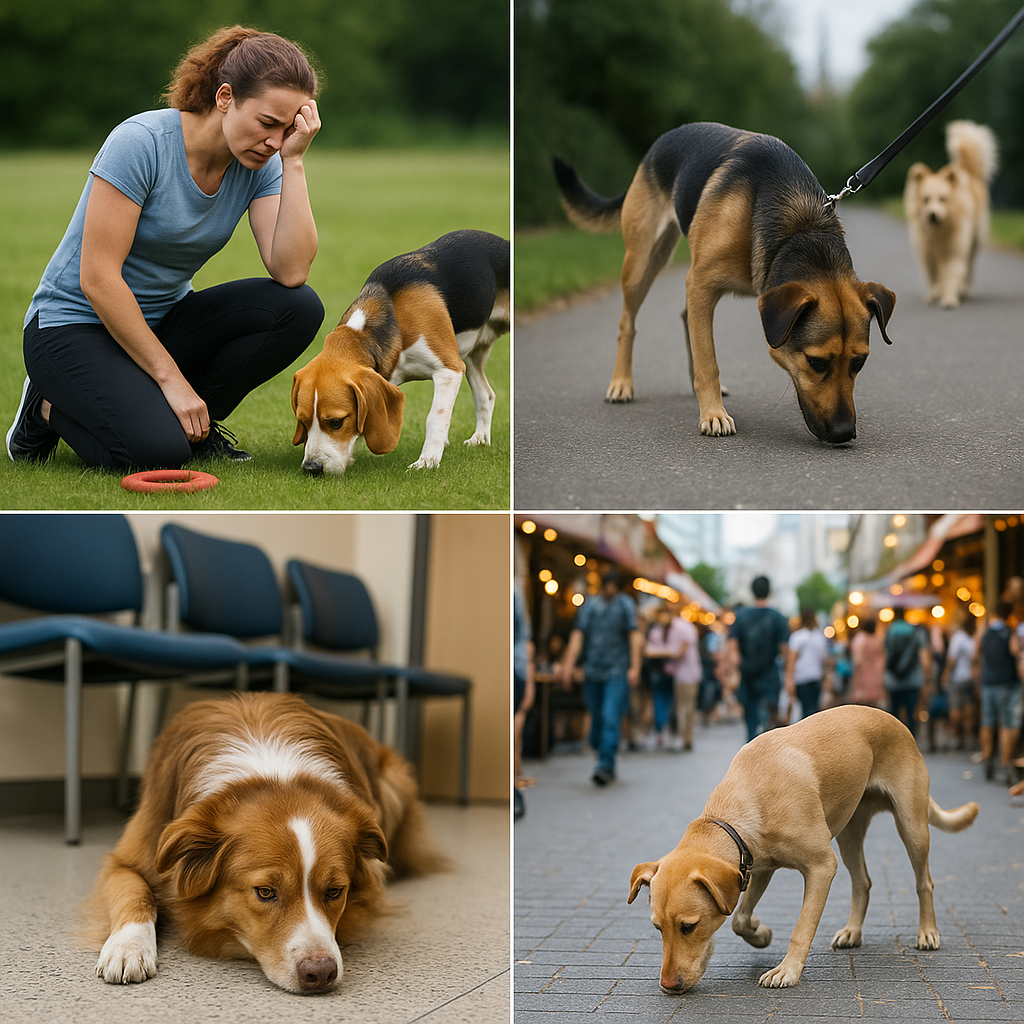
A short list of where stress sniffing typically appears:
- Training sessions where the dog is erring. The dog has been asked for a behaviour, has not produced it, and the handler is repeating the cue or showing frustration. The dog suddenly drops their nose to the floor and starts sniffing.
- Approach to an unfamiliar dog or person. The dog is on leash, the other dog/person is approaching, and the dog turns sideways and starts sniffing the ground.
- Vet office or grooming environment. The dog is in the waiting room or on the table and intermittently sniffs the floor.
- Multi-dog social settings where the dog is not comfortable. A new dog has joined; the dog sniffs the ground rather than engaging.
- Loud or chaotic environments. Festivals, busy markets, places with many simultaneous demands on the dog's attention.
Recognising the context helps interpret the behaviour. Sniffing in a quiet park with no apparent stressors is almost certainly exploratory; sniffing in a vet's office likely is not.
Why It Matters Practically
The distinction matters because the appropriate response is different.
For exploratory sniffing, the answer is generally to allow it. Sniffing is the dog's main cognitive activity outdoors and forced disengagement (constant pulling away from sniff opportunities) reduces the welfare value of the walk. Some practitioners explicitly build "sniff time" into walks as enrichment.
For stress sniffing, the answer is to recognise the underlying state and address the source. The dog is signalling that the situation is exceeding their capacity. The right responses include:
- Reducing the pressure. Increase distance from the trigger, simplify the training task, end the session, leave the environment.
- Not punishing or correcting the sniff. The sniff is a symptom, not a misbehaviour. Punishing it does not change the underlying state and adds further pressure.
- Not interpreting it as distraction or stubbornness. The dog has not "stopped listening" because they are bored; they have gone over threshold and the displacement behaviour is the consequence.
- Watching the broader pattern. Repeated stress sniffing in a recurring context (e.g., every training session, every vet visit) indicates that the context needs to be modified or the dog needs to be desensitised to it.
What This Does Not Imply
- Not all sniffing on a walk is stress. The default interpretation is exploratory; stress is a particular pattern in particular contexts.
- Stress sniffing is not pathological in itself. It is a normal behavioural response to elevated arousal; the question is whether the underlying situation is something to address.
- A dog who never displays displacement behaviours is not necessarily stress-free. Some dogs internalise more visibly than others; absence of displacement signs does not equal absence of stress.
What Is and Is Not Settled
Settled: displacement behaviours including sudden sniffing are well-established stress indicators in dogs (Beerda et al. 1997, 1998; broader ethological literature)[^beerda]; the Rugaas calming-signals framework popularised practitioner recognition of these signals; Horowitz's Being a Dog (2016) covers the broader olfactory and behavioural context[^horowitz].
Not settled: the precise quantitative reliability of any single displacement sign as a stress indicator across breeds and individual dogs; the comparative weight of sniffing vs. other displacement signs.
Key Takeaways
- Sniffing in dogs has two main forms: exploratory (information-gathering, the dominant kind) and displacement (a stress-related "spill-over" behaviour).
- Displacement sniffing typically appears in pressure contexts, has no clear target, is brief and repeated, and co-occurs with other stress signs (lip-licking, yawning, paw-lifting).
- Distinguishing the two matters: exploratory sniffing is benign or welcome; displacement sniffing is a signal to reduce pressure.
- The right response to stress sniffing is to lower the situation's demands, not to punish the sniff or interpret it as distraction.
- Beerda 1997/1998 (empirical), Rugaas (practitioner framework), and Horowitz 2016 (broader synthesis) cover the framework.
Sources & further reading
- Beerda, B.; Schilder, M. B. H.; van Hooff, J. A. R. A. M.; de Vries, H. W.. (1997). Manifestations of chronic and acute stress in dogs. Applied Animal Behaviour Science, 52(3-4), 307-319. https://doi.org/10.1016/S0168-1591(96)01131-8
- Horowitz, A.. (2016). Being a Dog: Following the Dog into a World of Smell. Scribner. https://www.alexandrahorowitz.net/
- Journal of Veterinary Behavior. Journal of Veterinary Behavior. Elsevier. https://www.sciencedirect.com/journal/journal-of-veterinary-behavior