Why Breed Shapes Play
Play in canids is closely related to predator motor patterns. The behaviours that make up play — chasing, stalking, grabbing, wrestling, body-slamming, mouthing — are the same motor patterns the species uses in predation, hunting, and intra-species communication, expressed in a play context with reduced arousal and explicit signalling (the play bow, the play face) that the behaviour is non-serious.
Domestic dog breeds were selected for specific subsets of the predator motor sequence, with some patterns enhanced and others suppressed. Coppinger & Coppinger's functional-breed-group framework lays out how breed selection shaped these patterns: herding breeds were selected for the eye-stalk-chase phase with the kill-bite suppressed; sighthounds for the chase-grab-bite phase; pointers for the eye-stalk-point phase with succeeding phases suppressed; retrievers for the soft-mouthed grab-and-carry phase; terriers for the grab-and-shake kill-bite; livestock guardians for body-blocking and threat displays without the predatory chase[^coppinger].
These same patterns shape how the breed plays. Play is essentially the predator motor sequence with the lethal endpoint removed and the social signalling enabled.
The Main Patterns
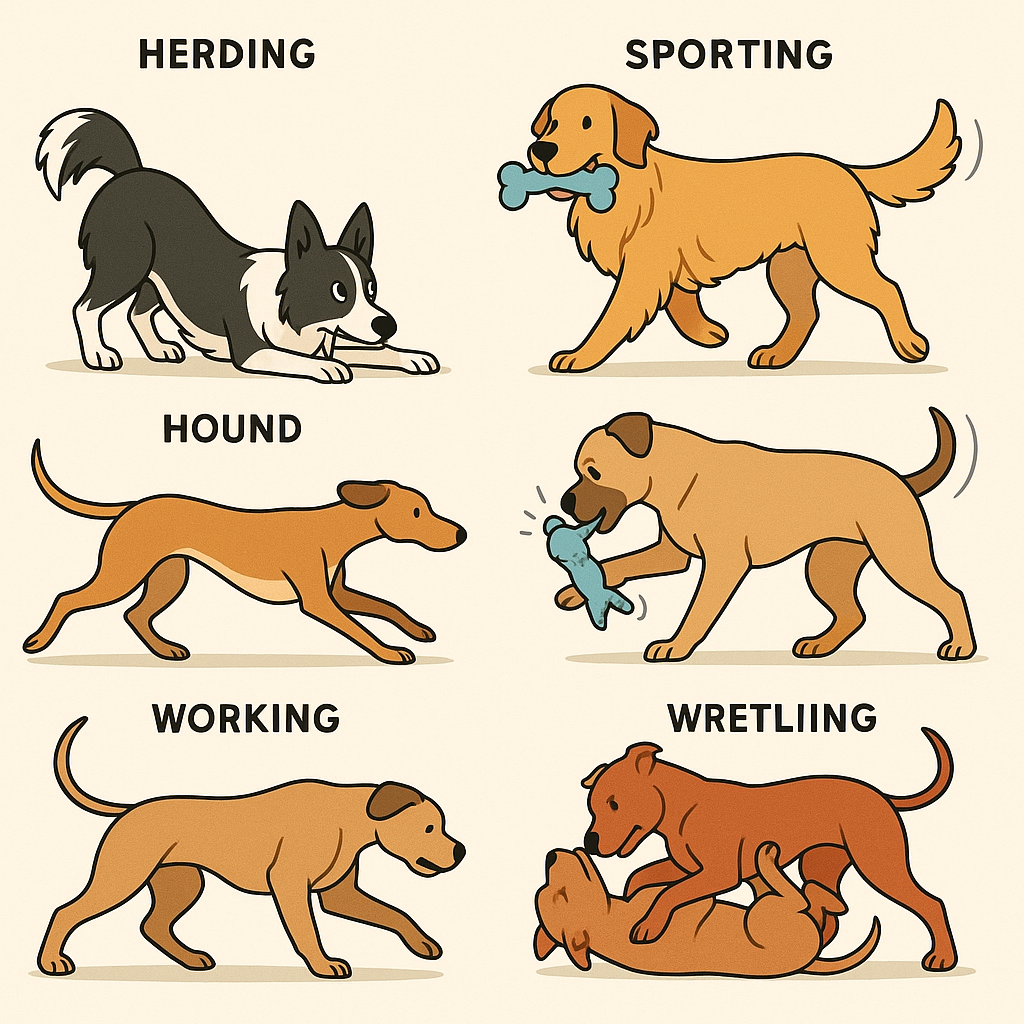
A short tour of typical play styles by functional group:
Herding breeds (border collies, Australian shepherds, Australian cattle dogs, German shepherds in some lines). Play often features:
- Intense visual focus (the "eye") — staring, low body posture, stalking approach.
- Circling and body-blocking — running around the playmate, cutting them off, redirecting their movement.
- Chase-pursuit — chasing the playmate, often without the grab-bite that a terrier or sighthound would add.
- Lower mouth pressure — the kill-bite is suppressed; mouthing during play is typically gentle.
- Higher arousal threshold — the play can become intense and may need handler intervention to settle.
Sporting breeds (retrievers, spaniels, setters, pointers). Play often features:
- Chase-and-retrieve patterns — fetching, carrying, returning.
- Soft mouth — the grab is gentle (retrievers' soft-mouthed selection); even the play-grab is bite-inhibited.
- Cooperative-feeling play — the play often involves sharing or alternating roles.
- Lower arousal escalation — most sporting breeds settle out of play more readily than working or herding breeds.
- Less body-slam — the body-contact components are typically lighter.
Terriers. Play often features:
- Grab-and-shake — the play-grab includes a brief shake motion characteristic of the terrier kill-bite.
- High arousal — terriers play intensely and can escalate quickly.
- Tug — many terriers favour tug-and-pull play with toys or with playmates' bodies.
- Less inhibited mouthing — the play-bite can be harder than in retrievers.
Sighthounds (greyhounds, salukis, whippets). Play often features:
- Chase pursuit — extended chase sequences with the playmate or with a moving object.
- Body-bumping — chest-bumps and brief body contact during the chase.
- Less wrestling — sighthounds typically do not engage in extended ground wrestling in the way mastiffs or pit-bull types might.
- Quick disengagement — the chase ends and the dog may move on without prolonged engagement.
Guardian and mastiff-type breeds (Rottweilers, mastiffs, Bernese mountain dogs, livestock guardians). Play often features:
- Body-slam and wrestling — heavy physical contact play.
- Mouthing without intense bite-shake — the play-mouth is wide-open but not the terrier shake.
- Slower escalation — the play often builds gradually rather than the sudden intense spikes of terriers.
- Body-blocking — using the larger body mass to control space.
Bull breeds and pit-bull-type breeds. Play often features:
- Wrestling and ground-play — extensive contact and grappling.
- High arousal sustainability — the play can sustain at high arousal for extended periods.
- Mouthing of the playmate's neck and shoulders — without the kill-bite endpoint.
- Body-on-body contact — much of the play is physical contact rather than chase-pursuit.
The Mismatched-Play-Style Problem
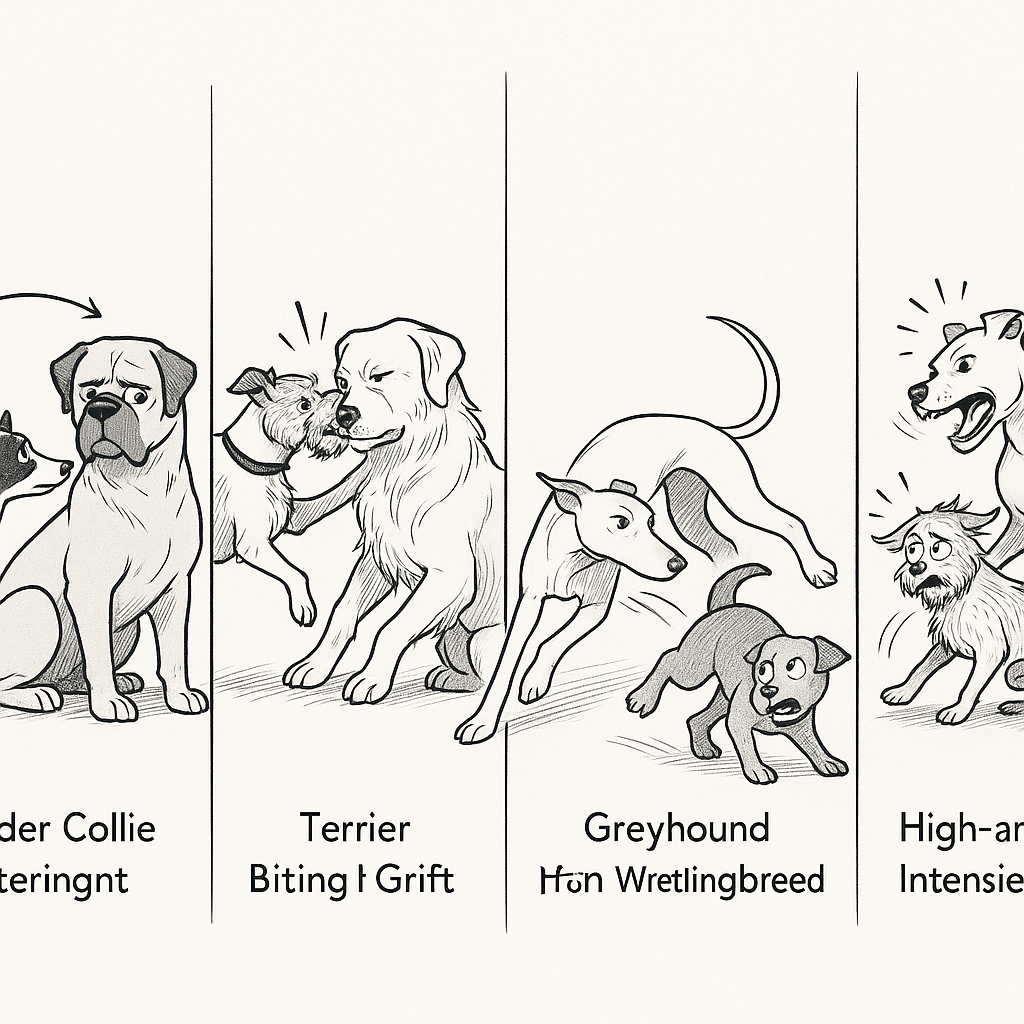
Play interactions between dogs whose play styles diverge considerably can break down for predictable reasons:
Herding-style play meeting guardian-style play. A border collie's stare-and-circle is play. A guardian-type dog reading the stare-and-circle as a threat display can respond defensively. The herder is increasingly intense in their attempt to engage; the guardian is increasingly defensive. Without intervention, the interaction can escalate.
Terrier grab-and-shake meeting retriever soft-mouth play. The terrier's play-grab includes mouth pressure that the retriever's soft-mouthed history is not adapted to. The retriever may yelp, retreat, or react defensively; the terrier reads the response as further play and intensifies.
Sighthound chase-pursuit meeting wrestling-prone breeds. The sighthound chases; the wrestling-style breed expects to grapple. The chase ends, the wrestler tries to engage, the sighthound moves on. The wrestler may pursue more insistently and the sighthound may escalate or disengage.
High-arousal terriers or pit-bull-types meeting low-threshold breeds. Sustained high-arousal play that one dog finds normal can overwhelm a partner with a lower arousal threshold.
These are tendencies, not absolutes. Many cross-breed play interactions go fine; many same-breed interactions go badly. But recognising the patterns helps owners read interactions and intervene before mismatches escalate.
Within-Group Variation
Breed-typical patterns describe central tendencies, not individual destiny. Substantial within-breed variation exists:
- Working-line vs. show-line differences are often larger than breed-group differences.
- Individual learning histories and socialisation experiences shape play independently of breed.
- Mixed-breed dogs often display partial elements of multiple groups.
The breed framework is a starting hypothesis ("this border collie probably plays with eye-stalk-chase patterns") to be tested against the individual dog's actual behaviour, not a deterministic rule.
Practical Implications
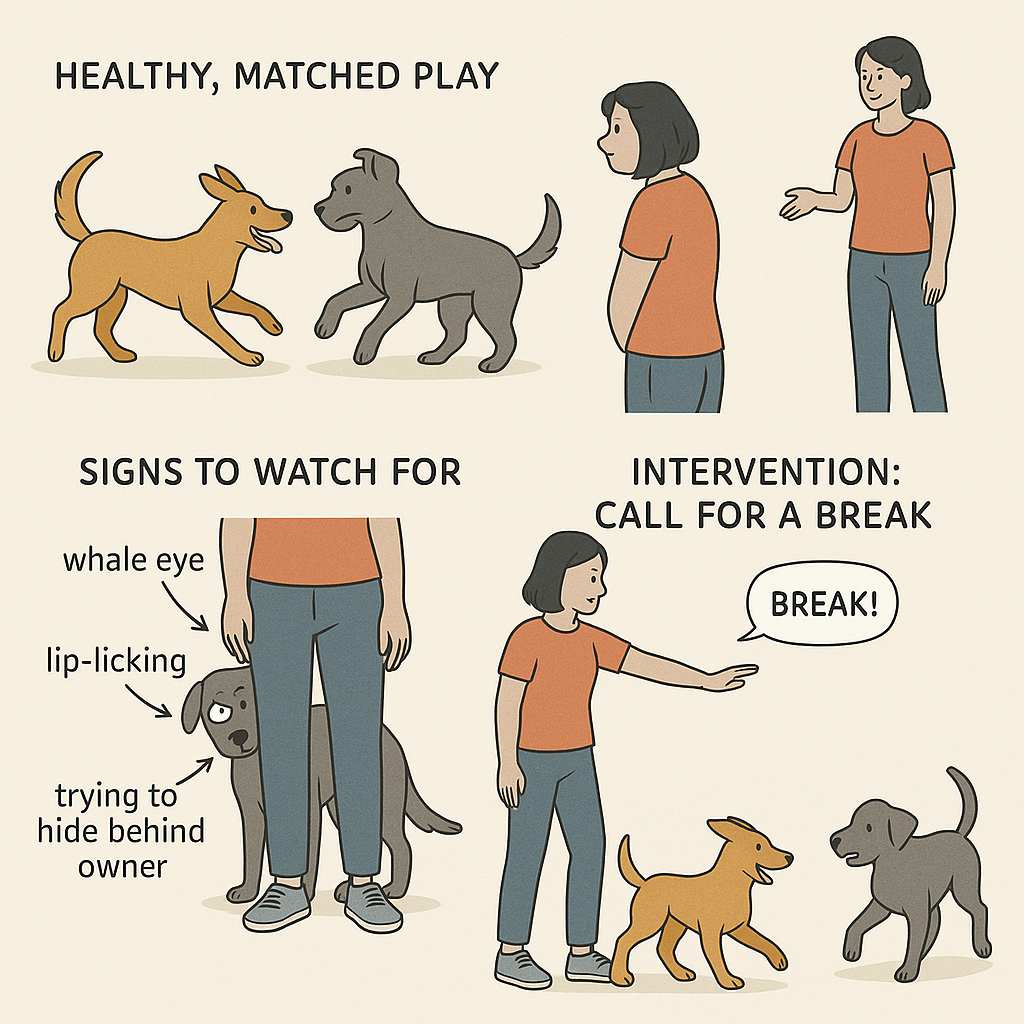
Match play partners thoughtfully. Dogs whose play styles align tend to have more sustainable play. Same-functional-group matches (two retrievers, two herders, two sighthounds) often work well. Cross-group matches need observation; some work, some do not.
Recognise breed-typical patterns as play, not threat. The herder's stare-and-circle is play. The terrier's grab-and-shake is play. The mastiff's body-slam is play. Reading these correctly within their breed context is part of dog-park literacy.
Watch for the dog who is not enjoying the play. Regardless of breed-typical patterns, if one dog is trying to disengage, hiding behind their owner, showing stress signals (lip-licking, yawning, whale eye — see the stress-sniff article for the broader stress-signal context), or turning away repeatedly, the play is not mutual and should be interrupted.
Heavy play between mismatched-arousal-threshold partners often needs management. A high-arousal dog playing with a lower-threshold partner can produce one-sided play; periodic interruptions ("happy breaks", brief redirects) help reset the arousal level.
What Is and Is Not Settled
Settled: predator motor patterns are differentially expressed across breeds (Coppinger & Coppinger framework)[^coppinger]; breed-typical behavioural patterns appear in C-BARQ data and other validated instruments[^cbarq]; play styles vary across functional breed groups in ways that match the predator-motor-pattern framework.
Not settled: the precise quantitative magnitude of breed-group play-style differences across populations; the optimal protocols for mixing play styles in group settings; the relative weight of breed vs. individual learning history in play preferences.
Key Takeaways
- Play in dogs is the predator motor pattern with the lethal endpoint removed and social signalling enabled.
- Breed selection shaped which parts of the predator sequence are emphasised; play styles follow the same patterns.
- Main groups: herding (eye-stalk-chase), sporting (chase-and-retrieve, soft-mouth), terriers (grab-and-shake), sighthounds (chase-pursuit), guardians/mastiffs (body-slam wrestle), bull breeds (sustained wrestling).
- Mismatched styles can produce play that breaks down or escalates; recognising the patterns helps interpret interactions.
- Within-breed variation is substantial; the framework is a starting hypothesis, not a deterministic rule.
Sources & further reading
- Coppinger, R.; Coppinger, L.. (2001). Dogs: A Startling New Understanding of Canine Origin, Behavior, and Evolution. Scribner. https://www.simonandschuster.com/
- Hsu, Y.; Serpell, J. A.. (2003). Development and validation of a questionnaire for measuring behavior and temperament traits in pet dogs. Journal of the American Veterinary Medical Association, 223(9), 1293-1300. https://doi.org/10.2460/javma.2003.223.1293
- Horowitz, A.. (2009). Inside of a Dog: What Dogs See, Smell, and Know. Scribner. https://www.alexandrahorowitz.net/
- Journal of Veterinary Behavior. Journal of Veterinary Behavior. Elsevier. https://www.sciencedirect.com/journal/journal-of-veterinary-behavior
- American Veterinary Society of Animal Behavior. AVSAB Position Statements on Play Behaviour. AVSAB. https://avsab.org/resources/position-statements/