The Most Common Owner Complaint
The owner has spent weeks installing sit, down, stay, and recall. The dog performs all four reliably in the kitchen. At the park, the dog stares at the owner blankly when asked to sit, does not respond to the recall when a squirrel appears, and acts as though they have never heard the cues before. The owner's conclusion is usually one of:
- "The dog is being stubborn."
- "The dog is dominant and refusing to obey."
- "The dog is too distracted to listen."
- "The dog must not really know the cue."
The first two conclusions are wrong. The third is partly true and the fourth is partly true, but neither captures the actual mechanism. The dog is not being stubborn, dominant, or unwilling. The dog literally does not yet know that the kitchen-sit and the park-sit are the same behaviour. The cue has been conditioned in one context, and the dog has not generalised it to others. This is stimulus generalization — or, more precisely, the failure of it without explicit work.
Why a Behaviour Is Context-Bound by Default
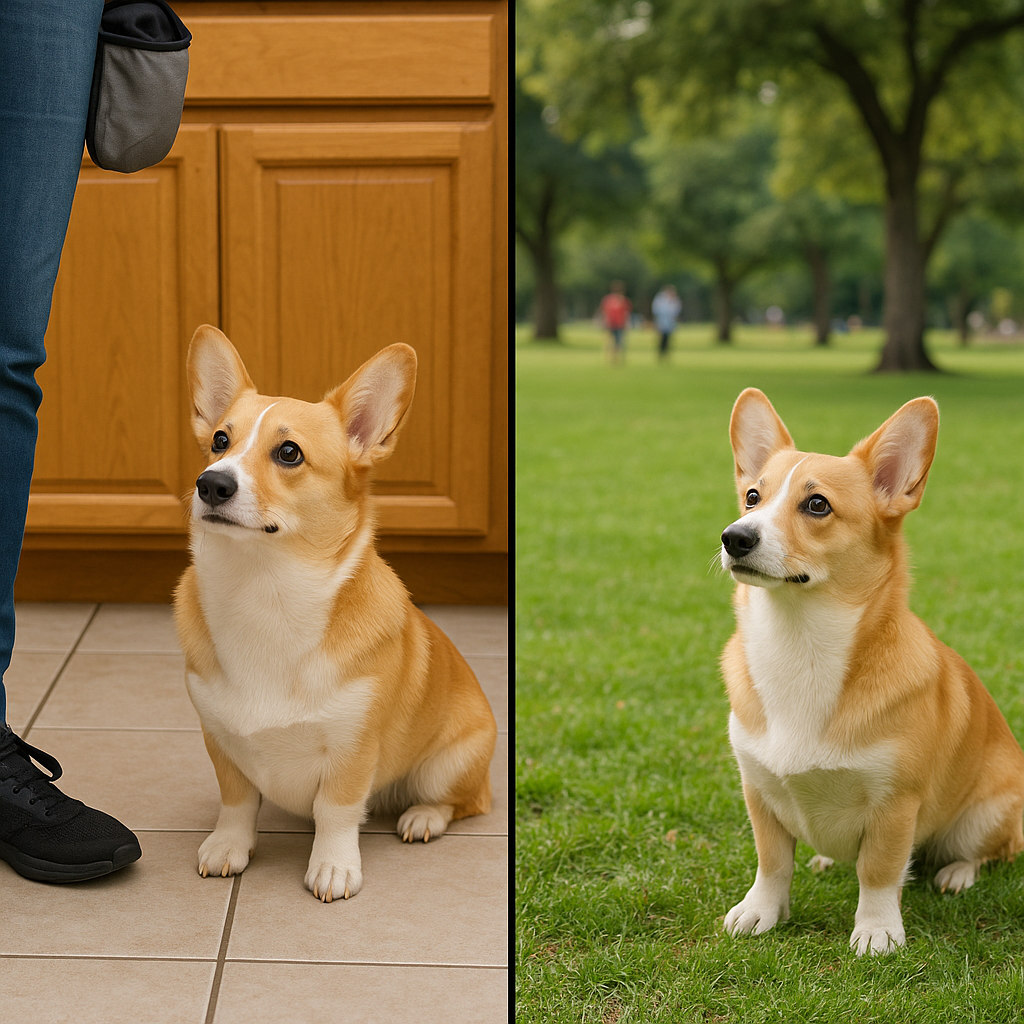
When a dog is conditioned to respond to a cue in a specific environment, the dog learns the cue and a constellation of context features that were present during conditioning. The "cue" in the dog's representation is not just the word "sit" — it is the word, the kitchen floor, the handler's specific posture, the angle of light from the window, the smell of the room, the absence of other dogs, the presence of the treat pouch, the sequence of behaviours that preceded the cue. All of these are features that co-occurred with the conditioning history.
The dog has not been disobedient at the park. The dog has been presented with a stimulus that — from the dog's perspective — is not the same stimulus as the one they were conditioned to respond to. Different floor, different smells, different distractions, different posture from the owner, different surrounding humans, no treat pouch in sight. The cue word is present, but it is buried in a context that does not match the conditioning history.
This is well-documented in the broader operant-conditioning literature: behaviours are context-bound until they are explicitly generalised, and the rate of spontaneous transfer is unreliable. The applied-animal-behaviour-science literature on context-dependent learning is consistent with the same conclusion[^aabs].
The Proofing Protocol
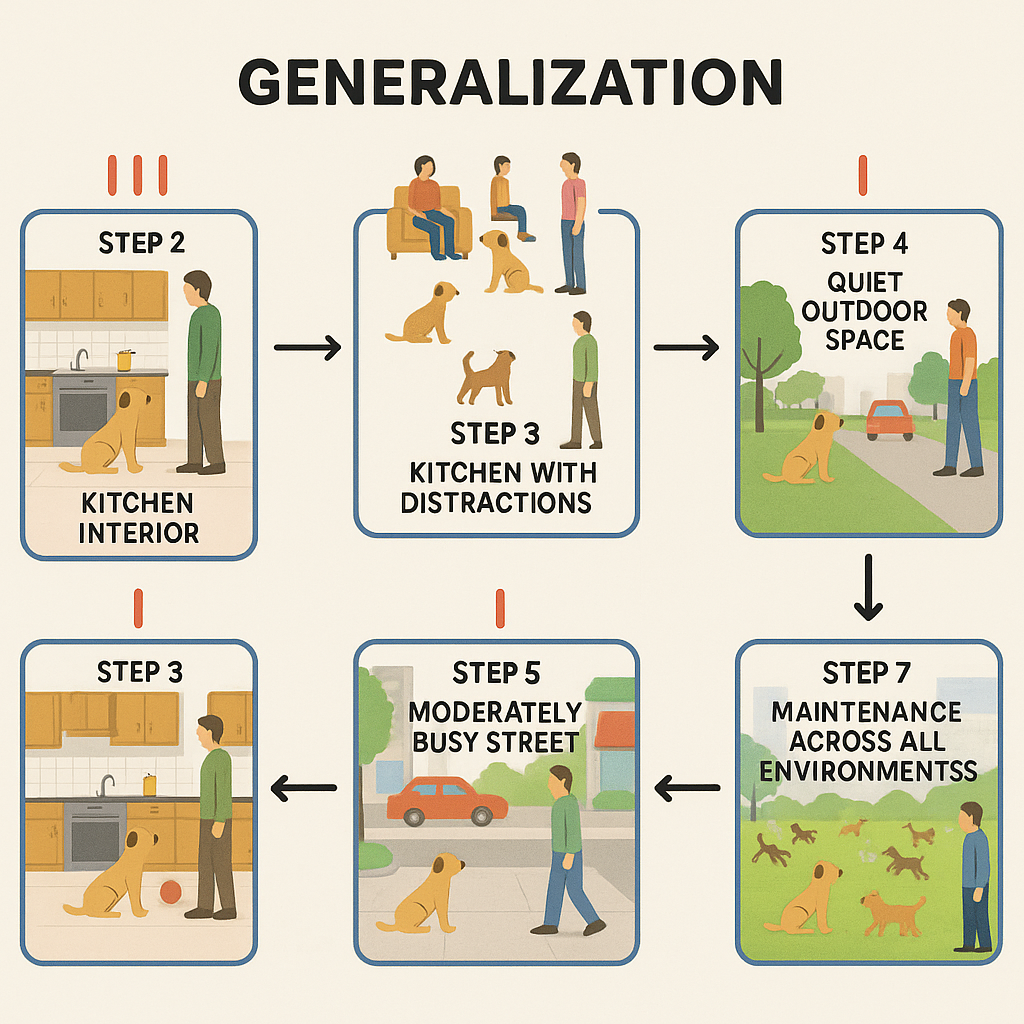
A workable protocol for generalising a behaviour across environments:
Step 1 — Establish the behaviour reliably in the original context. Before generalisation work begins, the dog should respond to the cue at near-100% reliability in the conditioning environment. Trying to generalise an unreliable behaviour wastes training time.
Step 2 — Vary one feature at a time. Change the room. Change the handler's posture (sitting, standing, kneeling). Change the time of day. Change the surface (carpet, tile, grass). Each variation is a separate small training step. Reinforce as if the behaviour is new — high rate of reinforcement, short sessions.
Step 3 — Add mild distractions in familiar environments. Practise the cue in the kitchen with the radio on, with a family member walking through, with the dog's toys on the floor. Mild distraction in a familiar environment is the bridge to unfamiliar environments.
Step 4 — Move to low-distraction novel environments. A quiet outdoor space at a quiet time, the hallway of an empty building, the back yard at dawn. Re-establish the cue at high rates of reinforcement.
Step 5 — Increase distraction gradually. A residential street at moderate-traffic time, the edge of a park (not the centre), a quieter section of a pet store. The increase is gradual; if the dog fails to respond, the distraction level is too high and should be reduced.
Step 6 — Add the high-distraction environment. The middle of the park, near other dogs, near food on the ground. By this stage, the dog has a robust history of responding across many contexts and the new environment is a small additional step rather than a leap.
Step 7 — Maintain across environments. A dog who has generalised the cue still benefits from periodic practice in varied contexts; without maintenance, behaviour can re-narrow toward the most-practised contexts.
Common Owner Errors
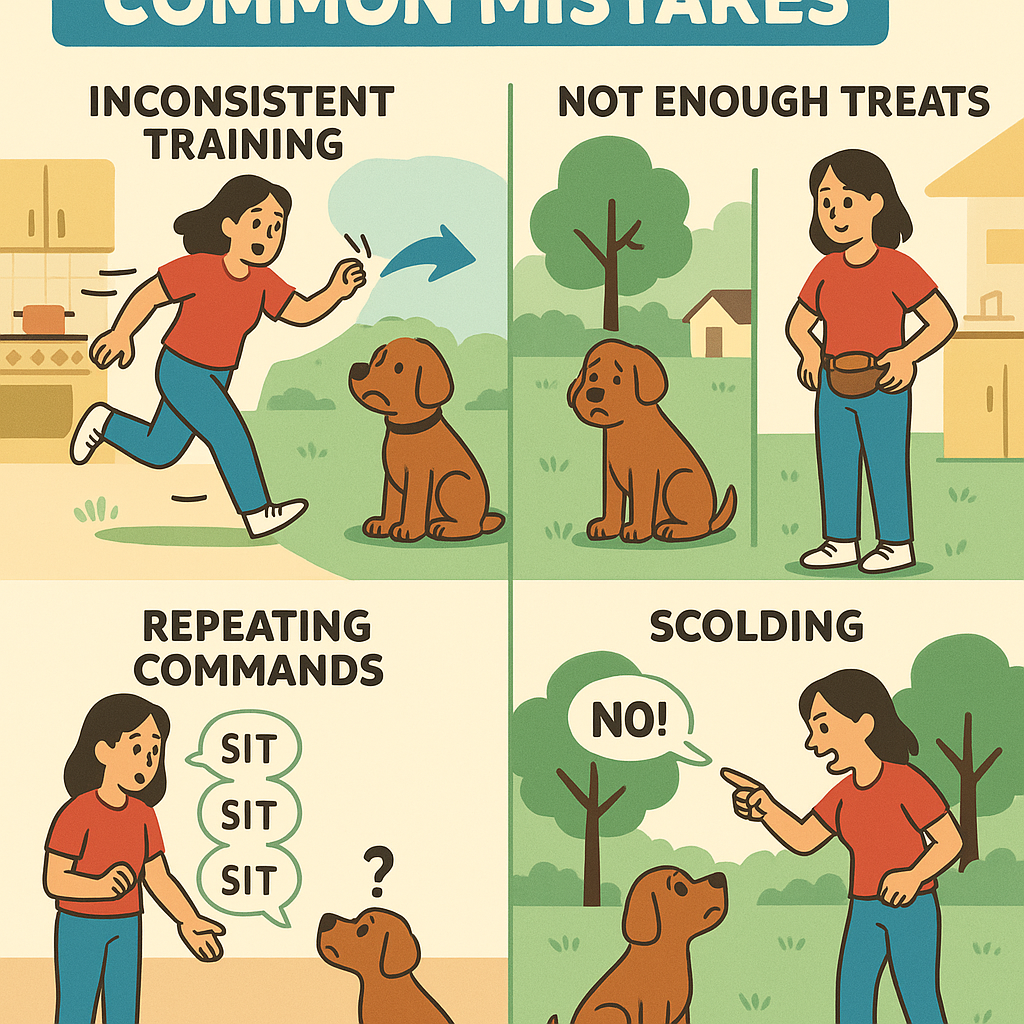
Things that go wrong:
Going too far too fast. The owner moves from the kitchen straight to the dog park. The dog fails. The owner concludes the dog is being stubborn. The fix is gradient: more intermediate steps, lower-distraction environments first.
Reducing reinforcement during generalization. The owner has thinned the reinforcement schedule at home and assumes the same schedule applies in the park. It does not. Each new environment is, from the dog's perspective, a re-introduction; reinforcement rate should temporarily return to near-installation levels.
Repeating the cue. The dog does not respond; the owner repeats the cue three times. The dog learns that the cue means "you might respond, or might not, and there will be repetitions". The fix is to give the cue once, wait briefly, and if there is no response, increase the distance from the distraction or simplify the context — not repeat.
Punishing the failure. The dog fails to respond at the park, and the owner scolds. The dog learns that the park is associated with scolding, which generalises the wrong way — the cue becomes a predictor of an unpleasant outcome in distracting contexts.
Treating the dog as having "forgotten". A dog who responds at home and not at the park has not forgotten anything. The behaviour is intact in the conditioning context; it has not yet been generalised. The owner's mental model should be "I have not finished training this yet" rather than "my dog has lost the behaviour".
A Practical Realistic Picture
Generalising a single foundation behaviour across the environments a typical pet dog encounters takes weeks of distributed practice — not because the behaviour is hard, but because each new context is a small additional training step and there are many contexts. A behaviour that is generalised across a dozen environments is robust; a behaviour generalised across two is fragile. The investment is worth it: the dog whose cues genuinely generalise is the dog who can be relied on outside the home.
What Is and Is Not Settled
Settled: behaviours conditioned in a single environment are context-bound by default and require explicit generalisation work to transfer reliably (broad operant-conditioning literature; applied-animal-behaviour-science treatment of context-dependent learning); positive-reinforcement-based generalisation is consistent with the AVSAB humane-training position[^avsab].
Not settled: the comparative effectiveness of specific generalisation protocols (one-feature-at-a-time vs. multi-feature variation) across breeds and individual learning histories.
Key Takeaways
- "My dog only listens at home" is overwhelmingly a generalization failure, not a disobedience issue.
- The cue, in the dog's representation, is bundled with a constellation of context features (room, posture, distractions, treat pouch); transfer to new contexts requires explicit re-training.
- Standard protocol: establish reliability at home → vary one feature at a time → mild distractions in familiar environments → low-distraction novel environments → graduated distraction → high-distraction environments → ongoing maintenance.
- Common errors: jumping levels, reducing reinforcement during generalization, repeating cues, punishing failures, treating the dog as "forgetful".
- The investment is weeks of distributed practice across many environments; the payoff is a dog whose cues genuinely transfer.
Sources & further reading
- Applied Animal Behaviour Science (journal). Applied Animal Behaviour Science. Elsevier. https://www.sciencedirect.com/journal/applied-animal-behaviour-science
- American Veterinary Society of Animal Behavior. (2021). AVSAB Position Statement on Humane Dog Training. AVSAB. https://avsab.org/resources/position-statements/
- Pryor, K.. (1999). Don't Shoot the Dog! The New Art of Teaching and Training (Revised Edition). Bantam Books. https://www.simonandschuster.com/books/Dont-Shoot-the-Dog/Karen-Pryor/9781982106461