What a Release Cue Is and Why It Is Missing
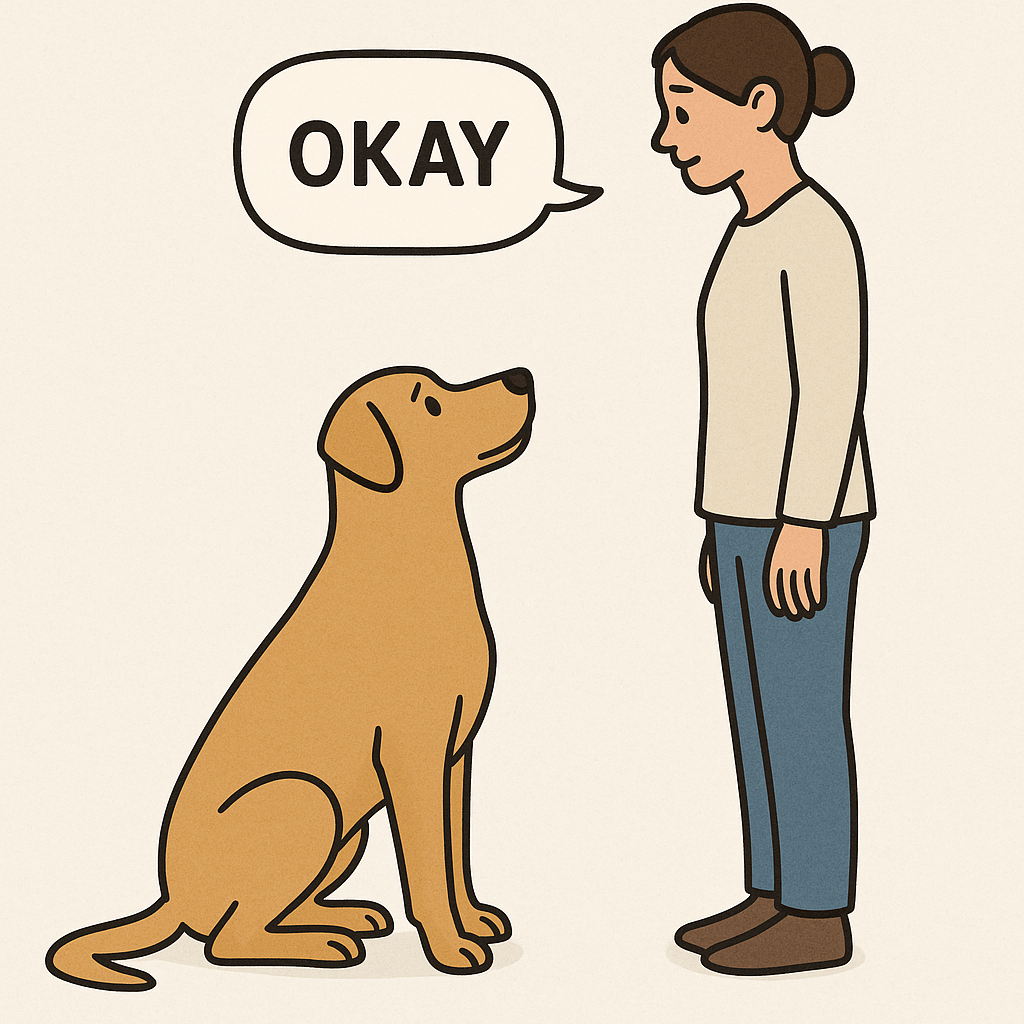
A release cue is a single word — "okay", "free", "release", "all done" — that tells the dog: the position-hold requirement is over, you can move now. It is the bookend to a duration behaviour. The entry cue ("stay", "settle", "wait", "place") starts the behaviour; the release cue ends it. The dog holds the position from one to the other and the requirement is unambiguous.
In most pet households the release cue is missing. The owner asks the dog to stay. The dog stays. Eventually the owner gets up, walks somewhere, starts a different activity, and the dog — at some point in this transition — gets up too. The dog has not been released; the dog has guessed that the requirement has ended. Sometimes the guess is right (the owner is fine with the dog getting up); sometimes the guess is wrong (the owner expected continued stay) and the dog is corrected for "breaking" the stay, which from the dog's perspective is not breaking — it is the end of an ambiguously-bounded behaviour they had no clear way to end correctly.
The cost of the missing release cue is a behaviour the dog cannot do reliably because the dog does not know when it is done.
Why It Matters Mechanically
A stay, settle, wait, or place is a duration behaviour: do this thing, hold it, until told otherwise. Without a clear "until told otherwise" signal:
- The dog has to estimate when the owner will be okay with movement, using ambient cues (the owner's body language, sounds, time elapsed). The estimation is unreliable.
- The dog learns from the owner's reaction whether the previous estimation was correct, but the feedback is delayed and inconsistent — sometimes the owner is fine, sometimes annoyed, sometimes nothing happens.
- The behaviour cannot be cleanly proofed: holding through distractions only matters if the dog knows the requirement continues; without a release cue, "the distractions stopped" is a plausible end-condition for the dog.
- The duration component cannot be deliberately built. Increasing duration requires the dog to hold through longer intervals before being released; if the release is implicit, the dog has no signal that distinguishes "long stay" from "short stay" except subjective time perception.
A release cue solves all of these by making the bracket explicit.
Installation Protocol
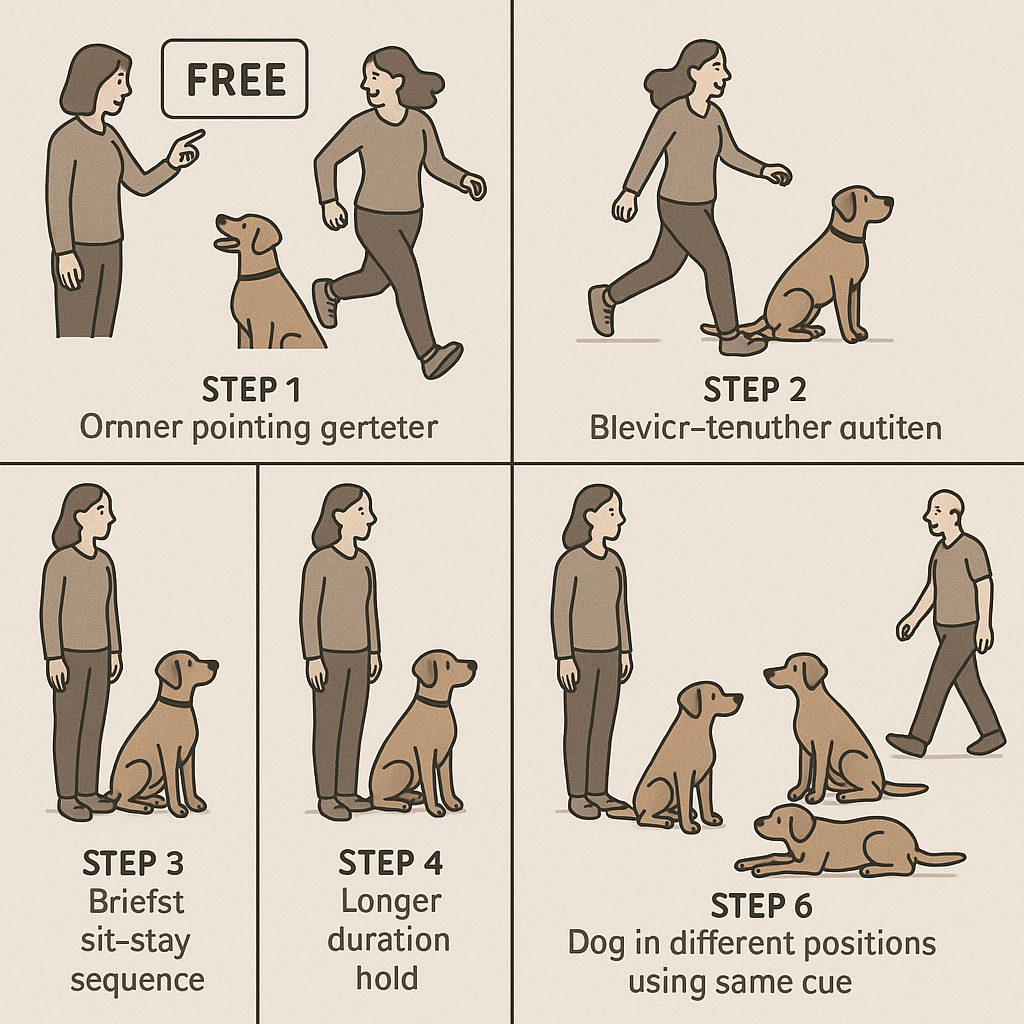
A workable protocol for installing a release cue from scratch and retrofitting it onto existing duration behaviours:
Step 1 — Pick the word. "Okay" is common but has the disadvantage that it is also a very common conversational word; some owners prefer "free", "release", or "all done" because the word is less likely to fire accidentally. Pick one and use it consistently.
Step 2 — Pair the word with movement. With the dog in a sit or down (no formal stay required at this stage), say the release word and immediately move with energy — take a step, clap once, toss a treat to the side. The dog moves with the cue and gets the reward of motion or food. Repeat dozens of times across multiple short sessions until the dog visibly anticipates motion when the word fires.
Step 3 — Add the cue to short stays. Ask for a brief stay (one second, two seconds), give the release cue, the dog moves, reward. The dog is learning that the stay has a defined end and that the end is signalled by the cue.
Step 4 — Build duration on the front end of the release. Increase the time between the stay cue and the release cue. The dog is reinforced for holding until the release; releases come at varied intervals so the dog cannot anticipate the timing.
Step 5 — Hold-through-distraction proofing. Add distractions during the stay; release only when the dog has held through. If the dog moves before the release, calmly reset to position; do not release into the broken position (which would inadvertently reinforce the break).
Step 6 — Generalise across positions and locations. Stay-with-release, settle-with-release, wait-with-release at the door, place-with-release on the mat. The release cue is the same across all of them — one cue means "the requirement is over" regardless of the entry behaviour.
Common Errors
-
The release cue is also the everyday word. "Okay" is fine if the household is careful, but if the dog hears "okay" in every conversation, the cue is firing constantly and is uninformative. A less-common word may be more reliable.
-
The release is given before the dog has held the position. If the owner releases as the dog is shifting weight or starting to break, the broken behaviour becomes the cued behaviour. Release only when the dog is holding cleanly.
-
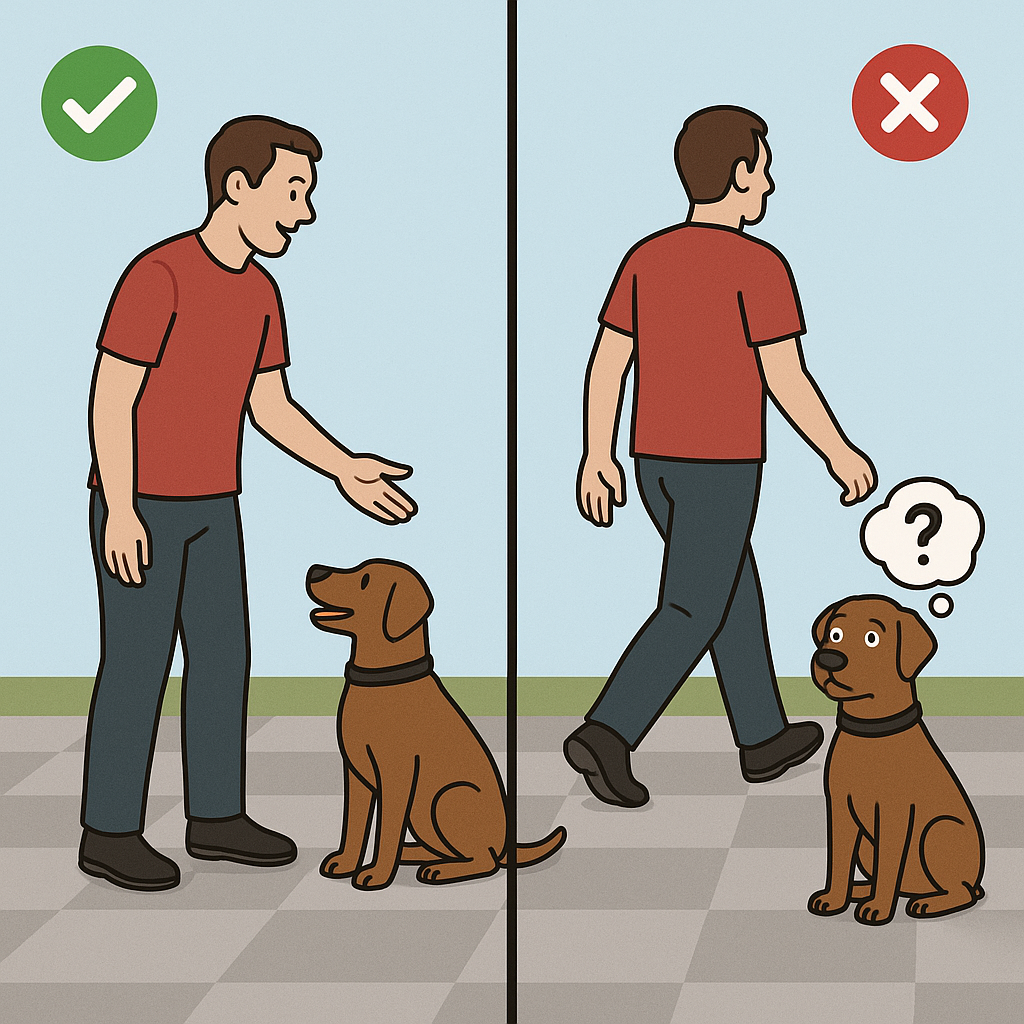
The release is implicit. The owner walks away, the dog gets up, the owner does not correct or react. The dog has been functionally released without the cue. Over time, the absence of the cue becomes the release signal — which is the original problem.
-
The release is paired with calling the dog. "Okay, come here!" merges the release with the recall. This is useful when the desired outcome is a recall after release, but if the dog is being released to free movement (not a recall), the release cue should fire alone.
-
Multiple inconsistent release words. "Okay" sometimes, "free" sometimes, "all right" sometimes, just walking away other times. The dog cannot determine which is the cue. Pick one and keep it.
-
Release in the middle of corrections. If the owner is frustrated by a broken stay and gives the release cue while annoyed, the cue picks up an aversive association. Release should be a clean, neutral-or-positive event.
What This Does Not Imply
- A release cue is not a substitute for proofing the stay. The cue is the bookend; the duration and distraction work still has to be done.
- Adding a release cue does not require formal training-class enrolment. It is a single-word addition to existing behaviours and can be installed at home.
- The release cue does not need to be dramatic. Calm delivery is fine; the cue's reliability matters, not its intensity.
What Is and Is Not Settled
Settled: in standard practitioner protocols across service-dog, working-dog, and competition-obedience training, an explicit release cue is a routine component of duration behaviours (Pryor 1999; APDT and broader practitioner reference body)[^pryor1999][^apdt]; the AVSAB humane-training position is consistent with positive-reinforcement-based cue installation including release cues[^avsab].
Not settled: the comparative effectiveness of specific release-word choices ("okay" vs. "free" vs. "release") in pet-dog reliability under everyday household conditions; the empirical literature does not test this directly.
Key Takeaways
- A release cue is the bookend to a duration behaviour; without it, the dog has to guess when the requirement ends.
- The cost of a missing release cue is unreliable stay/settle/wait/place — not because the dog is undertrained, but because the behaviour is not cleanly bracketed.
- Standard protocol: pick a word, pair with movement, add to short stays, build duration on the front end, proof through distraction, generalise across positions.
- Common errors: ambiguous word choice, implicit release, paired with recall by default, multiple inconsistent words, release during corrections.
- Adding a release cue is a single-word change that disproportionately improves reliability of duration behaviours.
Sources & further reading
- Pryor, K.. (1999). Don't Shoot the Dog! The New Art of Teaching and Training (Revised Edition). Bantam Books. https://www.simonandschuster.com/books/Dont-Shoot-the-Dog/Karen-Pryor/9781982106461
- Association of Professional Dog Trainers. APDT practitioner reference resources. Association of Professional Dog Trainers. https://www.apdt.com/
- American Veterinary Society of Animal Behavior. (2021). AVSAB Position Statement on Humane Dog Training. AVSAB. https://avsab.org/resources/position-statements/