What Proofing Means
Proofing is the deliberate, graduated exposure of a trained behaviour to distractions until the behaviour holds reliably under the distraction levels the dog will encounter in real life. The word is sometimes used loosely ("oh, I should proof this more"), but as a practitioner technique it has a specific structure: write a distraction hierarchy, work through it level by level, advance only when the dog is reliable at the current level.
Proofing is one of the three D's covered in distance-commands.md and duration-building.md. Distraction is the third dimension, and like the other two, it has to be built deliberately rather than assumed.
A behaviour that is reliable at home in a quiet kitchen is not, by default, reliable on a residential street with a dog walking past, or in a pet store with food smells everywhere, or at a dog park with multiple dogs running. Each distraction context is, from the dog's perspective, a different situation in which the cue is being asked. The dog who responds at home and not at the park has not "stopped listening" — the cue at the park is, in their representation, untested in that context.
Building a Distraction Hierarchy
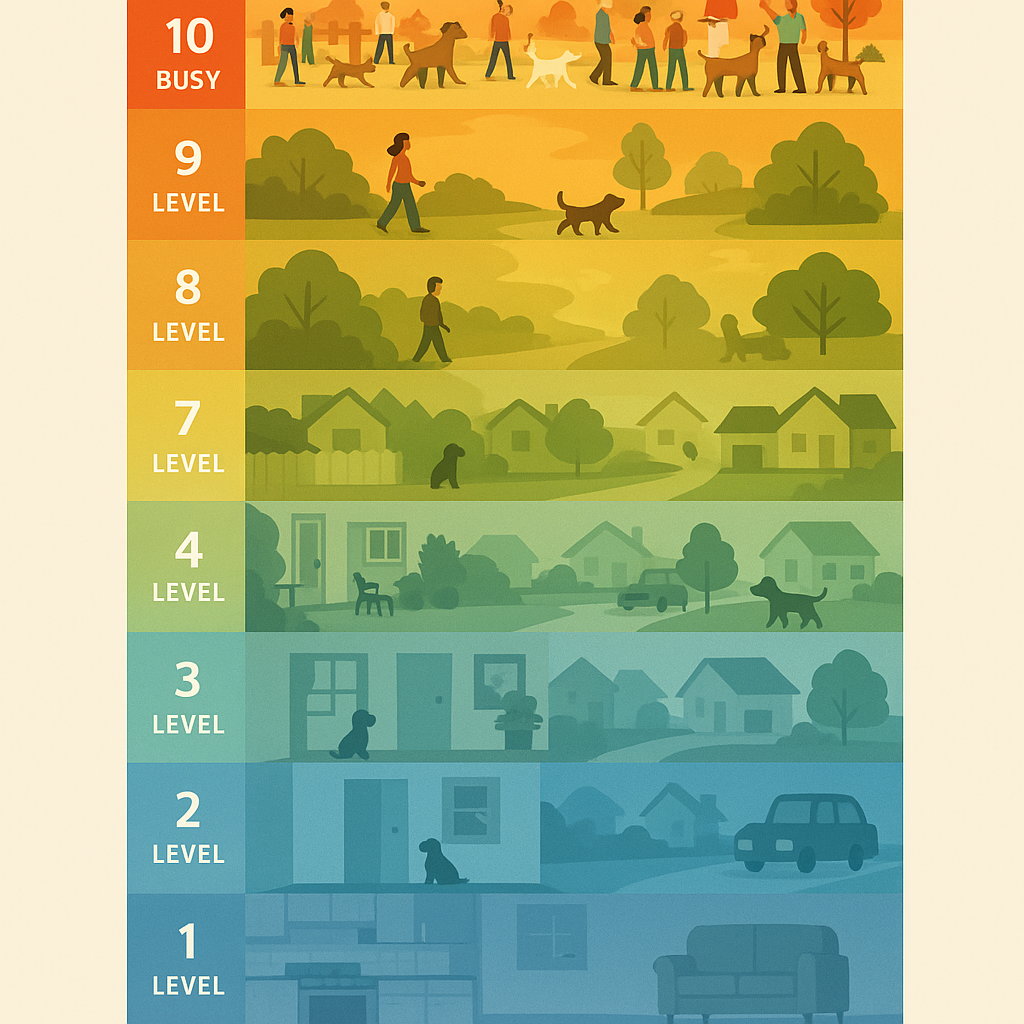
The first step in proofing is writing a distraction hierarchy from the specific dog's perspective. What is "low distraction" for one dog may be "high distraction" for another. The hierarchy is empirical: it is what the dog actually finds distracting, ranked.
A typical distraction hierarchy for a basic-obedience behaviour:
Level 1 (low) — Familiar quiet environment. The room where the behaviour was first installed. No other people, no other animals, no unusual sounds.
Level 2 — Familiar environment with mild ambient activity. Same room, with the radio on, family members moving through, dog's toys on the floor.
Level 3 — Other rooms in the house. A different room than the conditioning environment, with mild ambient activity.
Level 4 — Yard or familiar outdoor space at a quiet time. Outdoors but in a familiar, low-distraction setting.
Level 5 — Residential walk at low-traffic time. A familiar route with occasional cars and a few people.
Level 6 — Residential walk at moderate-traffic time. More cars, more people, occasional other dogs in the distance.
Level 7 — Pet store at quiet time. A novel environment with food smells, ambient activity, but not crowded.
Level 8 — Park at quiet time, away from other dogs. Outdoor novel environment, smells, occasional other dogs.
Level 9 — Park during normal activity. Other dogs moving and running, multiple humans, varied distractions.
Level 10 — Dog park or busy public event. High-density distraction environment.
The hierarchy is a tool, not a fixed set. For a specific dog, certain elements may need to be moved up or down: a dog with high prey drive may rank "squirrel in the yard" above "dog walking past on a leash"; a dog with social-drive may rank "another dog at distance" above "moderate traffic". The owner builds the hierarchy by observing what the dog actually finds distracting.
The Proofing Protocol
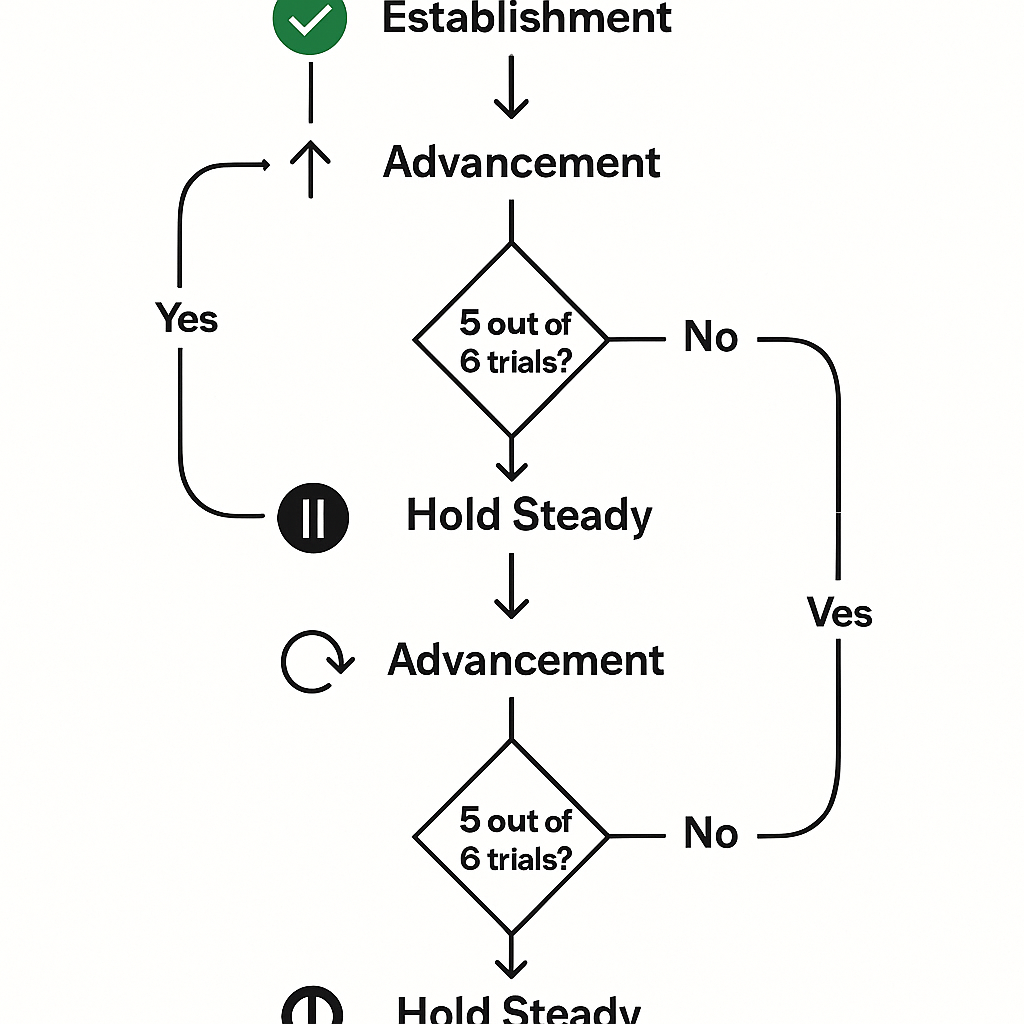
A workable protocol:
Step 1 — Establish the behaviour at level 1. The dog responds to the cue at near-100% reliability in the conditioning environment. Until this is true, proofing is premature.
Step 2 — Advance to level 2 with high-rate reinforcement. Each new distraction level is treated like a re-introduction. Reinforcement rate goes back up to near-installation levels temporarily, even if the behaviour is well-thinned at the previous level.
Step 3 — Hold at the level until reliable. The standard practitioner rule of thumb is the same as for shaping: the dog should produce the behaviour on five out of six trials at a given distraction level before the level is advanced. Advancing prematurely is the most common cause of proofing failure.
Step 4 — Advance one level at a time. Skipping levels is allowed only if the dog is genuinely reliable at multiple levels simultaneously and the next level is a small step. Most owners overestimate how much skipping the dog can handle.
Step 5 — Vary the level once a behaviour is broadly proofed. A dog who is reliable at levels 1-7 should be tested in unpredictable order — sometimes a hard distraction, sometimes an easy one — so the cue does not become context-dependent on a specific distraction level.
Step 6 — Add new distractions as life presents them. A new context (a friend's house, a new park, a vet's office) is a separate proofing situation. Each new context is approached at a low distraction level for that context and built up.
Step 7 — Maintain ongoing. Proofed behaviours degrade if not maintained. Periodic practice across the levels keeps the cue current.
What "Bombproof" Actually Means
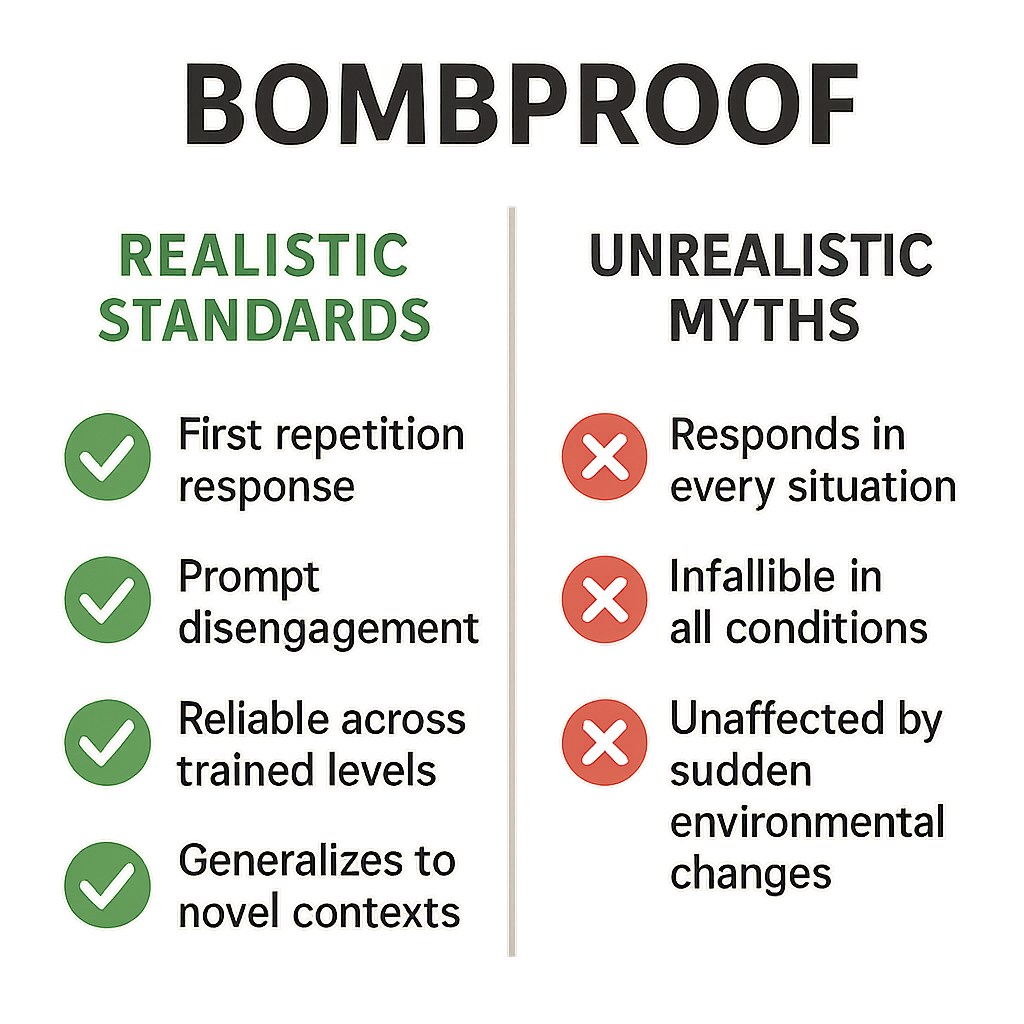
The term "bombproof" is used to describe behaviours that hold reliably across the full distraction hierarchy a typical pet dog encounters. A more useful operational definition:
- The dog responds to the cue on the first repetition.
- The response is prompt — disengagement from whatever the dog was doing within seconds.
- The response holds across the levels of the distraction hierarchy the owner cares about.
- The response generalises to novel contexts after a brief warm-up.
Note what is not in the definition: the dog responding in every conceivable situation regardless of arousal, prey, or sudden environmental change. No behaviour is bombproof in the absolute sense. A dog with a sudden squirrel in front of them, a dog who has just been startled by a loud noise, a dog mid-greeting with a familiar friend — these are situations where even well-proofed behaviours sometimes fail. The realistic standard is reliability across the levels the owner has trained, not infallibility.
Common Errors
- Jumping levels. The most common failure. The fix is to back up to a level where the dog is reliable and rebuild gradually.
- Skipping the hierarchy and just "practising in different places". Without a structured hierarchy, the owner cannot tell whether progress is being made or where the failures cluster. The fix is to write the hierarchy down and track reliability per level.
- Reducing reinforcement during proofing. A higher distraction level is a re-introduction; reinforcement rate should temporarily return to high levels.
- Repeating the cue when the dog fails. Multiple repetitions teach that the cue is optional. Give the cue once; if the dog fails, simplify the situation rather than repeating.
- Punishing failures in distracting contexts. The dog associates the high-distraction context with aversive outcomes, which produces avoidance rather than reliability.
- Treating proofing as one-and-done. A behaviour that was bombproof a year ago can drift; ongoing practice across the hierarchy maintains reliability.
What Is and Is Not Settled
Settled: distraction is a trainable dimension and behaviours require explicit proofing across distraction levels to generalise reliably (the broader operant-conditioning and stimulus-generalization literature; APDT, CCPDT practitioner reference bodies)[^apdt][^ccpdt]; the AVSAB humane-training position is consistent with positive-reinforcement-based proofing[^avsab].
Not settled: the comparative effectiveness of specific hierarchy-design approaches across breeds and individual learning histories; the optimal proportion of training time spent on proofing vs. installation vs. maintenance.
Key Takeaways
- Proofing is the systematic, graduated exposure of trained behaviours to distractions.
- Standard protocol: write a distraction hierarchy specific to the dog → start at level 1 reliable → advance one level at a time with high-rate reinforcement → hold at each level until reliable → vary levels once broadly proofed → maintain ongoing.
- "Bombproof" is reliability across the trained levels, not infallibility in every conceivable situation.
- Common errors: jumping levels, no written hierarchy, reduced reinforcement during proofing, cue repetition on failure, punishing failures, treating proofing as one-and-done.
- Distraction is one of the three D's; build it separately and combine with duration and distance deliberately.
Sources & further reading
- Association of Professional Dog Trainers. APDT proofing protocols and practitioner resources. Association of Professional Dog Trainers. https://www.apdt.com/
- Certification Council for Professional Dog Trainers. CCPDT certification standards and reference resources. Certification Council for Professional Dog Trainers. https://ccpdt.org/
- American Veterinary Society of Animal Behavior. (2021). AVSAB Position Statement on Humane Dog Training. AVSAB. https://avsab.org/resources/position-statements/