Why Target Training Is Worth the Investment
Most foundation behaviours an owner teaches — sit, down, stay — are static. The dog produces a position and holds it. Target training is different: it is a behaviour of motion-toward, and that single property makes it disproportionately useful across the rest of the dog's life.
A well-installed nose touch lets the handler:
- Move the dog into position without physical handling. The dog targets the palm and follows it onto the scale, into the crate, onto the grooming mat, or out of the way of an opening door.
- Redirect attention away from triggers. A reactive or excited dog who has a fluent target cue can be asked to touch the handler's hand instead of fixating on the other dog across the street.
- Build complex behaviours from a simple foundation. Retrieve, go-to-mat, station-on-platform, and many trick chains are built on top of a target.
- Reduce the stress of veterinary and grooming handling. A dog who voluntarily targets a stationary point on a vet's table participates in their own handling rather than being restrained through it.
The behaviour is cheap to install and keeps paying out across years.
The Mechanics
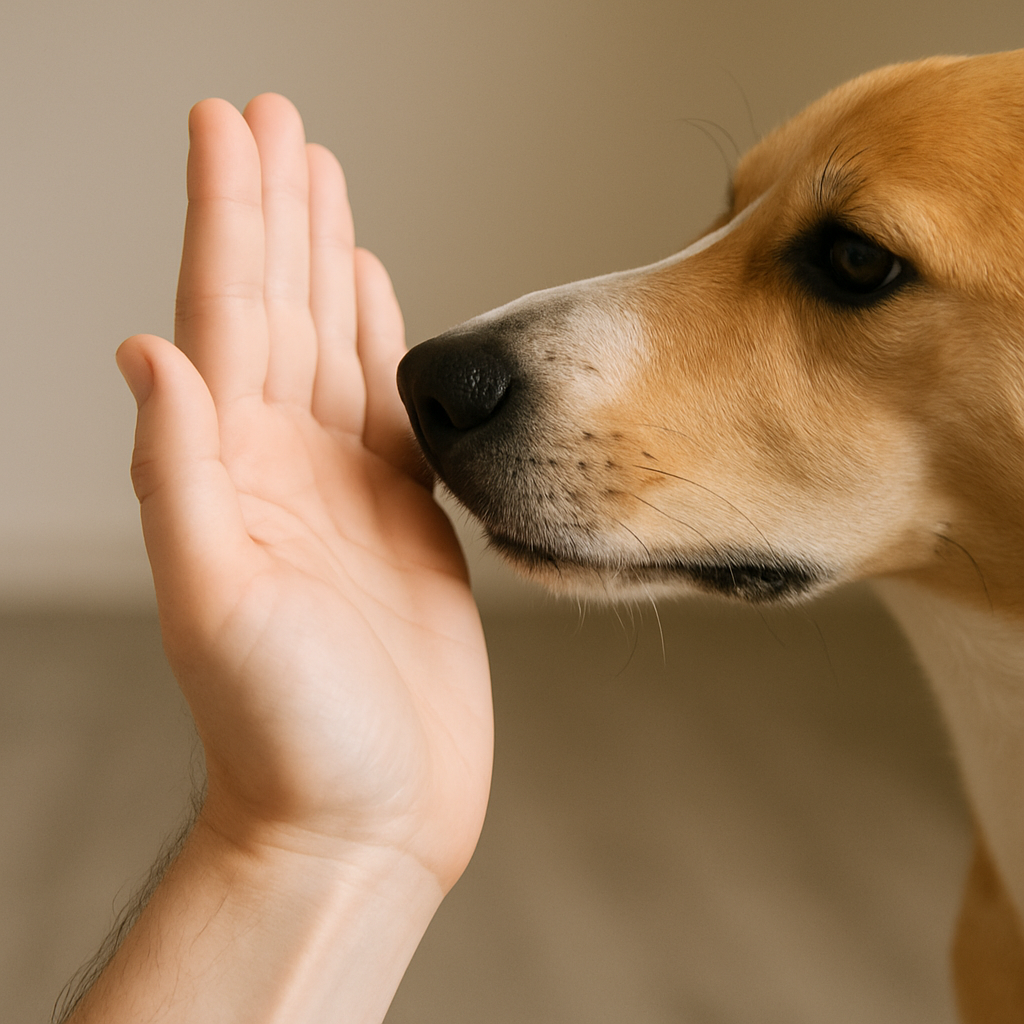
The standard installation protocol uses shaping and marker training. The whole process for a hand target is short — many dogs reach a fluent cue in three to five short sessions.
Step 1 — Present the target close to the dog's nose. An open palm held a few centimetres from the dog's nose is the simplest starting target. Most dogs investigate by sniffing or touching with the nose almost immediately because the novel stimulus is at investigation distance.
Step 2 — Mark the touch. The instant the nose contacts the palm, the marker (clicker or verbal "yes") fires. Timing matters — the marker has to be at the moment of contact, not after the dog has pulled back. A late marker reinforces the wrong behaviour.
Step 3 — Reward away from the target. The treat is delivered after the marker, but the delivery location is important. Delivering the treat directly at the palm risks the dog coming to the palm for the treat rather than for the touch. Delivering the treat to the side, dropped on the floor, or from the other hand resets the dog and produces a clean repetition.
Step 4 — Add the cue. Once the dog is offering the touch reliably (typically after a dozen or two repetitions), the cue word ("touch", "tap", "nose") is added immediately before the target presentation. The dog learns that the cue precedes the opportunity.
Step 5 — Fade the lure-like quality. Early on, the open palm is being investigated as a novel object. The behaviour matures when the dog touches on cue regardless of how the palm is presented — closed fist, back of hand, fingers, palm at unusual angles, palm in unusual locations.
Step 6 — Generalise to a target stick. A target stick (a chopstick, a small wooden dowel, a commercial telescoping stick) extends the handler's reach. Same protocol: present, mark the contact with the stick's tip, reward, add a cue if it is a separate cue. The stick lets the handler position the target where the hand cannot reach.
Step 7 — Generalise to arbitrary objects. A post-it note on the wall, a coloured disc on the floor, a specific spot on a piece of furniture. The dog learns that "touch" means "touch the indicated object", not "touch the palm".
Common Errors
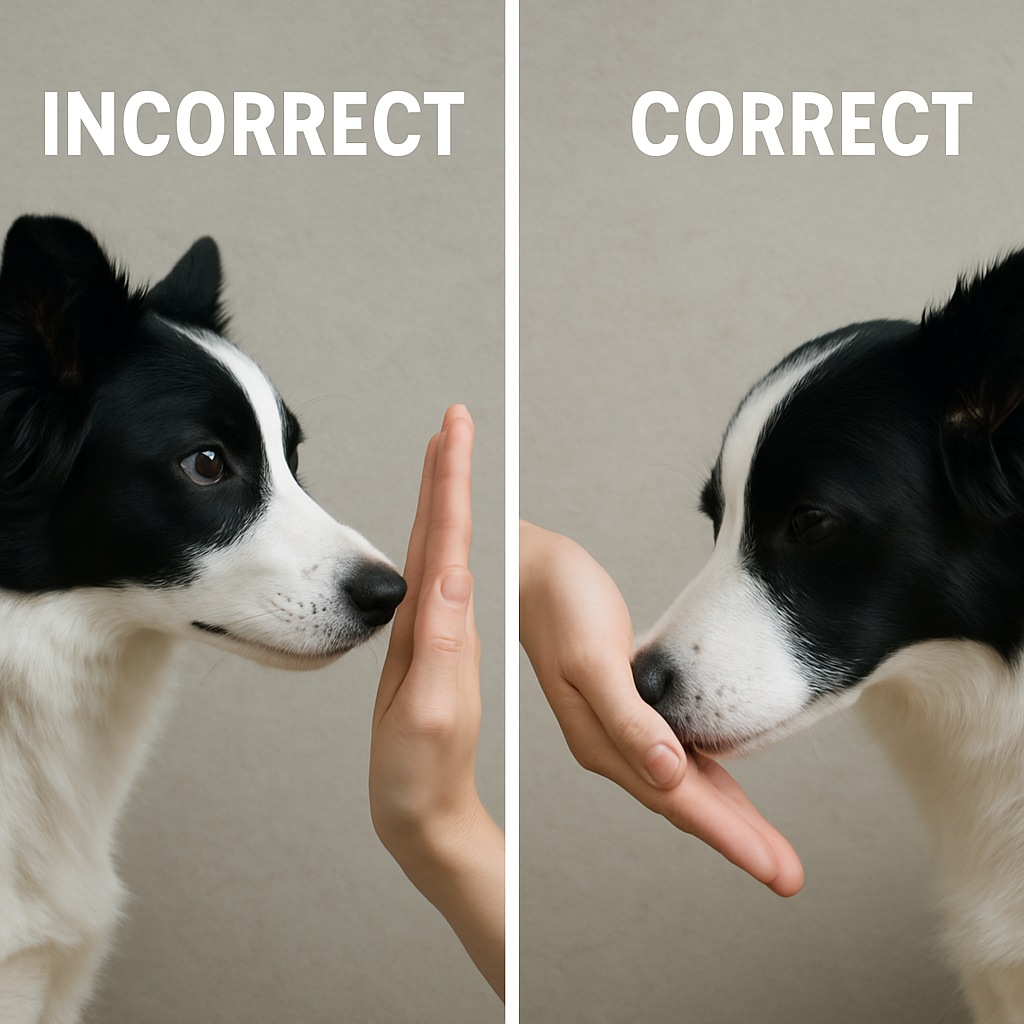
Things that go wrong:
- The dog learns to stare or hover. If the marker fires too early — when the dog looks at the palm rather than makes contact — the behaviour matures into a head-orient rather than a touch. The fix is to delay the marker until contact is made.
- The dog uses the paw instead of the nose. Some dogs default to pawing. The fix is to present the target so low or so close that the easiest way to reach it is with the nose; reinforce only nose contact.
- The treat-dispensing hand becomes the target. If the same hand presents the target and delivers the treat, the dog targets the food source. Use one hand to present the target and the other (or a treat pouch) to deliver the reward.
- The cue is added too early. A cue paired with an unreliable behaviour produces an unreliable behaviour-on-cue. Wait for the behaviour to be offered fluently before naming it.
- The behaviour is never generalised. A nose touch that works only in the kitchen with a treat pouch visible is a kitchen behaviour, not a portable cue. Practise in different rooms, different positions, and with the handler in different postures.
Applications

A short list of where the behaviour pays out:
- Husbandry handling. Targeting a stationary point during nail trims, ear cleaning, or grooming gives the dog a job and reduces the perceived restraint.
- Veterinary cooperation. A target on the scale, the exam table, or the floor is a low-stress alternative to lift-and-place handling.
- Reactivity management. A fluent target cue can be used as a redirection in moderate-distraction environments before more demanding behaviour modification protocols are needed.
- Position changes. Moving the dog out of the kitchen, off the bed, into the back seat — all without physical handling.
- Construction of complex behaviours. Retrieve (touch object → pick up object → bring to handler), go-to-mat (touch mat → settle on mat), and competition heel-position work all build on target as a foundation.
What Is and Is Not Settled
Settled: target training is a robust, well-established application of operant conditioning (Pryor 1999, 2001); the husbandry-training literature in zoo and laboratory animal contexts treats targeting as the standard low-stress handling tool[^pryor2001]. The AVSAB humane-training position is consistent with positive-reinforcement-based foundation behaviours including targeting[^avsab].
Not settled: the comparative effectiveness of specific target-introduction protocols (palm vs. fist vs. stick first) across breeds and individual learning histories.
Key Takeaways
- Target training installs a portable cue that pays out across husbandry, redirection, position changes, and the construction of complex behaviours.
- Standard protocol: present target, mark contact, reward away from target, add cue once the behaviour is reliable, generalise across objects and contexts.
- Common errors: marker too early (produces orient instead of touch), treat-and-target on same hand (produces food-targeting), cue added before reliability (produces unreliable cue).
- The behaviour is cheap to install (three to five short sessions for a fluent hand target) and durable across years.
- Husbandry and veterinary applications are the highest-yield uses for most pet-dog homes.
Sources & further reading
- Pryor, K.. (2001). Getting Started: Clicker Training for Dogs. Sunshine Books. https://clickertraining.com/
- Pryor, K.. (1999). Don't Shoot the Dog! The New Art of Teaching and Training (Revised Edition). Bantam Books. https://www.simonandschuster.com/books/Dont-Shoot-the-Dog/Karen-Pryor/9781982106461
- American Veterinary Society of Animal Behavior. (2021). AVSAB Position Statement on Humane Dog Training. AVSAB. https://avsab.org/resources/position-statements/