What Hip Dysplasia Actually Is
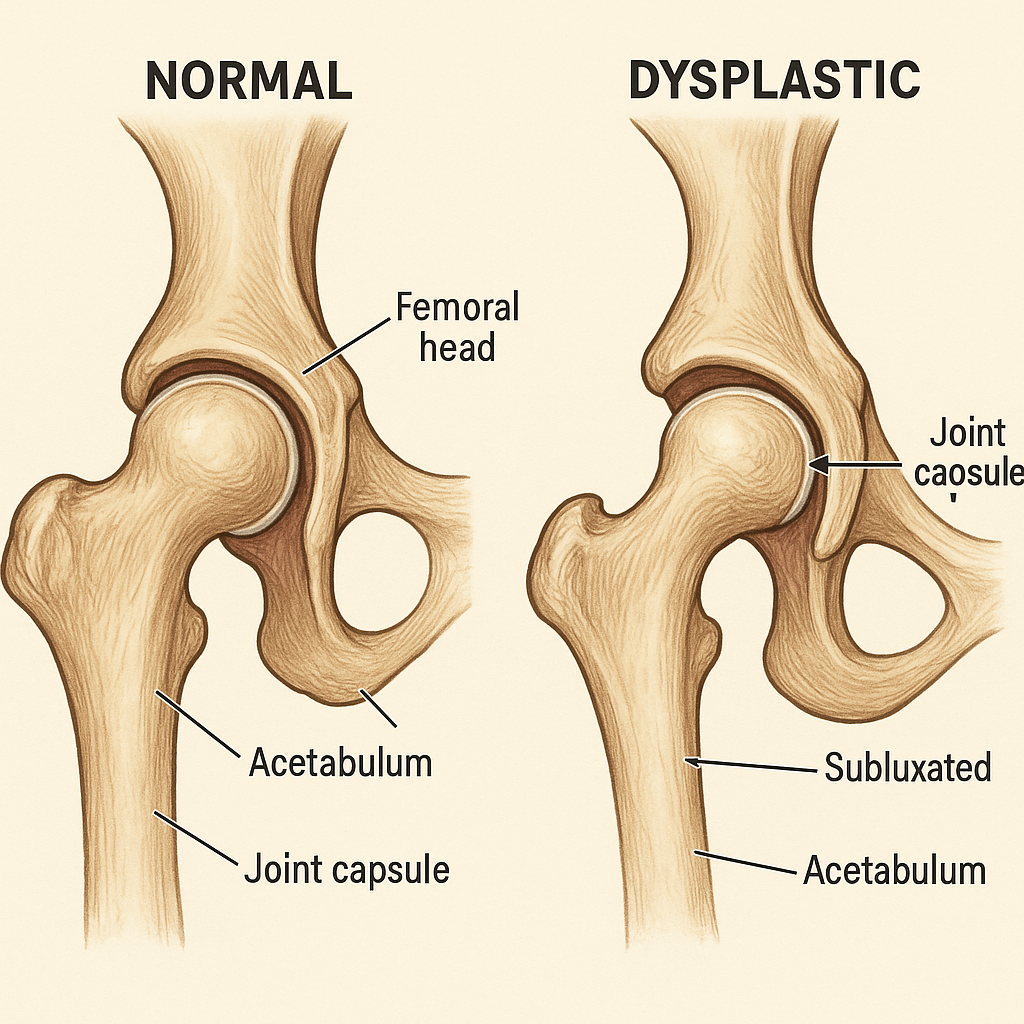
Canine hip dysplasia (CHD) is a developmental disorder in which the coxofemoral joint forms with insufficient congruency between the femoral head and the acetabulum. The proximate consequence is joint laxity — the femoral head moves more freely within the acetabulum than it should — and the distal consequence is osteoarthritis, driven by abnormal load distribution across cartilage that was not built to take it.
Ginja and colleagues' 2010 review in The Veterinary Journal is the contemporary clinical synthesis used in practice[^ginja2010]. The pathological cascade — laxity in the immature joint, subluxation under load, abnormal stress on developing cartilage, progressive osteoarthritis through middle and late life — is well-characterised. The clinical presentation in adult dogs ranges from mildly stiff in cold weather to severely lame and pain-limited in mobility, with the variation across this range a function of joint conformation, body weight, activity, age, and individual pain tolerance.
Genetics: Polygenic and Heritable, But Not Mendelian
CHD is a moderately heritable polygenic trait. Heritability estimates from various breeds and screening populations cluster in the 0.2-0.6 range — meaningful, but far from "if both parents are clear, the puppy is clear." The genetic architecture involves many loci of small individual effect rather than a single major-effect gene, which is why phenotype-based selection (radiographic screening) has been the practical breeding tool rather than DNA-marker selection.
Smith and colleagues' (2001) population study characterised the breed clustering: German Shepherds, Golden Retrievers, Labrador Retrievers, and Rottweilers showed markedly elevated risk of hip-related degenerative joint disease compared with unaffected breeds[^smith2001]. The pattern reflects the breed-specific allele frequencies of the underlying loci, not a fundamentally different disease mechanism.
The practical implication: selective breeding using OFA or PennHIP screening does meaningfully reduce CHD prevalence in a population over generations, but improvement is gradual and is undercut wherever popular sires with good cosmetics but unscreened or poor hips dominate the breeding pool.
OFA vs PennHIP: Two Different Tools
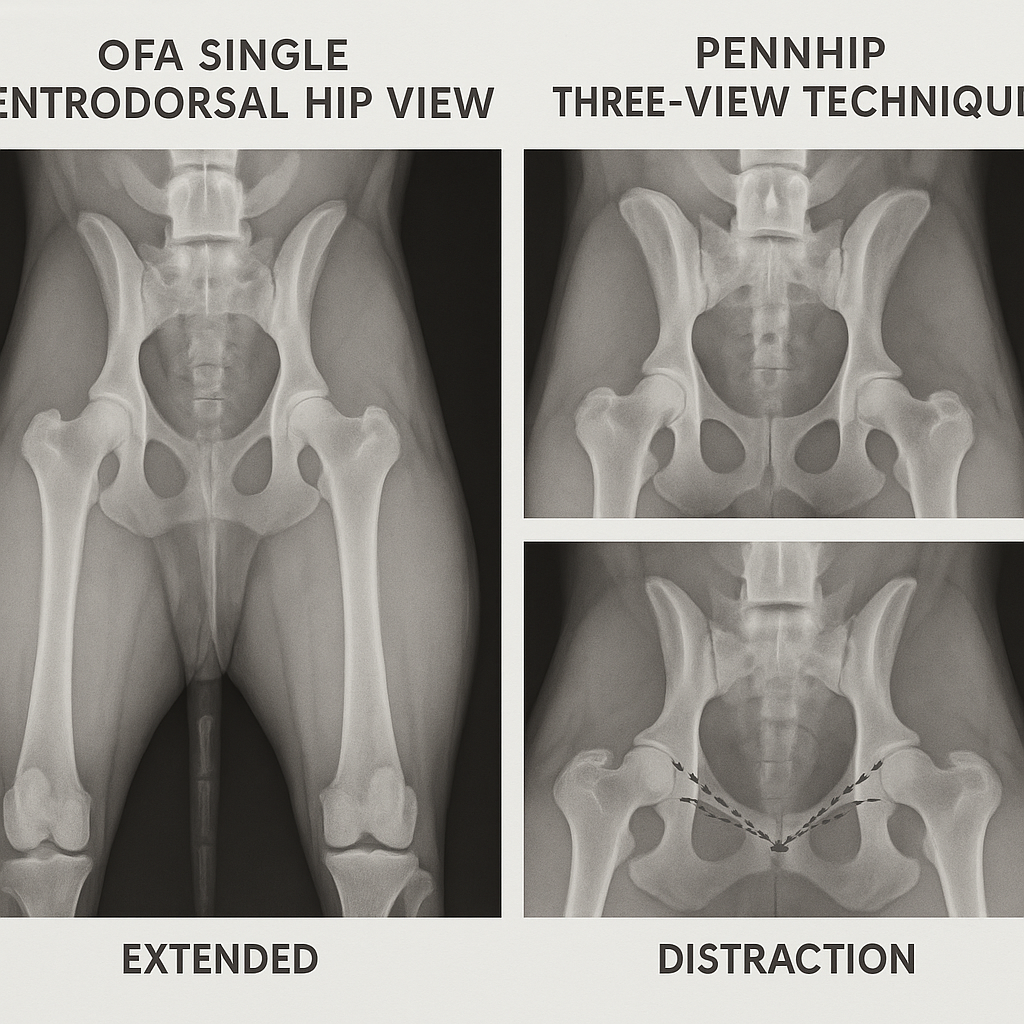
The Orthopedic Foundation for Animals (OFA) screening system uses a single-view ventrodorsal radiograph at age ≥24 months, scored subjectively (Excellent, Good, Fair, Borderline, Mild, Moderate, Severe). It is the older and more widely-used U.S. system.
PennHIP uses three views — a hip-extended view and two stress views — and measures a quantitative distraction index (DI), calibrated against breed norms. Crucially, PennHIP has demonstrated reliable predictive performance for later osteoarthritis development from as early as 16 weeks of age, which OFA-style scoring does not achieve. For a working-line or potential-breeding dog, earlier reliable screening is a substantive advantage.
The two systems are not interchangeable, and a comparable "good" rating on each does not have identical genetic-selection value. Many serious breeders use both. For a typical pet owner, PennHIP screening of a young dog gives the most informative single read on the hips that the dog will have for life.
The Body-Condition Modifier Most Owners Underuse
The Kealy and colleagues (2002) lifetime study of Labrador Retrievers — paired siblings on ad-libitum versus 25-percent-restricted feeding from weaning onward — is the cleanest demonstration that environment modifies CHD phenotype against the same genetic background[^kealy2002]. The longitudinal hip analysis of the same cohort, published as Smith and colleagues' (2012) Veterinary Surgery paper, found that the restricted-feeding dogs had notably lower prevalence and severity of CHD across life[^smith2012].
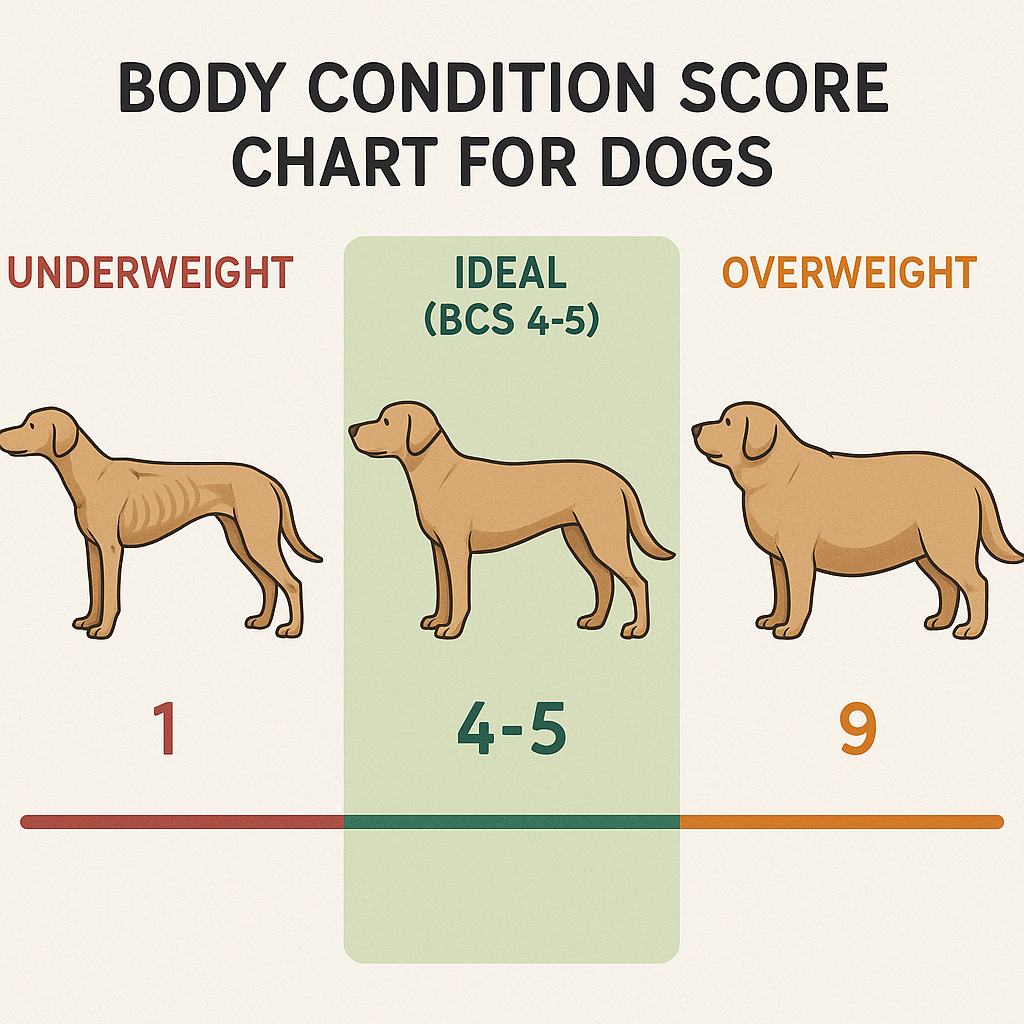
The mechanism is not mysterious. Body weight is the load on the hip joint. Joint laxity producing the same anatomical subluxation pattern produces less cartilage damage at lower body weight, and the dog progresses to clinical osteoarthritis later or not at all. This is the most powerful environmental lever an owner has, and it is available regardless of the dog's genetic background.
The practical translation: maintain BCS 4-5/9 across life. Do not over-feed during growth. Avoid the common large-breed-puppy practice of free-feeding to support "fast growth" — fast growth is part of the problem, not part of the solution.
Activity and Nutrition During Growth
The other modifiable environmental factors during the first 12-18 months:
- Avoid excessive impact and forced exercise in puppies. Long forced runs, repetitive jumping, and stair work on growing joints are the patterns associated with worse outcomes.
- Use a large-breed-formulated puppy diet if applicable. The relevant differentiator is calcium and energy density — large-breed puppy formulas are calibrated to slow growth rate slightly and avoid excess calcium, both of which reduce orthopaedic-disease risk.
- Do not supplement calcium or vitamin D in puppies on complete diets. Excess calcium during growth is implicated in skeletal disease.
Treatment Options When Needed
For affected dogs, management runs from conservative to surgical:
- Conservative / medical: weight management (the single largest lever), controlled exercise, joint nutraceuticals (omega-3 with the strongest evidence), NSAIDs as needed, physical therapy.
- Juvenile surgical: juvenile pubic symphysiodesis (JPS) before 20 weeks; double or triple pelvic osteotomy (DPO/TPO) in young dogs with appropriate joint anatomy.
- Adult surgical: total hip replacement (THR) is the gold-standard salvage procedure with the best long-term function; femoral head and neck excision (FHNE) is a less expensive alternative with good outcomes in smaller dogs.
The decision tree depends heavily on age at diagnosis, severity, body size, owner resources, and surgeon judgment. The general principle is conservative management first for milder cases, with surgical options reserved for dogs whose function and pain are inadequately managed.
What Is and Is Not Settled
Settled: CHD is moderately heritable and polygenic; body condition is a powerful environmental modifier (Kealy 2002; Smith 2012); PennHIP and OFA screening are valid phenotype-based selection tools, with PennHIP having earlier-age applicability.
Not settled: the precise genetic architecture and the prospect of marker-assisted selection; the optimal mix of medical and surgical management for milder adult cases.
Key Takeaways
- CHD is polygenic and moderately heritable; breed clustering reflects allele frequencies, not different disease mechanisms (Smith 2001).
- OFA and PennHIP are complementary screening systems; PennHIP works reliably from 16 weeks, OFA requires age ≥24 months.
- Lifetime caloric restriction well reduced CHD prevalence and severity in the Kealy / Smith Labrador cohort — the most powerful modifiable lever.
- Avoid over-feeding and excess calcium during growth; use large-breed puppy formulas where applicable.
- Surgical options (JPS, DPO/TPO, THR) are reserved for cases inadequately managed conservatively.
Sources & further reading
- Ginja, M. M. D.; Silvestre, A. M.; Gonzalo-Orden, J. M.; Ferreira, A. J. A.. (2010). Diagnosis, genetic control and preventive management of canine hip dysplasia: a review. The Veterinary Journal, 184(3), 269-276. https://doi.org/10.1016/j.tvjl.2009.04.009
- Smith, G. K.; Mayhew, P. D.; Kapatkin, A. S.; McKelvie, P. J.; Shofer, F. S.; Gregor, T. P.. (2001). Evaluation of risk factors for degenerative joint disease associated with hip dysplasia in German Shepherd Dogs, Golden Retrievers, Labrador Retrievers, and Rottweilers. Journal of the American Veterinary Medical Association, 219(12), 1719-1724. https://doi.org/10.2460/javma.2001.219.1719
- Kealy, R. D.; Lawler, D. F.; Ballam, J. M.; Mantz, S. L.; Biery, D. N.; Greeley, E. H.; Lust, G.; Segre, M.; Smith, G. K.; Stowe, H. D.. (2002). Effects of diet restriction on life span and age-related changes in dogs. Journal of the American Veterinary Medical Association, 220(9), 1315-1320. https://doi.org/10.2460/javma.2002.220.1315
- Smith, G. K.; Lawler, D. F.; Biery, D. N.; Powers, M. Y.; Shofer, F.; Gregor, T. P.; Karbe, G. T.; McDonald-Lynch, M. B.; Evans, R. H.; Kealy, R. D.. (2012). Chronology of hip dysplasia development in a cohort of 48 Labrador retrievers followed for life. Veterinary Surgery, 41(1), 20-33. https://doi.org/10.1111/j.1532-950X.2011.00935.x