What the Research Shows
The empirical research on pet-loss bereavement consistently shows that the grief experience is real, intense, and frequently comparable in magnitude to grief for human family members. The findings have accumulated over several decades:
Field, Orsini, Gavish & Packman (2009). Studied attachment, continued bonds, and grief outcomes following pet loss in adult owners[^field]. Findings supported that the grief experience varies in intensity based on attachment characteristics and that the magnitude can be substantial.
Wrobel & Dye (2003). Examined pet-loss grief in adults and found that 30% of bereaved pet owners experienced grief intense enough to disrupt daily functioning for at least six months[^wrobel]. The study supported earlier findings that pet-loss grief is not minor or transient for many owners.
Adams, Bonnett & Meek (2000). Studied grief and decision-making around companion-animal euthanasia, documenting the substantial emotional weight of the experience[^adams].
Other studies have examined related questions: the role of attachment style in grief intensity, the effects of sudden vs. expected loss, the role of euthanasia experience, the comparison of pet-loss grief to other bereavement.
The convergent picture: pet-loss grief is a substantial bereavement experience for many owners, with intensity sometimes equivalent to grief for human family members. The cultural and social acknowledgment of this has been variable but improving.
The Disenfranchised-Grief Framework
Doka's (1989) concept of "disenfranchised grief" describes grief that is not socially or culturally acknowledged in the same way as grief for human family members. Pet-loss grief has been a paradigmatic example of disenfranchised grief because:
- Workplace bereavement leave typically does not extend to pet loss in most jurisdictions and most workplaces.
- Social acknowledgment is variable; some social environments treat pet loss seriously while others minimise it ("it was just a dog").
- Time-to-recovery expectations from others are often shorter than the actual grief trajectory many owners experience.
- The grieving person may feel embarrassed or unjustified in expressing the depth of their grief publicly.
The disenfranchised-grief framework matters because the lack of social support compounds the bereavement experience. Owners grieving in environments that do not acknowledge the loss may feel isolated, may not access support resources, and may have grief trajectories that are extended by the lack of validation.
The picture has been improving — many workplaces now offer some pet-loss bereavement consideration, more support resources are available, social acknowledgment has grown — but unevenly.
What Pet-Loss Grief Looks Like
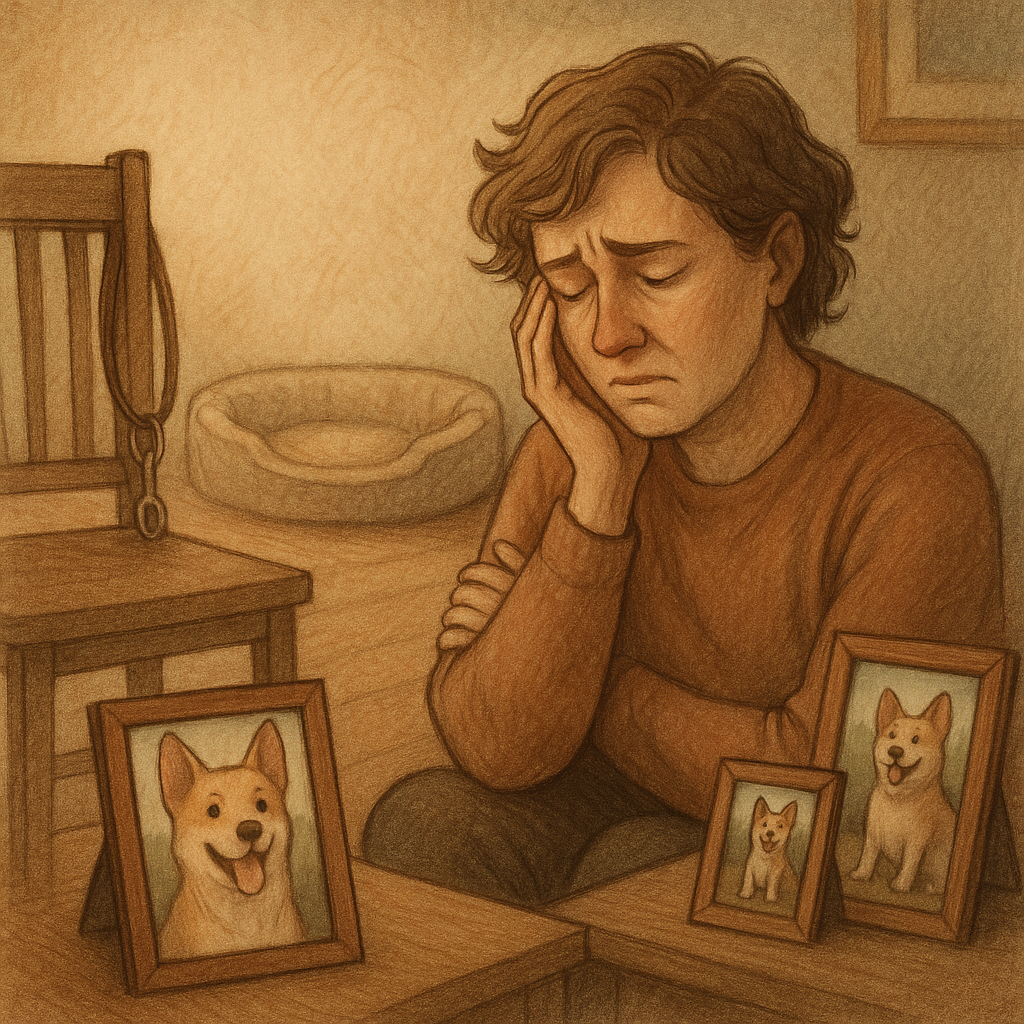
The grief experience varies markedly across individuals but commonly includes:
- Acute distress immediately following the loss — crying, intense sadness, disrupted sleep, reduced appetite.
- Difficulty with reminders. The dog's bed, leash, food bowl, photos, the routes you walked together — all are emotional triggers.
- Guilt about the death. Particularly common with euthanasia decisions ("did I do it too soon? too late? was there something else I could have done?"). The euthanasia decision-making is often a substantial component of the bereavement.
- Disruption of daily routine. The dog was woven into the daily structure (feeding times, walks, evening companionship); the absence affects the rhythm of the day.
- Anger and other emotions including frustration, regret, sometimes relief if the dog had been suffering.
- Continuing bonds. Many owners continue to feel a relationship with the deceased pet — periodic strong emotional moments, dreams, sense of presence. This is normal and not pathological.
- Eventual integration. Most grief resolves toward integration — the loss is real, the pain is less acute, the relationship is remembered with mixed emotion that includes positive memories.
Recovery trajectories vary notably. Some owners feel reasonably recovered in weeks; some take months; some experience grief that affects them for over a year. None of these is "wrong"; the variation is normal.
When Professional Support Is Helpful
Several scenarios warrant considering professional support:
Severe acute distress. If the grief is producing inability to function in daily life, persistent suicidal thoughts, or substantial deterioration in physical health, professional mental-health support is appropriate.
Prolonged grief. Grief that remains acute and disabling at 6+ months, with no signs of integration, may benefit from grief-focused therapy.
Complicated grief features. Persistent guilt that does not resolve, intense unresolved anger, dissociative experiences, or other features of complicated grief warrant professional attention.
Co-occurring loss or stressors. Pet loss alongside other major life events (job loss, relationship dissolution, human family loss, illness) may produce compound bereavement that benefits from support.
Lack of social support. If the owner's social environment does not acknowledge the loss, professional support fills the support gap.
Owners with prior mental-health vulnerabilities. Pre-existing depression, anxiety, or trauma can be exacerbated by bereavement.
Available Support Resources

Several types of resources exist:
Pet-loss hotlines. Trained volunteers offer phone or chat support. ASPCA, Lap of Love, and several university-affiliated programmes (Cornell, Tufts, Washington State, others) operate hotlines. They are free or low-cost.
Online support communities. Pet-loss-focused forums, Facebook groups, and Reddit communities provide peer support. The variable quality means some are highly supportive and some are less so.
In-person and online support groups. Some communities have pet-loss support groups; some veterinary practices host them periodically.
Mental-health professionals familiar with pet loss. A growing number of therapists specifically work with pet-loss grief. The fit between therapist and client matters; finding a therapist who takes pet-loss grief seriously is important.
Books and reading material. Several specifically-focused pet-loss bereavement books exist; some owners find reading helpful.
Memorialisation and ritual. Some owners find concrete actions (creating a memorial, planting a tree, writing about the dog) supportive of the grief process. The form is individual.
Special Considerations
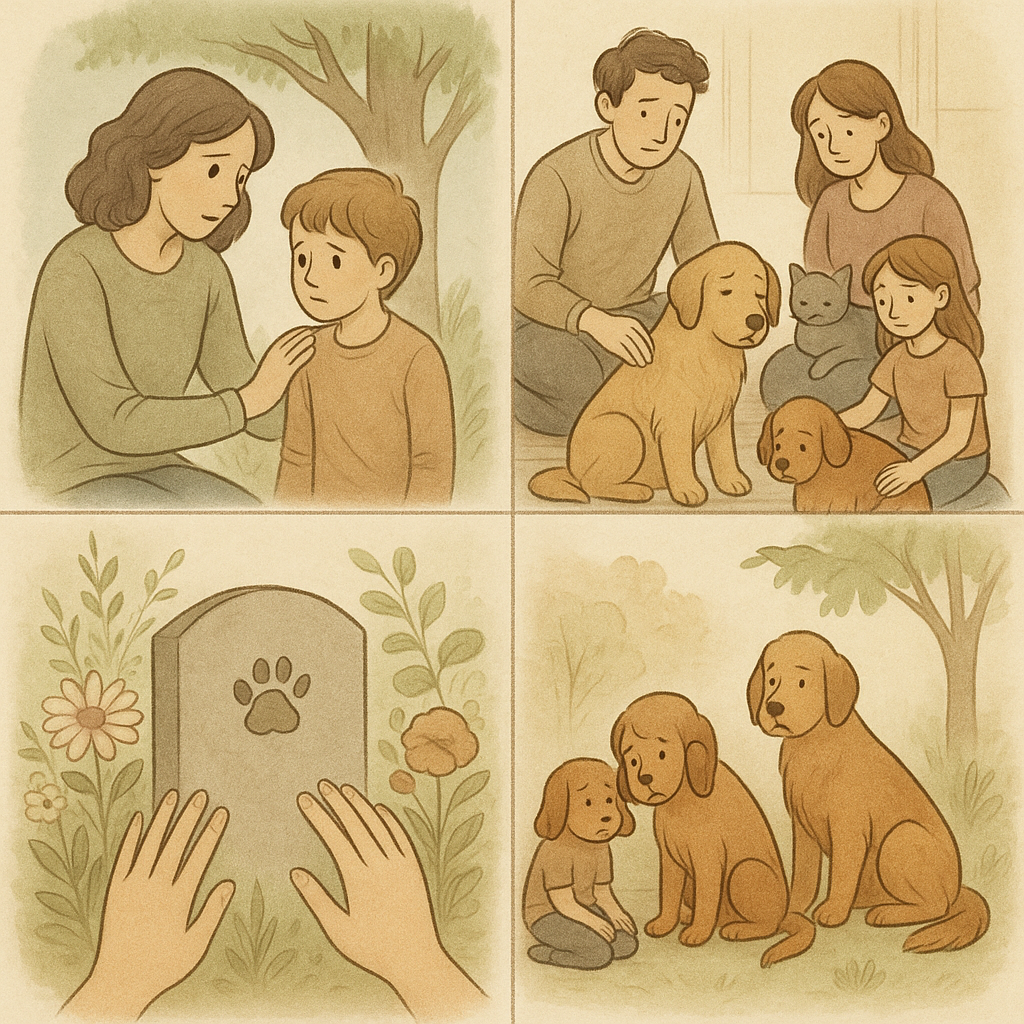
The euthanasia decision. Many pet-loss experiences involve euthanasia. Owners frequently second-guess the decision afterward. The quality-of-life-scales article covers the decision framework; from the bereavement angle, owners often need support specifically around the euthanasia decision-making and the moment-of-loss experience.
Children and pet loss. A child's first significant bereavement is often a pet. The experience can be formative; how the family handles the loss affects the child's broader understanding of grief and loss. Honest, age-appropriate conversation, allowing the child to participate in memorial actions if they want to, and validating the child's grief all support the experience.
Multi-pet households. The remaining pets often grieve too — they may show changes in behaviour, appetite, social engagement. The remaining-pet bereavement is real; the end-of-life article and broader practitioner-reference body cover this.
The "should we get another dog" question. Some owners want a new dog quickly; some need substantial time. There is no universally right answer. Both responses are reasonable; the timing depends on the individual.
What This Does Not Imply
- All pet-loss grief is severe. Variation is substantial; some owners process loss with relative speed and limited intensity.
- Pet-loss grief is the same as human-loss grief in every dimension. The experiences are comparable in magnitude for many owners; specific features differ.
- Owners must memorialise or process loss in specific ways. The form of grief work is individual.
- Professional support is required. Most owners process pet loss without formal professional support; the support is for those who need it.
What Is and Is Not Settled
Settled: pet-loss grief is a substantial bereavement experience for many owners with intensity comparable to grief for human family members (Field 2009; Wrobel & Dye 2003; broader literature)[^field][^wrobel]; the disenfranchised-grief framework helps understand the social-acknowledgment challenges; practical support resources exist.
Not settled: optimal interventions for the spectrum of pet-loss grief experiences; the precise comparative magnitude of pet-loss grief vs. specific human-loss grief contexts.
Key Takeaways
- Pet-loss grief is a substantial bereavement experience; empirical research consistently shows intensity comparable to grief for human family members.
- The disenfranchised-grief framework (Doka 1989) describes the cultural underacknowledgment that has historically affected pet-loss bereavement.
- Recovery trajectories vary; weeks to months is typical, longer in some cases.
- Professional support is helpful for severe, prolonged, or complicated grief, and for owners with limited social support or pre-existing mental-health vulnerabilities.
- Resources include pet-loss hotlines (ASPCA, Lap of Love, university-affiliated), online support communities, in-person groups, mental-health professionals familiar with pet loss.
- Special considerations: euthanasia decision-making support, children's bereavement, remaining-pet grief, individual variation in readiness for a new dog.
Sources & further reading
- Field, N. P.; Orsini, L.; Gavish, R.; Packman, W.. (2009). Role of attachment in response to pet loss. Death Studies, 33(4), 334-355. https://doi.org/10.1080/07481180802705783
- Wrobel, T. A.; Dye, A. L.. (2003). Grieving pet death: normative, gender, and attachment issues. OMEGA - Journal of Death and Dying, 47(4), 385-393. https://doi.org/10.2190/QYV5-LLJ1-T043-U0F9
- Adams, C. L.; Bonnett, B. N.; Meek, A. H.. (2000). Predictors of owner response to companion animal death in 177 clients from 14 practices in Ontario. Journal of the American Veterinary Medical Association, 217(9), 1303-1309. https://doi.org/10.2460/javma.2000.217.1303
- American Society for the Prevention of Cruelty to Animals. ASPCA Pet Loss Resources. ASPCA. https://www.aspca.org/
- American Animal Hospital Association. AAHA Pet Loss Guidelines. American Animal Hospital Association. https://www.aaha.org/
- American Veterinary Medical Association. AVMA Pet Bereavement Resources. American Veterinary Medical Association. https://www.avma.org/