Why a Methodology-Focused Article
The attachment-styles-dogs article covers what the dog-attachment literature shows in broad terms — that dogs form attachment-style relationships with their owners that share core features with infant-caregiver attachment. This article is the methodology companion: how the dog-attachment literature was built, what the Strange Situation Test specifically does, and what it does not measure.
The methodology matters because the strength of the broader attachment claim rests on the test design. Without the SST, "dogs are attached to their owners" would be an interpretation of casual observation. With it, the claim is empirically grounded.
What the Strange Situation Test Is
Mary Ainsworth's Strange Situation Test, developed in the 1960s and 1970s for human infants, is a standardised laboratory procedure designed to elicit attachment-related behaviour. The paradigm uses a sequence of episodes that vary the presence of the caregiver and a stranger, and observes the infant's behaviour at each phase: how willingly the infant explores when the caregiver is present, how the infant responds when the caregiver leaves, what the infant does with the stranger, and crucially how the infant behaves when the caregiver returns. The behaviour patterns observed across these episodes form the basis of the now-classic attachment classifications — secure, insecure-avoidant, insecure-resistant.
The SST became the standard tool for studying infant attachment because it produces measurable, replicable patterns of behaviour tied to specific theoretical predictions about caregiver-infant relationships.
Adapting the Paradigm to Dogs
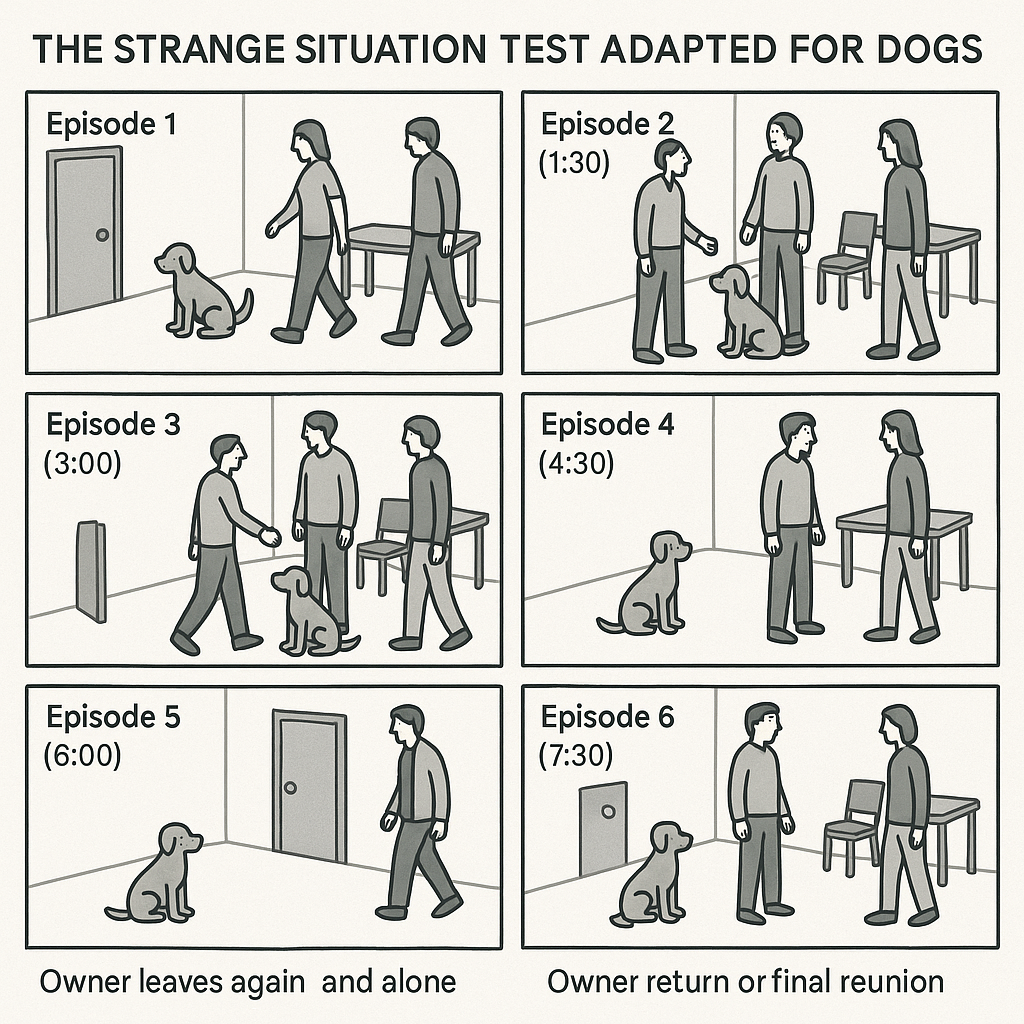
Topál, Miklósi, Csányi and Dóka (1998), working at Eötvös Loránd University in Budapest, asked whether the SST methodology could be adapted to study dog-owner attachment. The published study in Journal of Comparative Psychology tested 51 pet dogs and their owners through a modified SST procedure[^topal1998].
The Topál adaptation typically uses seven or eight short episodes of about three minutes each (slightly varied across studies):
- Owner and dog enter unfamiliar room. The dog explores; the owner sits.
- Stranger enters. Owner and stranger interact briefly; the stranger then engages the dog.
- Owner leaves quietly. Dog is left with the stranger.
- Owner returns; stranger leaves. Reunion phase.
- Owner leaves again. Dog is alone.
- Stranger returns. Stranger interacts with the dog.
- Owner returns; stranger leaves. Final reunion phase.
The behaviours coded include proximity-seeking, contact maintenance, exploration, play, vocalisation, and behaviour at owner return. The dog's behaviour across episodes is the basis for inferring attachment characteristics.
What the Studies Find
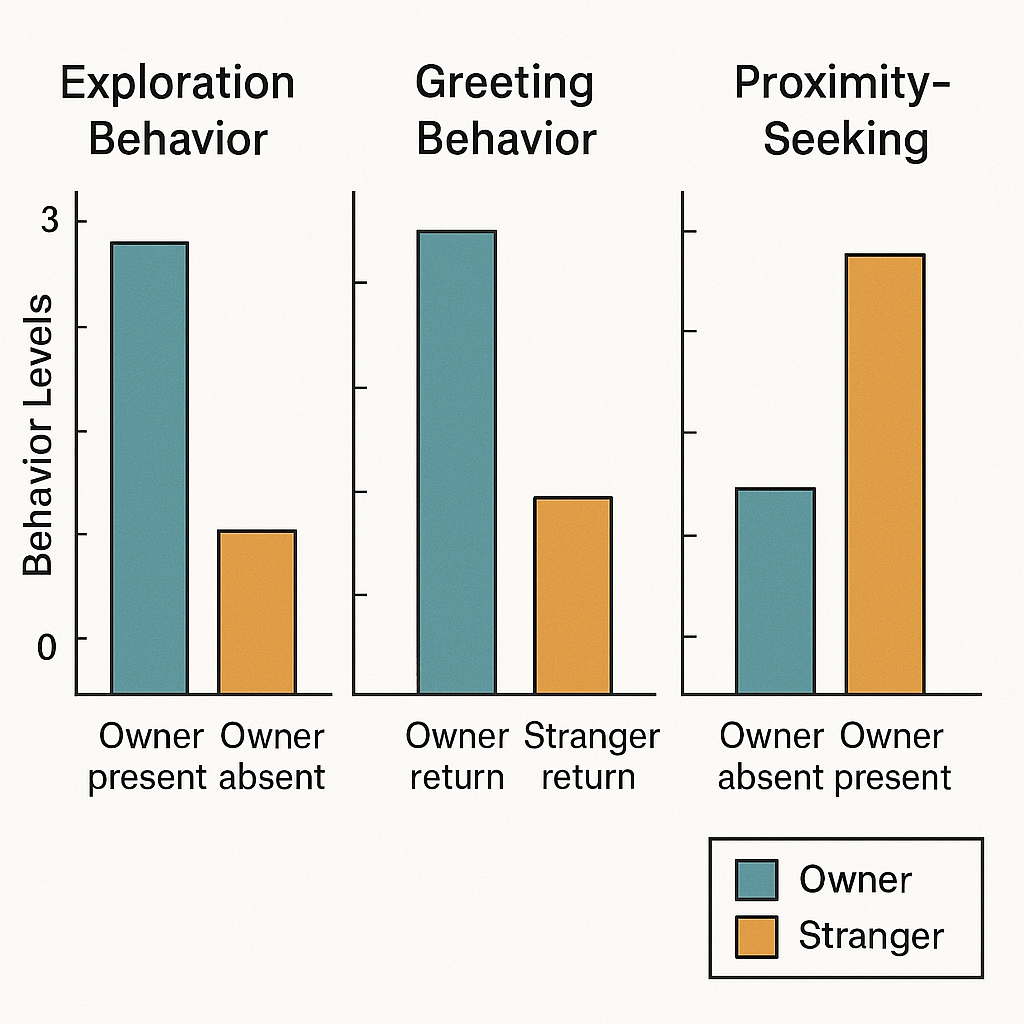
The core findings replicated across the dog-SST literature:
- Dogs explore more when the owner is present than when the owner is absent. This is the classic "secure base" effect — the owner's presence supports exploratory behaviour. When the owner leaves, exploration drops and proximity-seeking increases.
- Dogs greet the owner enthusiastically on return, more so than they greet the stranger on the stranger's return. The differential greeting is a marker of attachment to the specific individual.
- Dogs distinguish the owner from the stranger. They are not simply seeking any human; they are seeking the specific attachment figure.
- Individual differences appear across dogs that parallel the infant secure / insecure patterns. Some dogs show secure-base behaviour with rapid recovery on reunion; others show patterns that parallel insecure-resistant (anxious distress at separation, ambivalent reunion) or insecure-avoidant (reduced acknowledgement of return) patterns.
The Topál study and its successors (Palmer & Custance 2008; Prato-Previde et al. 2003; many others) have produced a consistent picture[^palmercustance][^pratoprevide]. The methodology is robust enough that the findings replicate across labs, countries, and breeds.
What the Test Does Measure
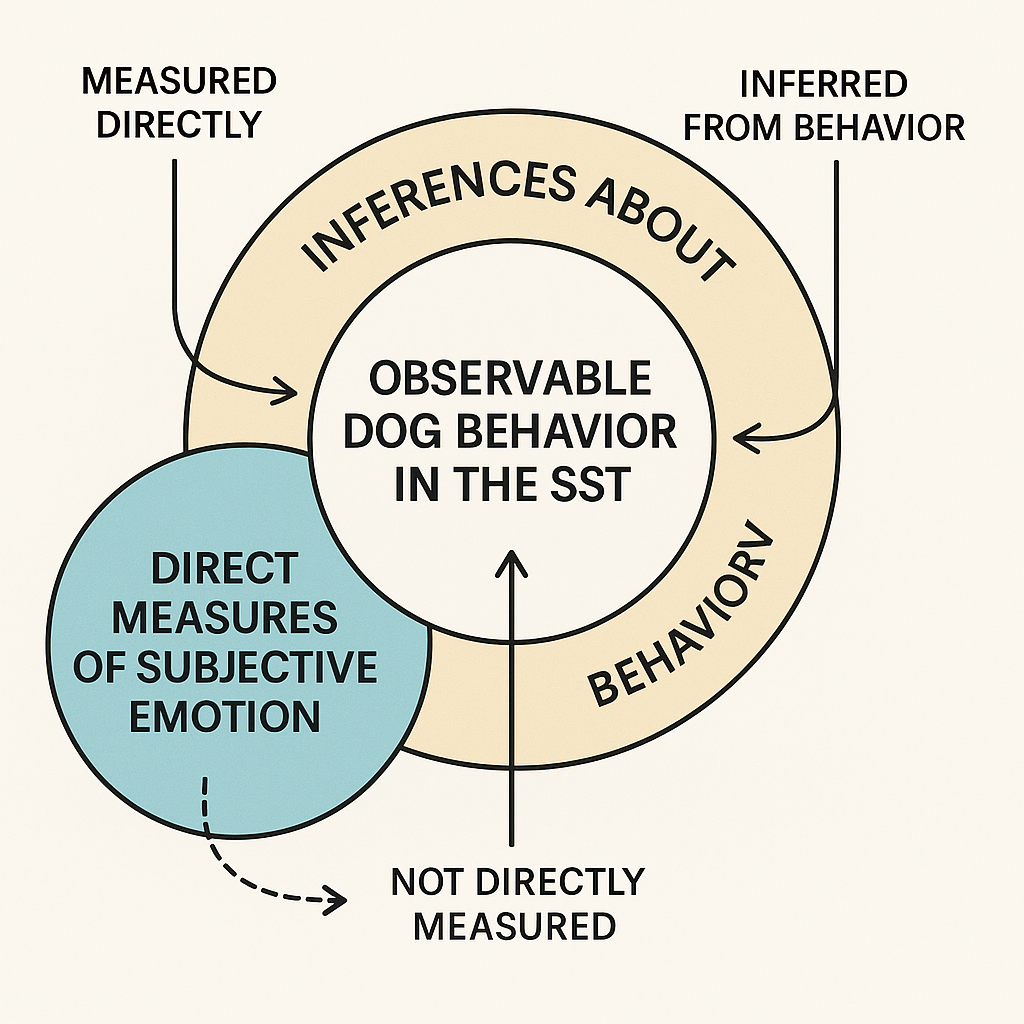
The SST measures the dog's behavioural response to a specific test situation — separation from the owner in an unfamiliar environment, in the presence of a stranger, with reunions. The behaviours observed are taken to reflect the underlying attachment relationship.
What this licenses, given the empirical pattern across studies:
- The claim that dogs form attachment relationships with specific human caregivers.
- The claim that the relationship has a "secure base" function — owner presence supports exploration; owner absence reduces it.
- The claim that individual differences in attachment patterns exist among dogs, partly paralleling the patterns described in infant attachment.
- The claim that the relationship is to a specific individual rather than to humans in general.
What the Test Does Not Measure
The SST is a measure of behaviour in a specific context. It does not directly measure:
- The dog's subjective emotional state (we observe behaviour; we infer emotion).
- The full structure of the dog-owner relationship in everyday life. The SST captures one slice of the relationship; many other dimensions (training history, daily interaction patterns, household dynamics) are not assessed.
- The dog's responses in environments other than the unfamiliar test room. Some attachment-relevant behaviour at home may differ from SST behaviour.
- A direct equivalent to the infant taxonomy. The dog patterns parallel but are not identical to the infant secure/insecure-avoidant/insecure-resistant classifications. Some authors argue that direct mapping is too strong; others argue that the parallels are substantial enough to use the framework. The literature is more conservative on direct mapping than on the existence of attachment itself.
How It Relates to the Broader Attachment Literature in Dogs
The SST is the foundational empirical method, but it is not the only method. Subsequent work uses:
- Free-form observation in real-world environments to test whether SST patterns predict everyday behaviour.
- Cardiac and HPA-axis measures (heart rate, cortisol) to test whether SST behavioural patterns correspond to physiological stress responses to separation.
- Variations of the paradigm to isolate specific factors (e.g., does it matter if the stranger is friendly or neutral; does it matter if the room is the dog's home rather than an unfamiliar setting).
The combined picture is that dog-owner attachment is real, has a measurable behavioural and physiological signature, and is a stable enough characteristic of the relationship to be used as a research construct. The attachment-styles-dogs article covers the broader literature; this article covers the methodological foundation that supports it.
Common Misinterpretations
- "My dog is showing avoidant attachment because he doesn't greet me at the door." SST classifications are based on a specific test, not casual observation. Real-world greeting behaviour is influenced by many factors (the dog's recent activity, household norms, training history) and does not directly map to SST classifications.
- "Dogs have human-like attachment." The parallels are substantial but not identical. The SST findings support that dogs have attachment, not that the attachment is identical to infant attachment.
- "The SST proves dogs love their owners." The SST measures behaviour consistent with attachment; it does not directly measure the dog's subjective experience. The behavioural finding is robust; the inference about subjective experience is interpretive.
What Is and Is Not Settled
Settled: dogs show SST behaviour patterns consistent with attachment to specific human caregivers (Topál 1998; Palmer & Custance 2008; Prato-Previde 2003; many replications)[^topal1998][^palmercustance][^pratoprevide]; the secure-base effect (more exploration when the owner is present) is robust; the differential response to owner vs. stranger reunion is robust.
Not settled: the precise mapping between dog SST patterns and the infant secure/insecure-avoidant/insecure-resistant taxonomy; the long-term stability of individual dog SST classifications across the dog's life; the contributions of breed and individual learning history to SST patterns.
Key Takeaways
- The Strange Situation Test, originally designed by Ainsworth for infants, was adapted to dogs by Topál et al. (1998) and has been replicated widely.
- Dogs explore more when the owner is present, distress at owner absence, and greet the owner differentially from a stranger — patterns parallel to the infant secure-base findings.
- The methodology is the empirical foundation for the broader claim that dogs form attachment relationships with specific human caregivers.
- The test measures behaviour in a specific context; it does not measure subjective emotion directly, nor does it produce a one-to-one mapping with the infant attachment taxonomy.
- Companion to attachment-styles-dogs, which covers the broader literature.
Sources & further reading
- Topál, J.; Miklósi, Á.; Csányi, V.; Dóka, A.. (1998). Attachment behavior in dogs (Canis familiaris): a new application of Ainsworth's (1969) Strange Situation Test. Journal of Comparative Psychology, 112(3), 219-229. https://doi.org/10.1037/0735-7036.112.3.219
- Palmer, R.; Custance, D.. (2008). A counterbalanced version of Ainsworth's Strange Situation Procedure reveals secure-base effects in dog-human relationships. Applied Animal Behaviour Science, 109(2-4), 306-319. https://doi.org/10.1016/j.applanim.2007.07.002
- Prato-Previde, E.; Custance, D. M.; Spiezio, C.; Sabatini, F.. (2003). Is the dog-human relationship an attachment bond? An observational study using Ainsworth's Strange Situation. Behaviour, 140(2), 225-254. https://doi.org/10.1163/156853903321671514
- Horowitz, A.. (2009). Inside of a Dog: What Dogs See, Smell, and Know. Scribner. https://www.alexandrahorowitz.net/