What Proximity-Seeking Is
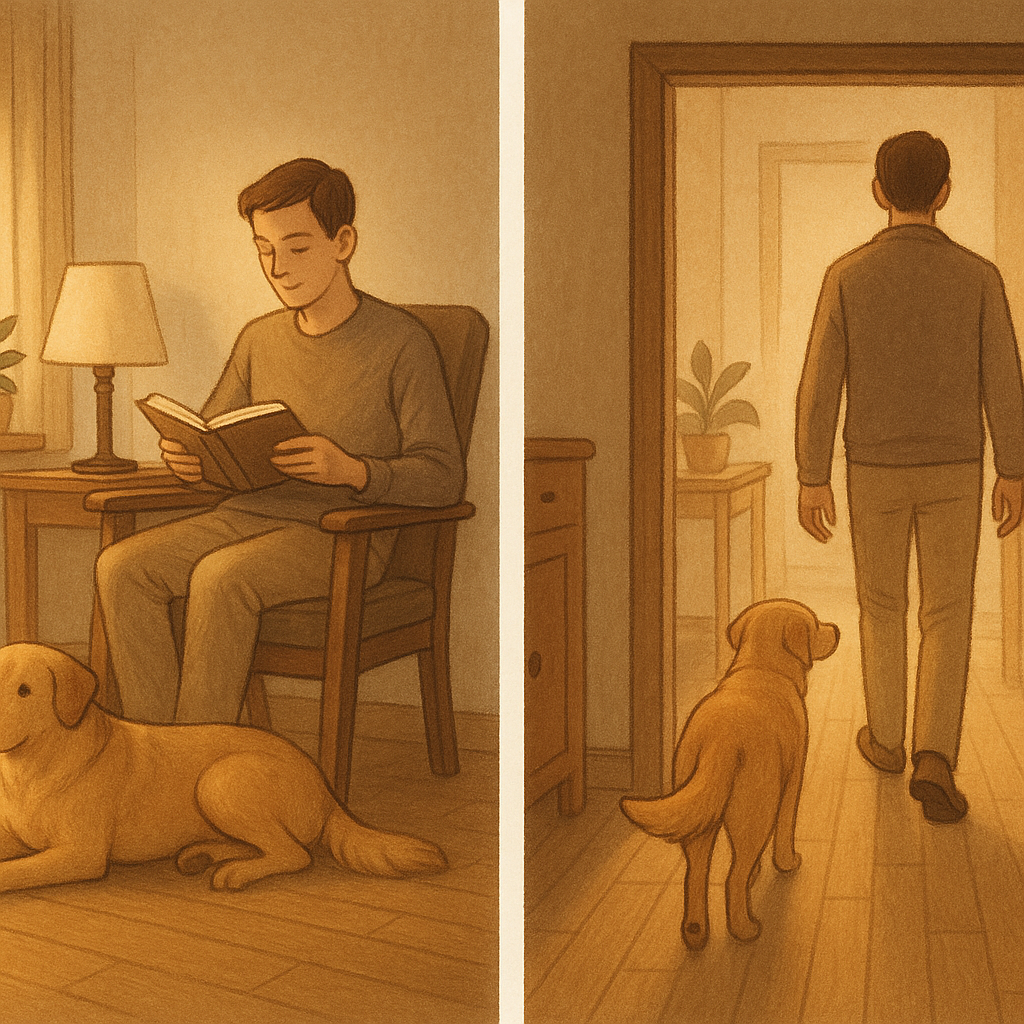
Proximity-seeking is the behaviour of an attached individual maintaining physical proximity to their attachment figure when the option is available. In humans, infants engage in proximity-seeking with caregivers — moving toward them, looking at them, monitoring their location. In dogs, the equivalent behaviour is what owners describe as "my dog follows me everywhere": room-to-room movement that tracks the owner's location, lying near the owner's chair while the owner reads, repositioning when the owner moves.
The behaviour reflects the underlying attachment relationship. The dog has a secure-base relationship with the owner (covered in the strange-situation-test article and attachment-styles article); proximity to the secure base is the default state when the option is available. When the secure base moves, the dog moves with it.
This is normal. Most well-bonded pet dogs show some level of proximity-seeking. The variation across dogs (some are highly velcro-like; some maintain more independent positioning) reflects individual differences in attachment style and personality, not a bonding deficiency in the more independent dogs.
Why Dogs Follow
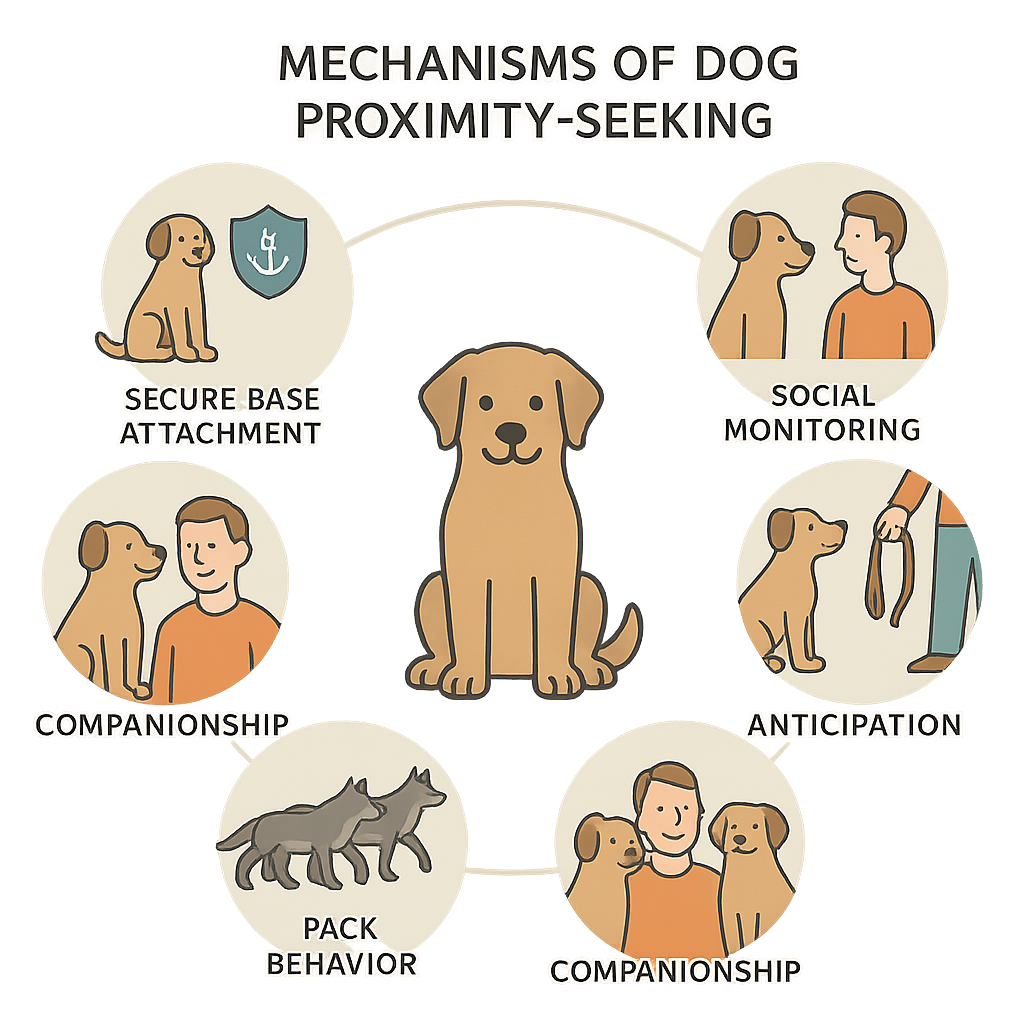
Several converging mechanisms produce the proximity-seeking pattern:
Secure-base attachment. The owner is the dog's anchor for safety and security. Proximity to the anchor reduces baseline arousal and supports relaxed exploration. The dog moves with the owner because the dog wants to maintain access to the secure base.
Social monitoring. Dogs are social-information specialists. The owner's behaviour is informational — what the owner is doing tells the dog something about what is happening in the environment. Following allows the dog to monitor.
Anticipation of relevant events. The owner moving from one room to another sometimes precedes feeding, walks, departures, or other dog-relevant events. Following ensures the dog is positioned to respond.
Resource-association. The owner is the source of food, walks, social attention, and other resources. Proximity to the owner is functionally rewarding because it positions the dog for resource access.
Pack and group behaviour from the canid heritage. Wolves and other social canids maintain proximity to group members; the behaviour persists in the domestic dog with the human-dog social group as the relevant unit.
Just companionship. Sometimes the dog simply enjoys being near the owner. The relationship has positive emotional valence and proximity is intrinsically rewarding.
These mechanisms operate together; specific situations may engage some more than others.
The Distinction From Separation Anxiety
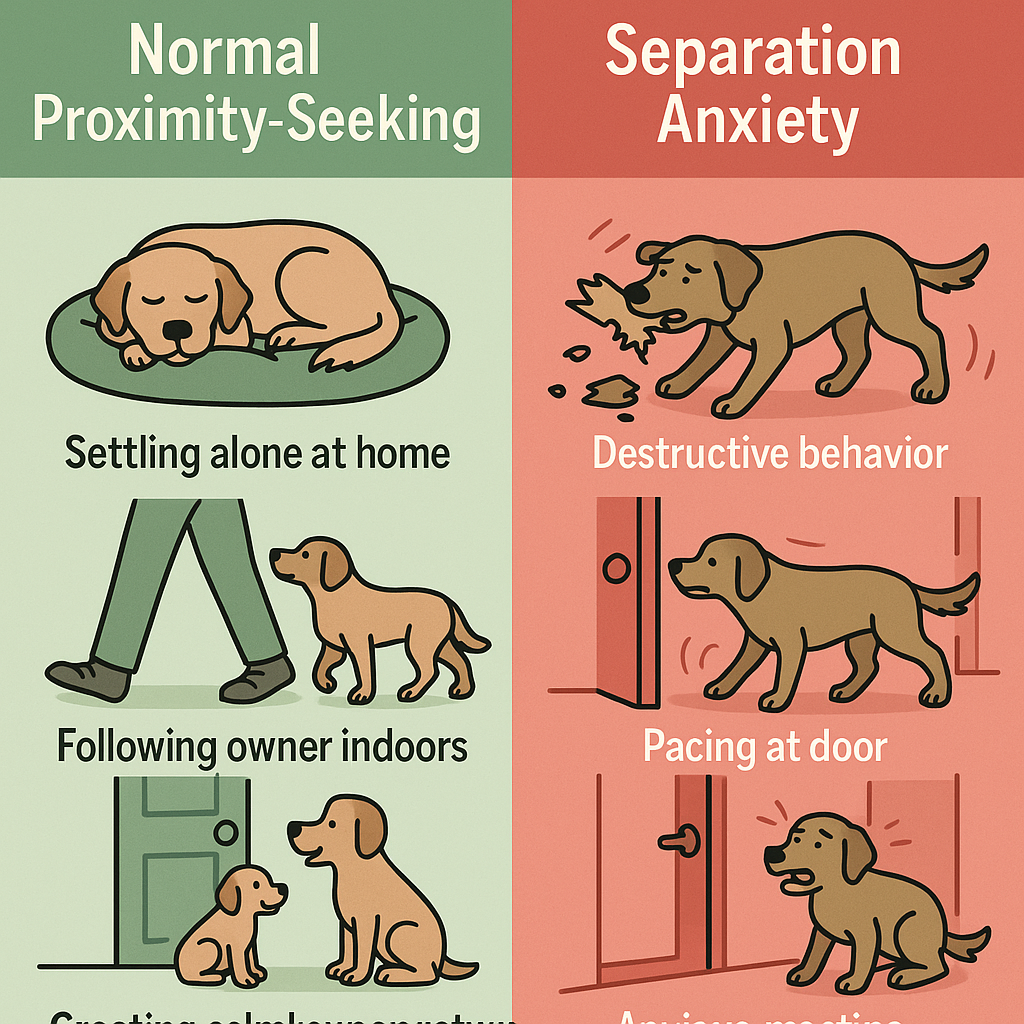
The proximity-seeking pattern is normal attachment behaviour. It is structurally distinct from separation anxiety, which is a clinically significant condition.
Proximity-seeking (normal):
- Occurs when the option is available — the dog follows when free, but settles when separation is mild and brief.
- Does not produce distress when the owner is in a different room briefly.
- Does not produce destructive or self-injurious behaviour during separation.
- The dog can be left alone (in the house, not in another room) for typical durations without significant signs of distress.
- Greeting on owner return is enthusiastic but proportional and resolves quickly.
Separation anxiety (clinical):
- Distress during owner absence — vocalisation, pacing, panting, drooling, attempts to escape.
- Destructive behaviour, particularly directed at exit points (doors, windows) or near owner-associated items.
- House-soiling that is not present at other times.
- Self-injurious behaviour in severe cases.
- Greeting on return is disproportionate and prolonged.
- Prolonged distress that does not resolve when the owner returns.
The separation-anxiety article covers separation anxiety in detail. The relevant point for the proximity-seeking discussion: a dog that follows the owner around the house but is calm when left at home alone is showing normal attachment behaviour. A dog whose proximity-seeking extends to substantial distress during owner absence is showing something more.
When Proximity-Seeking Becomes Excessive
A few patterns where the normal proximity-seeking shifts toward concerning:
Hyperattachment / "velcro dog" behaviour. Some dogs become so persistently attached to a single person that the relationship becomes restrictive — the dog cannot tolerate any separation, blocks others from interacting with the attached person, refuses to settle without immediate proximity. The velcro-dog article covers this pattern.
Anxiety-driven proximity-seeking. When the dog is more anxious than usual (storms, environmental changes, new visitors, illness), proximity-seeking can intensify substantially. This is typically situational and resolves with the underlying anxiety.
Medical or pain-related changes. Senior dogs or dogs in pain sometimes increase proximity-seeking; the change can be a clinical signal warranting evaluation.
Cognitive decline. Senior dogs developing cognitive dysfunction (CCD, covered in the DISHA article) sometimes show increased proximity-seeking as part of the broader behavioural change pattern.
These patterns warrant attention; routine following-the-owner-around-the-house behaviour does not.
Practical Implications
A few takeaways:
Following is normal; do not interpret it as pathological. The dog who follows you to the bathroom is showing normal attachment, not anxiety.
Independence is not a goal in itself. Some popular dog-training framing emphasises building "independence" as if proximity-seeking were a problem. It is not. Comfortable proximity-seeking with the option to settle is the appropriate balance.
Brief separations within the home are appropriate. Closing a door briefly, leaving the dog in another room for a few minutes, going to the bathroom alone — these are all reasonable and well-tolerated by dogs without separation anxiety.
Watch the dog's response when you leave the house. This is the relevant test for separation anxiety vs. proximity-seeking. Calm tolerance of being left at home alone (with appropriate management for puppies still in housetraining and similar) is consistent with normal attachment.
Multi-owner households often produce primary-attachment patterns. A dog may follow one specific person more than others. This is normal; the dog has formed a stronger attachment to that person, which does not exclude relationships with others.
Sudden changes in proximity-seeking warrant attention. A dog that previously was independent and is now anxiously following everywhere may be signalling pain, illness, anxiety, or cognitive change.
What This Does Not Imply
- Dogs that do not follow are unbonded. Some dogs are simply more independent in their attachment style; they bond well but maintain different physical positioning.
- Proximity-seeking is the same as separation anxiety. It is not. The structural distinction matters.
- Following the owner is "needy" in a problematic sense. The framing of dogs as "needy" for normal attachment behaviour is a misframing.
- Owners should discourage proximity-seeking. Forcing distance from a normally-attached dog produces stress without benefit.
What Is and Is Not Settled
Settled: dogs form attachment relationships with their owners that include normal proximity-seeking patterns; the empirical foundation is in the Strange Situation Test literature and broader attachment work[^topal][^horowitz]; proximity-seeking and separation anxiety are structurally distinct.
Not settled: the precise quantitative range of "normal" proximity-seeking across breeds and individuals; the optimal management approaches for the transition from normal proximity-seeking to mild hyperattachment.
Key Takeaways
- Dogs follow their owners around the house as a normal feature of secure-base attachment, not as a sign of anxiety.
- Mechanisms include secure-base attachment, social monitoring, anticipation of relevant events, resource-association, pack-heritage social behaviour, and simple companionship.
- Proximity-seeking is structurally distinct from separation anxiety, which involves distress and destructive/self-injurious behaviour during owner absence.
- The relevant test is the dog's response to the owner leaving the house, not the dog's tendency to follow within the house.
- Excessive proximity-seeking can occur in hyperattachment, situational anxiety, pain, illness, or cognitive decline; sudden changes warrant attention.
- Independence is not a goal in itself; comfortable proximity-seeking with the option to settle is the appropriate balance.
Sources & further reading
- Topál, J.; Miklósi, Á.; Csányi, V.; Dóka, A.. (1998). Attachment behavior in dogs (Canis familiaris): a new application of Ainsworth's (1969) Strange Situation Test. Journal of Comparative Psychology, 112(3), 219-229. https://doi.org/10.1037/0735-7036.112.3.219
- Horowitz, A.. (2009). Inside of a Dog: What Dogs See, Smell, and Know. Scribner. https://www.alexandrahorowitz.net/
- American Veterinary Society of Animal Behavior. AVSAB Human-Dog Bond Position Statement. AVSAB. https://avsab.org/resources/position-statements/
- Journal of Veterinary Behavior. Journal of Veterinary Behavior. Elsevier. https://www.sciencedirect.com/journal/journal-of-veterinary-behavior